The central role of Oman and Qatar vis-à-vis Iran
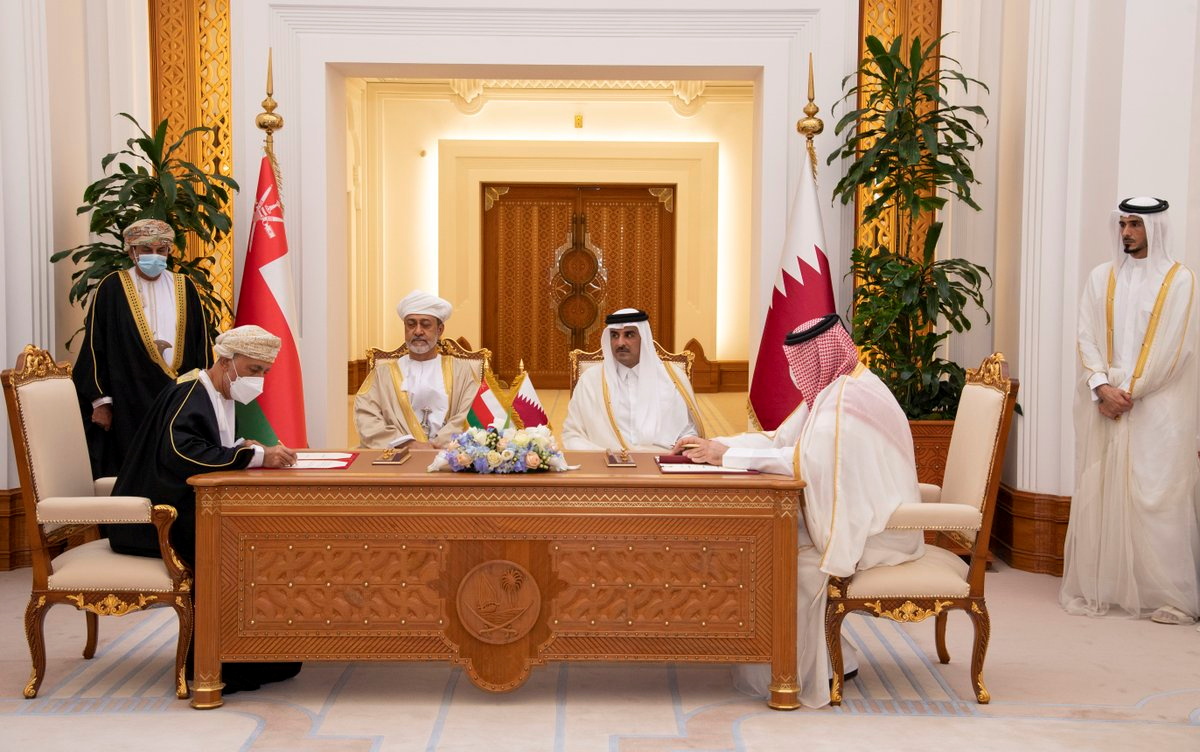
Sultan of Oman Haitham bin Tariq Al Said has invited Iranian President Ebrahim Raisi for discussion. The visit, which will be held in Oman’s capital Muscat on Monday 23, will be used to discuss bilateral economic, political and cultural relations. Last week, a delegation of 50 Iranian businessmen and economic activists visited Oman to pave the way for the expansion of trade relations between the two nations. In fact, in addition to a meeting with the Sultan of Oman, Iran’s president is expected to sign a series of cooperation agreements and hold talks with Iranian expatriates and Omani businessmen in the Arab country. This will be the Iranian president’s fifth trip abroad since taking office in August 2021, this meeting is part of the Iranian administration’s new policy of developing close ties with neighboring countries and promoting political, economic and cultural cooperation. Indeed, precisely, the following trip is part of the wake of Iran’s expanding engagement with its southern Arab neighbors, including Qatar, Saudi Arabia, and the United Arab Emirates. The invitation from Haitham bin Tareq Al Said, the Sultan of Oman, also serves to keep the country’s important role as a bridge active while other Sunni kingdoms in the region are cautiously opening up to the Shiite Islamic Republic. A role that for the Omani is part of its own global strategic dimension, which has always been recognized especially by the United States.
Precisely, Oman plays a very important role in the Middle East chessboard and has always had a place as an intermediary between the Islamic Republic of Iran and the United States of America.
The country with the capital Muscat also plays a key role regarding the JCPOA issue. The JCPOA, or the nuclear deal, has been stopped by the Trump administration in 2018 while now the new U.S. administration is trying to change the policy without, however, getting too out of line. For this reason, Oman could work as a valuable country to return to the negotiating table.
Another country that is having an extremely important position from the U.S. perspective is Qatar, this is for several reasons especially regarding the Iranian issue
The U.S. State Department, in the past few days, has issued a brief note concerning the phone call between Secretary of State Antony Blinken and Qatari Foreign Minister Mohammed bin Abdulrahman Al Thani.
The Secretary of State reiterated his deepest condolences for the tragic killing of Al Jazeera journalist Shireen Abu Akleh, a Palestinian-American citizen, and discussed the strong and growing U.S. partnership with Qatar, acknowledging the constructive role the Emirati country is playing in attempting to resolve Iran-related issues.
Qatar is historically a country with ties to the United States of America and is a strategic annex in the Middle East context; in fact, it is the only nation that has allowed the “star-spangled country” to host the Pentagon’s regional hub.
It is important for the United States that Doha has decided to place three extremely sensitive situations among its foreign policy and diplomatic priorities.
The first is about the Ukraine crisis and the active role it is playing in the armed conflict.
The second, on the other hand, is the constant communication with the Taliban.
The third is the dialogue with Iran.
The latter is really at the heart of the Middle East context.
Emir Tamim bin Hamad Al Thani, was in the capital of the Islamic Republic of Iran last week for meetings with Raisi aimed toward finding spaces to reach an understanding on the renewal of the Jcpoa.
Another element that is pivotal in the dialogue between Doha and Tehran, for which Iran has much better relations with Qatar than any other country in the rest of the Gulf, concerns an energy issue, then an economic one as is often the case. In fact, the two countries share the most important natural gas field in the world, the South Pars / North Dome, two-thirds of which are Qatari – and they represent the force with which Qatar has been pushing its economy for years, and even more will continue to push it at this stage in which Doha is becoming from many European countries the main supplier partner for energy supplies with liquefied natural gas (LNG). To disengage from Russian energy dependence for the reasons we all sadly know.
Therefore, it should be emphasized, in conclusion, that Oman and Qatar are increasingly playing a decisive role in Middle East-West relations. Their role is becoming more and more decisive. It should also be said that there is a climate of greater détente in the area especially between Saudi Arabia, the United Arab Emirates and Iran. The latter is having a more assertive stance toward other countries, similar situation also for Turkey which seems to be more ready for dialogue. This set of factors could be important for a new phase in the JCPOA negotiations.
By Michele Brunori