A Dangerous Standoff: What a U.S.–Venezuela Clash Would Mean for Caracas and the Region?

Over the weekend, pro-government crowds in Venezuela lined up to join the national militia after President Nicolás Maduro ordered a nationwide mobilization of 4.5 million members in response to new U.S. naval movements in the Caribbean.
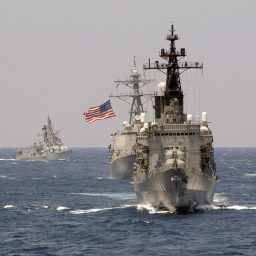
The U.S. deployment, directed by President Donald Trump, involves three guided-missile destroyers, an amphibious squadron, at least 4,500 sailors and roughly 22,000 Marines, according to the Navy. The Pentagon says the heightened presence is aimed at disrupting regional drug cartels. It comes as Washington doubles a Justice Department reward to 50 million dollars for information leading to Maduro’s arrest, alleging his role in large-scale narcotrafficking.
Maduro, calling the operation an “unacceptable provocation,” urged mass enlistment and said 4.5 million militia members would be stationed across the country. “We will defend our seas, our skies, and our lands,” he said, warning against any incursion. Opposition figure María Corina Machado countered that “very few high-ranking military officers are supporting Maduro.”
Regional governments have begun to stake out positions. Trinidad and Tobago said it “fully supports” the presence of U.S. military assets aimed at dismantling drug networks. Prime Minister Kamla Persad-Bissessar added that if Venezuela were to attack Guyana or cross into its territory and Washington requested access to Trinidadian facilities to defend Guyana, her government would grant it. Venezuela and Guyana remain locked in a long-running dispute over the oil-rich Essequibo region.
Guyana said Friday it is “committed to working with our bilateral partners to find meaningful solutions” and will back regional and global efforts to dismantle criminal networks in the interest of shared security.
The standoff, as it is today
Warships on station, militias on parade, and rival indictments of criminality have pushed Washington and Caracas into a dangerous standoff with regional consequences. Venezuela has surged troops to the Colombian frontier while the United States has moved naval assets into the Caribbean, each side insisting it is enforcing the law and defending its people. What happens next will ripple far beyond Venezuela’s shoreline, touching energy markets, migration routes, and fragile security balances from Guyana to the Panama Canal.
This is not the first time Washington and Caracas have stared each other down. It is, however, the most combustible mix of military signaling, legal escalation, and domestic political incentives in years. If the friction tips into a confrontation, by design or accident, the costs will be borne first by Venezuelans and then by their neighbors.
Press secretary Karoline Leavitt said the United States was prepared to use “all the resources of its power” to choke drug flows and bring those responsible to justice. Pentagon officials, meanwhile, emphasized that the three U.S. warships dispatched to Caribbean waters had not been ordered to the edge of Venezuela’s territorial sea. The message was pressure without a hard line crossed, a posture designed to project reach while preserving room for de-escalation.
 Venezuelans line up to enlist in the Bolivarian National Militia, August 23, 2025. REUTERS/Juan Carlos Hernandez
Maduro also reached for a diplomatic counterweight, spotlighting ties with Beijing at every turn. In a televised aside he showcased a new Huawei phone he said was a personal gift from China’s Xi Jinping, joked in Mandarin, and later met China’s ambassador to celebrate “progress” in economic and technology cooperation. Beijing’s foreign ministry backed that narrative with a carefully worded objection to “the use or threat of force” and any outside interference in Venezuela’s internal affairs. It was classic Chinese positioning: signal political support for a partner, avoid explicit commitments, and warn against steps that could destabilize a region where Chinese commercial stakes are growing.
That triangulation matters because the confrontation is no longer purely bilateral. Washington has hardened its narcotics narrative, even doubling the bounty for Maduro while reinforcing the maritime tasking with additional naval and intelligence assets. Guyana, watching disputes nearby and new oil wealth at risk, has amplified concerns about cross-border criminal networks. China, for its part, has economic reasons to prefer calm: investors are moving into Venezuelan fields under long contracts, and the Essequibo basin is drawing global interest. Maduro’s vow that “no empire will touch the sacred ground of Venezuela” plays well at home; whether it holds in practice will depend on whether these outside actors keep the contest in the lanes of messaging and maritime maneuver rather than allow a misstep to convert theater into crisis.
How a conflict could ignite
The likeliest flashpoints are at sea and along the Colombia–Venezuela border. Close intercepts, misread intent, or overzealous counternarcotics actions could cascade quickly. On land, a muscular Venezuelan buildup in Zulia and Táchira raises the risk of clashes with Colombian forces, but the more immediate danger is a vicious cycle with non-state actors: traffickers shifting routes, guerrilla remnants and militias exploiting the fog, and border communities caught between uniforms and guns that don’t wear them.
At sea, a show-of-force posture by U.S. destroyers invites cat-and-mouse behavior from Venezuelan patrol craft and aviation. The more crowded the picture, the more a routine boarding or a warning shot can become an international incident. The incentive on both sides to “prove” resolve—one through interdiction, the other through defiance—creates precisely the kind of ladder of escalation that diplomats dread.
Maduro’s playbook: rally, mobilize, repress
Hard power at the door is oxygen for Venezuela’s state narrative. Caracas will frame external pressure as proof of a plot and use it to justify internal controls. Expect rapid militia mobilization, loyalty pledges from state institutions, and a security dragnet aimed as much at silencing critics as deterring saboteurs. In the short run, that dynamic strengthens the center; in the long run, it hollows it out. Professionals leave, informal networks grow, and the state’s most competent people are absorbed by survival tasks rather than governing.
The economic costs are immediate. Insurance premia for Venezuelan waters jump. Shippers seek alternate routes or raise prices. Any tentative recovery in oil flows stalls. Refining and fuel distribution, already fragile, feel the strain. Food and medicine availability tightens, prices rise, and households turn again to coping mechanisms that have defined the past decade: fewer meals, more remittances, more departures.
Colombia has the longest border and the most to lose. Increased troop presence on the Venezuelan side complicates Bogotá’s attempts to stabilize border economies and rein in armed groups. If commerce slows and crossings tighten, informal smuggling routes become lifelines and flashpoints. For Brazil and Guyana, any uptick in Venezuelan nationalism reverberates in unresolved disputes and frontier politics, adding risk to a Guyana oil boom and to Brasília’s efforts to keep the Amazon border quiet.
The Caribbean feels it at sea. A heavier U.S. footprint and more aggressive interdictions will disrupt trafficking, but they also ripple through licit trade and fishing livelihoods. Island governments will face higher costs to move goods and higher uncertainty at peak hurricane season, when maritime flexibility is a safety issue as well as an economic one.
And then there is migration. Every shock in Venezuela has produced a surge outward. Another wave would land on neighbors that are already saturated: schools struggling to integrate new students, hospitals treating patients without stable funding, city services strained by informal settlements. Donors will promise support, but delivery lags policy speeches. The politics of welcome, frayed by years of stress, will fray further.
Energy markets will initially shrug; Venezuela’s export capacity is a shadow of its former self, but traders will price the tail risk of wider disruption in the Caribbean basin. If sanctions tighten and shipping risks rise, barrels that recently crept back into the market could vanish again. The knock-on effect is less about volume than volatility: a premium on uncertainty that complicates central bank fights against inflation throughout the Americas.
Geopolitically, an armed U.S.–Venezuela confrontation would redraw alignments. Havana and Managua will close ranks with Caracas. Moscow and Tehran will scent opportunity to needle Washington at low cost. Beijing will preach non-interference while quietly safeguarding its commercial stakes. Brazil and Mexico will be under pressure to lead de-escalation but will resist being seen as proxies for either side. The Organization of American States will convene; the real work will happen offstage, in calls among a handful of capitals that can still speak to all parties.
It is tempting to view the current choreography as familiar theater, destined to recede once messages have been sent. That is the most benign scenario, and it may yet prevail. But the margin for error is thinner than it looks. A single fatality at sea, a stray missile on a radar screen, an explosive incident on the border, and leaders who have vowed not to blink will be dragged by their own words toward choices they did not plan to make.
For Venezuela, even a short, sharp clash would be devastating: another turn of the economic screw, another wave of fear, another exodus. For the region, it would mean months of emergency diplomacy, crowded clinics, and budgets bent to the breaking point. The United States can surge ships and forces quickly; stability, once broken, moves on a slower clock.
Avoiding that future does not require trust, but it does require discipline. Keep lines open, agree on basic safety rules, and resist the urge to prove a point with the nearest patrol boat. The alternative is a conflict that no one needs and that Venezuelans, above all, cannot afford.
By I. Constantin