George Pomutz – The Romanian Who Sold Alaska to the United States.
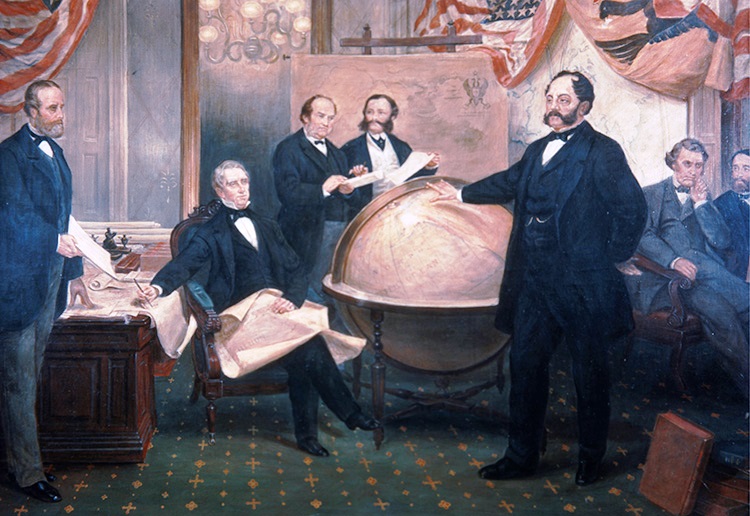
When Donald Trump and Vladimir Putin stepped onto the tarmac in Anchorage for their high-stakes summit, the symbolism of Alaska was not lost on observers. For some, the choice of location seemed puzzling: Why Alaska, this vast and remote land once dismissed as “Seward’s Folly”? Yet for those who know their history, Alaska is more than a strategic outpost. It is a territory whose very presence on the American map is owed, in part, to the vision and persistence of an unlikely figure, a Romanian emigrant named George Pomutz.

George Pomutz was born in 1818 in Gyula, then part of the Austro-Hungarian Empire, into a Romanian family. Like many of his generation, he was swept into the turbulence of the Hungarian Revolution of 1848, which sought to break free from imperial domination. A fervent believer in liberty and national rights, Pomutz fought on the side of the revolutionaries.
When the uprising was crushed, Pomutz, like thousands of others, faced persecution. Rather than live under surveillance or compromise his ideals, he chose exile. His path, like so many revolutionaries of 1848, led him across the Atlantic, to the United States.
Pomutz arrived in America with little more than his education, determination, and belief in freedom. Settling first in Iowa, he quickly earned respect within the immigrant community. When the American Civil War erupted in 1861, he enlisted in the Union Army, joining the fight against slavery and secession.
Far from being a marginal figure, Pomutz rose to prominence. He was appointed Colonel of the 15th Iowa Infantry Regiment, and by the war’s end, he had achieved the rank of Brevet Brigadier General. He fought in some of the bloodiest campaigns of the Western Theater, including the Siege of Vicksburg and Sherman’s March to the Sea, demonstrating not only courage but also a keen sense of leadership and strategy.
For his service, Pomutz became one of the few Romanians in history to hold the title of General in the U.S. Army. But his destiny extended far beyond the battlefield.
After the war, the U.S. government recognized Pomutz’s abilities and appointed him as U.S. Consul in St. Petersburg, Russia in 1866. This was no ceremonial post. At the time, Washington was in delicate negotiations with the Russian Empire to acquire Alaska, a territory vast in size but of limited strategic value to St. Petersburg.
While Secretary of State William H. Seward is credited with finalizing the deal, Pomutz’s presence in Russia was indispensable. Fluent in multiple languages and steeped in European political culture, he was a vital intermediary, working behind the scenes to ease Russian concerns and smooth diplomatic relations.
On March 30, 1867, the treaty was signed. For $7.2 million, the United States purchased Alaska, a landmass more than twice the size of Texas. Critics in Washington sneered, deriding the transaction as “Seward’s Folly,” convinced the U.S. had bought nothing but ice. Yet history would vindicate the purchase: Alaska proved to be rich in gold, oil, and strategic importance, especially during the Cold War.
Pomutz had helped secure America’s future, and in doing so, he ensured that today’s Trump–Putin summit could even be held on American soil.
George Pomutz remained in Russia as consul until his death in 1882. He never returned to his native Romania, nor to his adopted America. He died in relative obscurity, far from the lands he had served with such devotion. His grave lies in St. Petersburg, where few passersby know the story of the Romanian who once shaped the destiny of two continents.
Pomutz’s life is a mosaic of revolution, exile, military service, and diplomacy. He embodied the restless energy of the 19th century, when men crossed oceans not only in search of opportunity but also to fight for ideals. A Romanian by birth, an American by conviction, and a diplomat by talent, he bridged worlds at a time when borders were shifting and empires recalibrating.
Today, as Alaska once again becomes a stage for global politics, it is worth remembering George Pomutz. Without him, the summit of Trump and Putin might have been held not on American soil, but in a territory still marked with the double-headed eagle of imperial Russia.
Pomutz’s story is not just about the sale of Alaska. It is about the enduring influence of immigrants, the forgotten contributions of small nations to global history, and the quiet, uncelebrated hands that change the course of history.
By I. Constantin