Trump’s Speech Put the U.N. on Notice: “Your Countries Are Going to Hell’

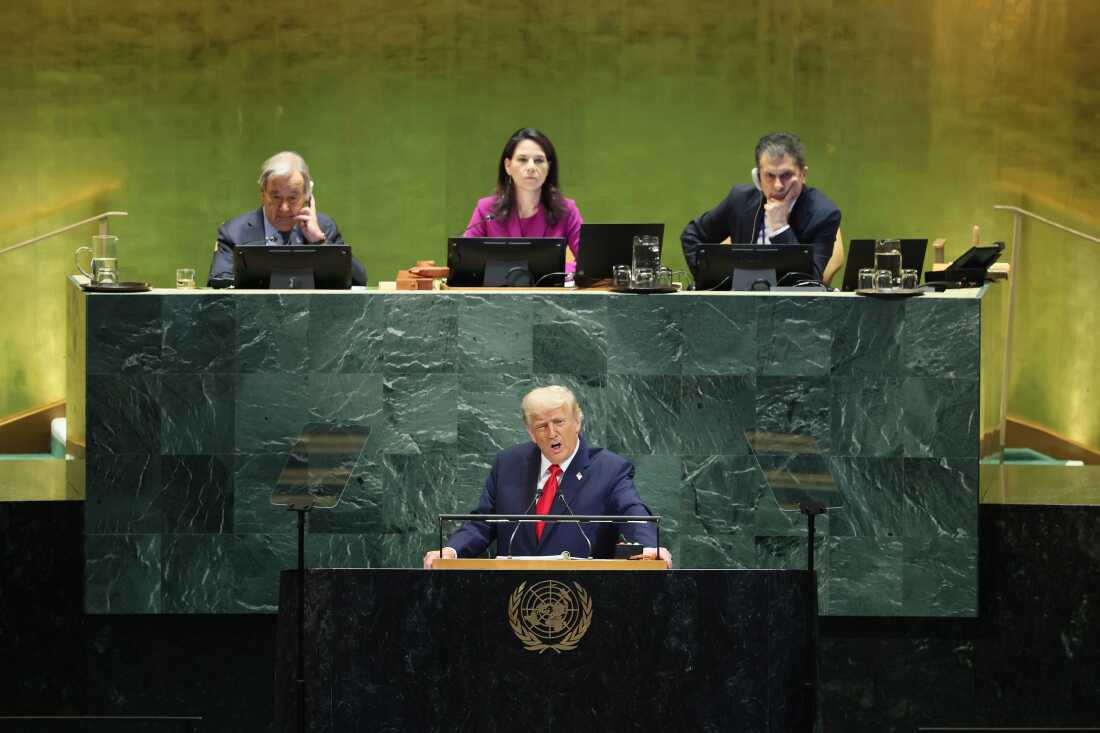
Eight months into his second term, President Donald Trump returned to the General Assembly with a familiar message burnished to a harder edge: America first, multilateralism last, borders over bargains, energy abundance over green ambition. The speech fused stock lines from his earlier U.N. appearances with a cascade of new claims about military operations, economic revival and immigration crackdowns, culminating in a blunt admonition to fellow leaders – “your countries are going to hell” – that captured both the performance and the provocation.
Whatever one thinks of his style, his second-term address to the General Assembly restored a vocabulary that has been missing from multilateral diplomacy: sovereignty spoken without apology, borders treated as the foundation of legitimacy rather than an obstacle to humanitarian aspiration, and power described as something to be used responsibly and visibly rather than hidden behind communiqués and process. It was a bracing reminder that international order is not an etiquette class; it is a negotiation among states with interests, and only those willing to exert leverage shape the outcomes.
The address was less a tour of global hot spots than a theory of world order in which sovereign states act alone or not at all, international bodies talk but rarely deliver, and U.S. leverage flows from tariffs, drills and deterrence rather than from treaties and consensus. If his 2017 “Rocket Man” debut announced a disruptive entrant, this iteration read as a governing manifesto: transactional, maximalist and unapologetically domestic in its preoccupations, even as it claimed sweeping international results.
Trump’s argument began at home and radiated outward. He presented an economy he says is cooling prices, lifting wages, and drawing investment at a scale that underwrites everything else a superpower attempts, and he tied that performance to a reordering of incentives: tax relief, aggressive deregulation, and a tariff architecture designed not as a tantrum but as a strategic tool that raises revenue and compels fair dealing.
You could hear the murmurs from delegations that prefer American growth so long as it is modest and mannerly. Trump’s case is that prosperity, to be worthy of the name, must be felt on the shop floor and not only in a summit’s closing statement, and that America’s renewed dynamism is not merely a domestic boast but the precondition for credible security guarantees abroad.

He then turned to the United Nations itself with a critique that, for all its showmanship, was deadly serious. The institution, he said, is prodigious at letters, rituals and declarations, and strikingly poor at preventing wars or ending them: “The UN is supposed to stop invasions, not create them and not finance them.”
Europe is in serious trouble. They have been invaded by a force of illegal aliens like nobody has ever seen before… Both the immigration and suicidal energy ideas will be the death of Western Europe,” he said.
He has always mocked the theater. What marked this speech was his insistence on substituting enforceable arrangements for performative consensus. That is why, even as he mocked the bureaucracy’s foibles, he proposed an innovation more concrete than a dozen solemn pledges: an artificial-intelligence verification regime to give the moribund Biological Weapons Convention teeth. The message was unmistakable: multilateralism earns respect when it delivers outcomes, not when it congratulates intent.
Nowhere was the collision between Trump’s method and Turtle Bay’s manners more vivid than in his account of hard power and truce. He claimed credit for brokering the end of seven active conflicts and for forcing a short, stabilizing cease-fire between Israel and Iran; his critics will contest the particulars, but they will not miss the premise, which is that deterrence precedes diplomacy, and that pressure, not platitude, moves adversaries to a table where terms have meaning. On Gaza he fused clarity and compassion, demanding the immediate return of hostages and an end to fighting without dangling the reward of statehood in the midst of terror, and he did so in a tone that will offend professional conflict managers precisely because it dispenses with their favored sequencing. You do not pay ransom with recognition; you begin with human lives.
The most controversial passages, predictably, addressed migration and the corrosion of civic confidence when borders fail.
I am really good at this stuff,” Trump told world leaders. “Your countries are going to hell.
Trump accused the U.N. of blurring the line between relief and facilitation, argued that generous societies have been repaid not with gratitude but with crime and strain, and warned European leaders that moral vanity is not a policy. That admonition, “your countries are going to hell”, was ugly in sound and clean in meaning: sovereignty is a duty, and states that relinquish control of who enters and on what terms are not practicing compassion; they are abandoning stewardship. One can deplore the phrasing and still admit the force of the warning, especially in capitals where the politics of migration have eaten the center from within.
Energy policy received the same treatment. Trump ridiculed wind and solar catechisms, praised nuclear and domestic hydrocarbons, and offered U.S. supply as a lifeline for industrial democracies trapped by their own contradictory targets. This, too, will outrage activists, but it speaks to a reality business leaders whisper in private: factories and families require affordable baseload power, and climate credibility will not be built on shuttered industries and offshored emissions. The point is not to sneer at transition, but to insist that transition be anchored in physics, price, and reliability. If Europe wishes to avoid strategic dependency dressed up as virtue, it must reconcile its ambitions with the arithmetic of energy, and if it cannot, it should stop lecturing those who can.
On Ukraine, he advanced an instrument many diplomats dislike because it works: tariffs calibrated to bite, imposed with speed, and conditioned on allied alignment. He scolded Europe for financing the very aggression it condemns through energy purchases, and he set a test that is as unglamorous as it is effective: stop buying what fuels the war and join an economic squeeze that shortens it. There was less talk of open-ended aid and more of leverage that changes Moscow’s cost-benefit math. That is a strategy that keeps faith with Ukrainian lives by seeking a finish line rather than an indefinite grind.
The law-and-order passages, designating cartels as foreign terrorist organizations, warning the Maduro regime that U.S. power will follow syndicates onto the high seas, will be caricatured as cowboy diplomacy. In truth, they represent a belated alignment of legal categories with lived reality. Fentanyl kills as surely as a bomb; human trafficking destroys communities as surely as corruption does. If a superpower cannot suppress these networks at source and transit, it confesses impotence dressed up as jurisdictional modesty. Trump refuses the confession.
What made the speech potent was not that every claim will survive fact-checking, nor that every boast will go uncontested, but that it restored the sense that someone is actually accountable for results. Modern multilateralism has become addicted to the consolation prize of intention; goals are announced, funds are “mobilized,” task forces are created, and by the time failure is obvious, responsibility has diffused to the point of invisibility. Trump’s doctrine is the opposite of diffusion. It names the levers: prosperity at home, energy abundance, border control, tariff pressure, credible force, and then dares others to meet him at the level where outcomes, not atmospherics, are measured.
There will be howls about tone, and some of them will be deserved. The president’s contempt for diplomatic nicety can land as contempt for partners. Yet the reason the hall was quiet, and the reason capitals are already parsing how to respond, is that the choices he described are not manufactured for applause at rallies; they are the choices governments are already making. Do you defend your frontier or outsource the politics to NGOs and judicial chambers. Do you build reliable power or export the emissions and the jobs. Do you pressure adversaries in ways they cannot ignore or settle for clever language that pleases conferences and fools no one in the field.
A statesman’s task is not to flatter the venue. Trump’s address did not ask the United Nations to admire an American mood; it told the United Nations what the United States intends to do, how it will measure success, and where cooperation is welcome. If the institution wants a role beyond renting out microphones, it can seize the few places where verification, interdiction and enforcement make it indispensable, biological weapons first among them. If not, the work will proceed without it.
That is why the speech resonated beyond its provocations. It treated peace as the absence of shooting, not the triumph of process; treated prosperity as the product of policy, not the by-product of sentiment; and treated sovereignty as a virtue, not a vice. Friends of America should welcome the clarity, because clarity is how you negotiate with a superpower that intends to be taken seriously again. Enemies should note it for the same reason.
Seven years ago, delegates chuckled when Trump boasted and bluffed. The laughter was a way of saying that none of it would matter. This year, the same hall listened in a tight silence. You could read that hush as disapproval, but it felt more like recognition: the world has moved into the realm of consequences, and the man at the lectern, however polarizing, now operates with levers that bite, tariffs that change behavior, energy policy that alters prices, border rules that actually hold, a readiness to use force that others must factor, not dismiss. Laughter belongs to the era of cost-free posturing. Silence is the sound of governments recalculating. It is also a kind of respect, grudging or otherwise, for a country that has decided again to speak in the language of interests and outcomes. Trump asked the United Nations to match that seriousness or step aside.
The room’s quiet suggested that, this time, it took him at his word.
By I. Constantin