Scroll Top

The United Nations died along with international law
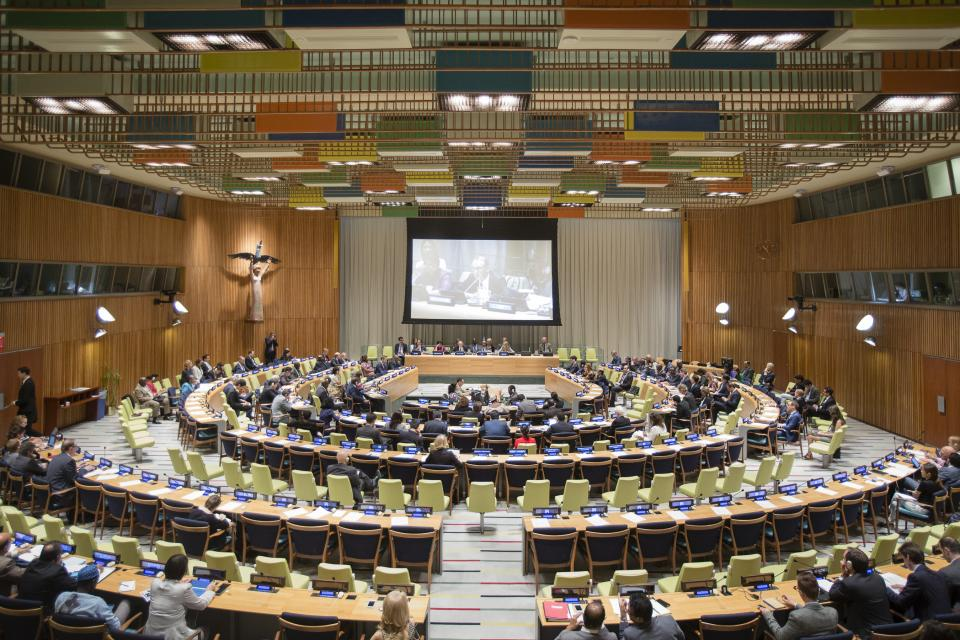
International law appears to have died definitively on the night between January 2 and 3, 2026, the night when, for the umpteenth time, the United States decided to assert itself as the world’s historic policeman and undertake an operation to capture President Maduro, unconventionally agreed upon with other powers. International law was born historically with the Peace of Westphalia in 1648, which marked the formation of sovereign and independent states, giving rise to the first nucleus of the international community. This event is considered a fundamental point of reference for the development of modern international law, even though its greatest moment of splendor and importance occurred with the birth of the major international organizations and international courts. In particular, international law acquired historical relevance with the creation of the United Nations and with the recognition and substantial participation of all the countries of the world. However, a post-World War II structure, with the composition of a body like the Security Council and, above all, a system like the veto power within the United States, Russia, the United Kingdom, France, and China, makes the UN an organization with a dated and inefficient structure.

Indeed, the UN is the prime suspect in demonstrating that international law is on the verge of no return. Not only because of the genocide in Gaza, the annexation of the West Bank, Russia’s aggression against Ukraine, and precedents in Iraq, Rwanda, and the former Yugoslavia, but also because of the risk that Donald Trump will legitimize the United Nations’ agony, with his explicit support for Jerusalem and his covert agreement with Putin. It’s as if to say that if I’m stronger, I prefer the historic law of the strongest.
The UN’s impotence over Gaza, Ukraine, or Trump’s actions and threats in general is only a small part of the whole. The organization’s credibility is in free fall everywhere, because principles, treaties, and conventions like the Geneva Convention are being overturned. The use of anti-personnel mines is increasing, despite the ban enshrined in treaties. The percentages of civilian casualties versus military casualties are inverted exponentially, even compared to world wars. No one seems to care anymore about induced famines or arbitrariness in so many corners of the world. The United States has left UNESCO, Israel has left the Human Rights Council, The International Criminal Court is not recognized by three of the five members of the Security Council. The right of veto in the Security Council is an instrument of impotence and a relic of an era that no longer corresponds to current geopolitics. Nowadays, it is still difficult to cultivate hopes for a global alliance based on Kant’s concept of perpetual peace. The institution finds itself in an irreversible crisis, unless a fundamental reform is implemented that gives voice to the entire planet. On the contrary, the shift in power dynamics, which China seeks to exploit with its contingent of allies, risks further influencing events.
The historic law of force, arguably the oldest unwritten law in history, which, with more or less dramatic blows, has asserted itself in the most diverse scenarios, has definitively conquered the field of relations between states, and has thus removed all hypocrisy from a situation in which the appeal to the rules that have governed international relations increasingly appeared entirely rhetorical, and almost always self-serving. International law, in recent times, has been defended by states when it was convenient to justify their own choices, and forgotten by the same parties when those choices led in directions incompatible with international law itself.
This scenario, therefore, did not arise suddenly, given that for too long now we can say we have been in a phase of true “worship of force”: not only by those who use it to illicitly achieve their objectives, but also by those who, compared to the former, see no other possible response than that of force. This is the logic of the “just war,” adopted by those who resign themselves to war, forgetting that there are other ways to resolve conflicts; and it is the logic of rearmament, adopted by those who believe that, in the face of rumoured dangers, we must first and foremost protect ourselves militarily. The logic of those who believe, in short, that a new order if it can ever be created, it can only arise on the basis of deterrence, that is, once again, on the basis of power relations.
By dint of placing force at the center, those who wish to proceed on the basis of their principle no longer even feel the need to justify themselves, much less the duty to pay hypocritical homage to that international law, which for better or worse had occasionally made its voice heard.
This transition from the adoration and necessity of international law that regulates international disputes (avoiding violent conflicts) to the actual veneration of force and the threat of using force to impose oneself on others cannot be attributed solely to heads of government, who in some cases were legitimately chosen by the population, but must be attributed to a type of culture and mentality that has emerged—generally speaking—among the world’s populations, which, in all likelihood, cannot identify with any “leader of nonviolence.”
By Domenico Greco

Related Posts