Nicaragua’s Drift toward the Ortega-Murillo Dynasty: the 2024 Constitutional Reform and Its Far-Reaching Consequences

Photo: Reuters
The Democracy Index 2023 by the Economist Intelligence Unit highlights that “less than 8% of the world’s population live in a full democracy, while almost 40% live under authoritarian rule—a share that has been creeping up in recent years”. Part of this 40% is represented by the Nicaraguan population, governed by the leadership of politician and guerilla José Daniel Ortega Saavedra. He entered the political scene as a member of the Sandinista National Liberation Front (Frente Sandinista de Liberación Nacional, FSLN), the revolutionary movement that overthrew the dictatorial regime of Anastasio Somoza Debayle in 1979. His figure gained more and more credit, to the extent that he held the presidential office from 1985 until 1990 before regaining power in 2007, obtaining a second term that he still holds today after 17 years. Ortega’s power has been consolidated through continuous internal reforms, pushing the country increasingly from an electoral autocracy toward a closed autocracy, as evidenced by the recent constitutional amendment.
The constitutional reform of 2024: a response to the tensions of 2018
On November 22, 2024, Nicaragua’s history was marked by a crucial event that not only has its roots in past events but also appears to carry profound repercussions for the country’s future. On this date, the unicameral National Assembly unanimously approved a bill to partially reform the political Constitution of the Republic of Nicaragua. In support of this decision, the President of the aforementioned legislative body, Nicaraguan politician Gustavo Eduardo Porras Cortés, stated that achieving peace in life lies in “respecting the Political Constitution of Nicaragua.”
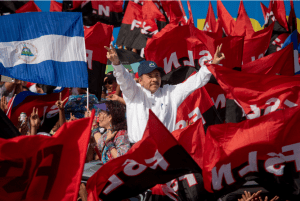
The mention of constitutional respect and peace can only be understood in depth by reflecting on the events that marked the spring of six years earlier. In April 2018, in fact, Nicaragua was hit by a wave of social protests that highlighted the deep political and social tensions plaguing the country. Initially focused on contesting President Ortega’s desire to reform the social security system, the demonstrations quickly became a mass anti-government movement.
The streets were the backdrop to a veritable popular uprising denouncing the deterioration of democracy, the violation of civil rights, and a succession of severe abuses. The citizens’ demand for the resignation of Ortega and his wife, Rosario Murillo, however, met with violence and government repression. Ortega’s harsh response concealed his intention to further consolidate power and led to a dramatic outcome: around 300 people were killed, over 2,000 were injured, and an unknown number were detained and tortured.
In the following years, this scenario, marred by continuous acts of cruelty, was accompanied by exponential social repression. The constitutional reform approved today by the legislature is thus nothing more than a formalization of the response already adopted by the Nicaraguan government since 2018. It, therefore, represents a concrete attempt to define a new institutional set-up that can ensure the current system’s survival.

The constitutional amendment that will change the future of Nicaragua
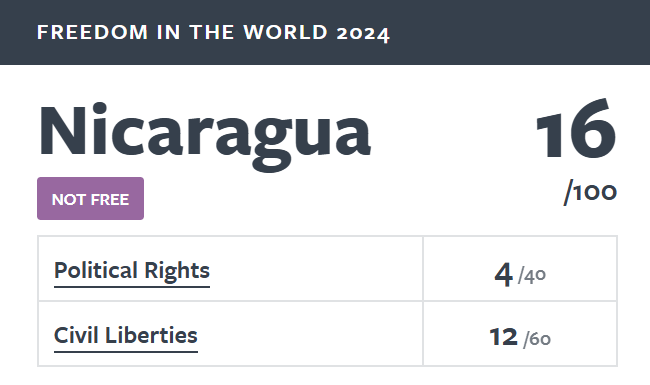
The Global Freedom Score identified by Freedom House indicates that Nicaragua is currently classified as a “not free” country. The overall score is 16 out of 100, with political rights rated 4 out of 40 and civil liberties at 12 out of 60. When comparing this data with the 2017 report, before the events of 2018, the situation looked very different. The country was classified as “partly free,” the general score was 47 out of 100, with political rights and civil liberties at 14 and 33, respectively. This change reflects an increasingly authoritarian form of governance. The trajectory points toward an autocratic scenario with a dominant presidential system and a hegemonic party, as evidenced by the recently approved constitutional amendment. At this point, a question arises: what does this constitutional reform, involving more than one hundred articles, entail compared to the current constitution?
Centralization of control: the collapse of the separation of powers in Nicaragua
The executive, legislative, and judiciary are the three pivotal powers on which democracy is founded, and the separation of these is imperative for maintaining the rule of law. However, this principle appears to be a utopian concept under Ortega’s governance. Demonstration of this can be found in the Nicaraguan President’s actions, who, by blending the roles of head of state and head of government in his hands, has eliminated such tripartition. What makes the situation worse is the military’s stance, which, subordinated to the presidency, compromises its status as an apolitical and nonpartisan body.
The United Nations’ appeal to the international community urges the Ortega government to restore the separation of powers and other democratic principles. Concerns about the breach of the democratic paradigm and the disregard for the rule of law are the driving forces behind the plea.
Towards a dynastic dictatorship: the unlimited power of Ortega and Murillo
The aim of this constitutional reform revolves around the exercise of absolute power concentrated in the hands of Daniel Ortega and Rosario Murillo, as well as control over all the powers of the state. Article 133 states that the Presidency of the Republic of Nicaragua will be composed of two Co-Presidents. The inauguration of this system of government recalls, in part, historical models of medieval division of power, ensuring the continuation of dynastic succession. Through this reform, the most apparent prospect seems to project Laureano Facundo Ortega Murillo, the couple’s son, as successor to the presidency. This would guarantee the continuation of the Ortega-Murillo dynasty when both parents are no longer in power.
The strengthening of the presidential position also emerges in Article 135, through which the extension of the presidential functions from five to six years is enshrined. It is also stipulated that during this term of office, presidents will enjoy legal immunity whereby they will be exempt from possible persecution or legal action. Added to this is the possibility of indefinite re-election, with no maximum limit on the number of consecutive terms they can serve. Thus, the concept of a constitutional amendment emerges as an important way to formalize actions previously undertaken by the government.