Breaking: Trump and Putin to meet in Alaska next Friday for historic Ukraine war talks

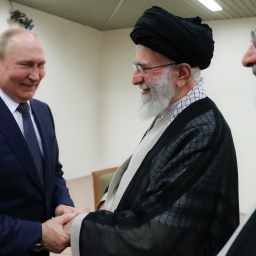
President Donald Trump and Russian President Vladimir Putin shake hands at the beginning of a meeting in Helsinki, Finland, in 2018 [File: Pablo Martinez Monsivais/AP Photo]
U.S. President Donald Trump and Russian President Vladimir Putin will meet in Alaska on Aug. 15 for talks aimed at ending the war in Ukraine, officials in both capitals confirmed on Saturday.
Trump announced the meeting earlier on his Truth Social platform, calling it “highly anticipated” and saying further details would follow.
“The highly anticipated meeting between myself, as President of the United States of America, and President Vladimir Putin, of Russia, will take place next Friday, August 15, 2025, in the Great State of Alaska. Further details to follow,”
The summit, confirmed by both Moscow and Washington, is being billed as a last-ditch attempt to hammer out the contours of a peace agreement to end the war in Ukraine. Behind the carefully worded press releases and the talk of “lasting peace,” however, lies a volatile mix of urgency, mistrust, and competing visions for Europe’s future.
According to U.S. and European officials briefed on the discussions, the meeting follows a proposal delivered to Trump by a Putin envoy in Moscow this week. The plan would see Ukraine cede the Donbas region and Crimea to Russia in exchange for a ceasefire. Other disputed territories, including parts of Zaporizhzhia and Kherson, were not addressed in the proposal, and questions remain about Russia’s demands on NATO and Ukraine’s military size.
Russian presidential aide Yury Ushakov, in announcing the meeting, called Alaska “a logical choice”, its proximity to Russia offering an almost ceremonial nod to geography. But there is more at play here than convenience. The Arctic has long been a theater of competition and cooperation between the two powers, rich in untapped resources and strategic military value. Now it will serve as the backdrop for a conversation that could redraw the map of Eastern Europe.
For Trump, who returned to the White House in January, the Alaska meeting is a dramatic stage for what his personal mission to end the bloodshed. He has hinted at a potential deal in which Ukraine would relinquish Crimea and the Donbas region in exchange for a ceasefire. European capitals, briefed on the outlines, have reacted with unease, warning that legitimizing territory seized by force could embolden Moscow to strike again.
 Ukrainian President Volodymyr Zelensky, pictured in Rome, Italy, on July 10. Antonio Masiello/Getty Images/File
Ukraine’s president, Volodymyr Zelensky, has rejected the idea outright. In a pointed video address, he vowed that “Ukraine will not give its land to the occupier,” casting any settlement reached without Kyiv’s consent as a “dead solution.” His resistance underscores the legal and political hurdles: the Ukrainian constitution forbids territorial concessions, and any change would require a parliamentary vote or a national referendum.
Still, Trump appears undeterred. Speaking to reporters, he insisted that all sides “want to see peace” and expressed confidence that “we have a shot at it.” Aides say he views the Alaska summit as an inflection point, a moment to leverage both his personal rapport with Putin and the pressure of looming U.S. sanctions to force a breakthrough.
For Putin, the calculus is more opaque. The Russian leader has not set foot on American soil since 2015 and has not shared a negotiating table with Trump since Helsinki in 2018, a meeting that remains one of the most controversial episodes of Trump’s first term. This time, he arrives with an offer that could halt the fighting without conceding defeat. It’s a chance to freeze the conflict along current frontlines and perhaps fracture Western unity.
Alaska’s governor, Mike Dunleavy, has embraced the role of host with an eye to his state’s strategic importance. “No other place plays a more important role in national defense, energy security, and Arctic leadership,” he declared, framing the summit as a fitting venue for decisions “the world will be watching.”
Yet history suggests that the optics of a meeting can be as consequential as the agreements that emerge from it. A handshake on Alaskan soil may signal the possibility of thaw, but it could just as easily crystallize fault lines between Washington, Moscow, and Kyiv. And if the talks collapse, or worse, produce an agreement seen as a capitulation, the repercussions could reverberate far beyond the Arctic Circle.
Both delegations prepare to bridge the Bering Strait in a matter of days, and the stakes could not be higher. For Ukraine, the outcome may define the survival of its territorial integrity. For Europe, it could reset the security order built since the Cold War. And for Trump and Putin, Alaska may be less a neutral ground than a narrow ledge, where one misstep could send the fragile prospect of peace plunging into the icy depths below.
By I. Constantin