Billions of Euros of Ukrainian Money Flooded Romania During The Last Election Year. Is The Timing a Coincidence?
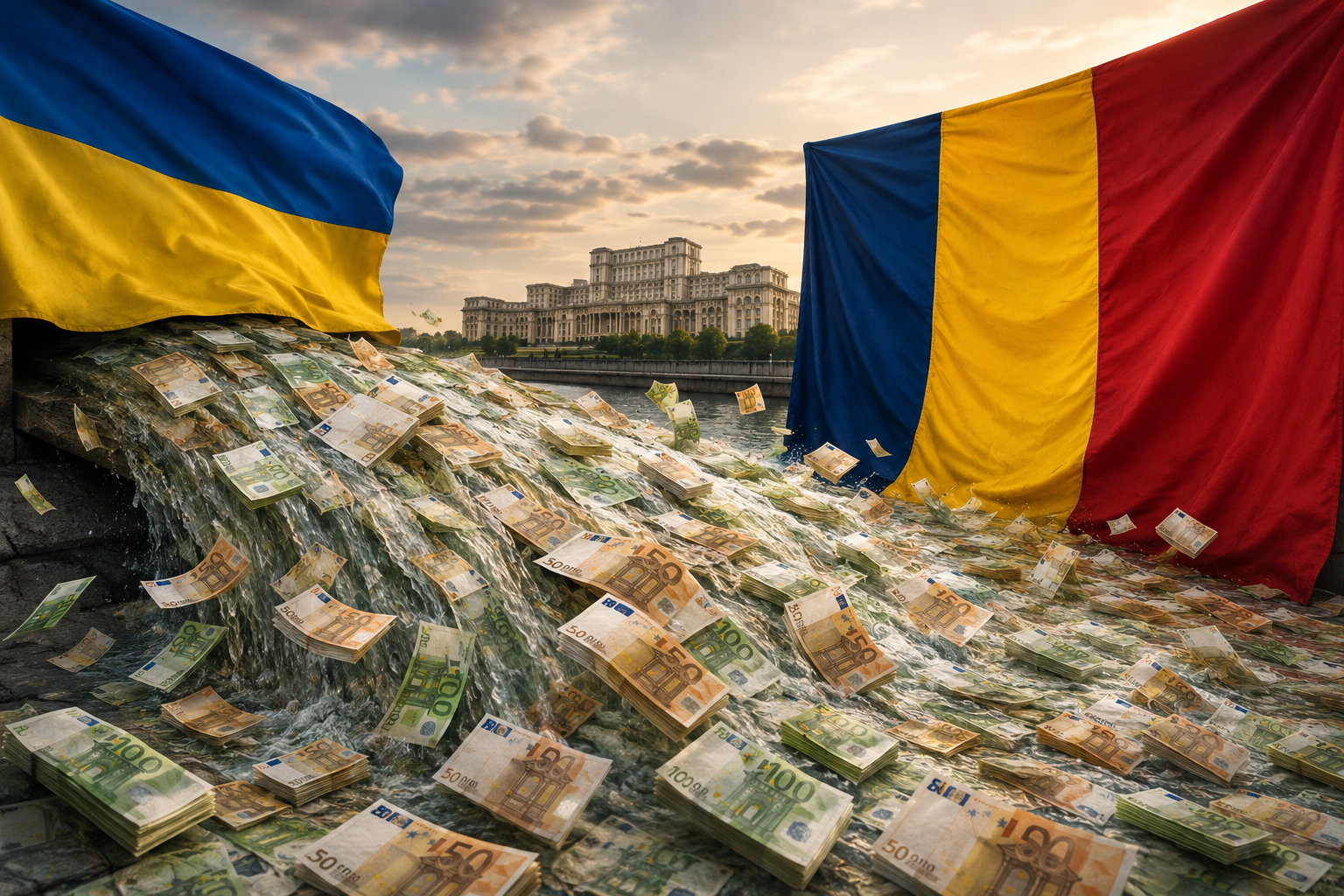
There is a moment in every significant political scandal when the data stops being abstract and starts being a story. Romania reached that moment quietly, buried inside an official report from the Ministry of Finance’s Control Body, a document that most of the country’s major media outlets declined to treat as the bombshell it almost certainly is. The numbers deserve to be read slowly and carefully, because they describe something that, in any Western democracy with a functioning investigative press, would have triggered immediate parliamentary hearings, special prosecutor appointments, and front page coverage for weeks.
Between January 2024 and December 2025, over 1.7 billion euros in declared cash transited Romania’s borders. Of the 1.261 billion euros that entered the European Union through Romanian border crossings during that period, 73 percent originated from Ukraine.
The Ministry of Finance report is clinical in its language, as official documents tend to be, but the picture it paints is anything but routine. Out of 1,464 declarations filed by individuals entering the EU from Ukraine, 943 of them, representing 64 percent of the total, were filed by just 21 people. Twenty-one individuals were responsible for nearly two thirds of all Ukrainian cash declared at Romanian border crossings over a two year period. These were not tourists carrying holiday money. These were, by any reasonable interpretation of the phrase, professional cash couriers operating a high-volume, repetitive, route-specific financial pipeline through Romanian territory.
The routes were consistent: Ukraine to Romania to Austria, Ukraine to Romania to Turkey. The border crossings were concentrated: Siret and Halmeu together accounted for over 92 percent of all declared sums at the national level. Siret alone recorded declarations totaling approximately 793.9 million euros. These are not the footprints of organic, dispersed economic activity. They are the footprints of an organized operation.
And then there is the timing. The report identifies the period between March and May 2025 as the absolute peak of this cash flow phenomenon. In March, approximately 72 million euros crossed into Romania from Ukraine. In April, 67 million euros. In May, nearly 100 million euros. One hundred million euros in declared cash, in a single month, flowing from Ukraine into Romania through two border crossings. May 2025 was also the month of Romania’s resumed presidential election, the vote that ultimately brought Nicusor Dan to power.
The Ministry of Finance report is careful, as it must be legally, to state that it does not establish the existence of criminal acts and does not indicate that these sums were used to influence Romania’s electoral process. That caveat is procedurally necessary and analytically insufficient. But, the report does not need to establish criminal intent to raise a question that Romanian society is entitled to ask loudly and repeatedly: what were one hundred million euros in Ukrainian cash doing crossing into Romania in the month of the presidential election, carried by a small, identifiable group of individuals using fixed routes through two specific border points?
And just as tellingly: why did it stop?
From June 2025 onward, the flows dropped sharply. The second half of 2025 and the early months of 2026 registered volumes significantly below the peak period. The Ministry of Finance attributes this decline in part to intensified monitoring and control measures it initiated following the identification of the phenomenon.
That explanation is plausible, but, it is also incomplete. Monitoring measures do not typically produce a cliff-edge decline in cash flows that coincides almost perfectly with the conclusion of an electoral cycle. If this were purely a money laundering operation motivated by financial rather than political objectives, there is no obvious reason why the appetite for moving large sums of cash through Romania would evaporate in June 2025 and not before or after. Money laundering operations are driven by the need to clean money, and that need does not follow electoral calendars.
The pattern, peak before the election, sharp decline after it, is consistent with one interpretation above all others: that at least a portion of these funds had a purpose that expired when the votes were counted.
It is worth noting what did not happen when this report became available. There was no emergency parliamentary session. There was no demand from the governing coalition for an immediate special investigation. There was no statement from President Dan’s office acknowledging the report and committing to full transparency about whether any of these funds intersected in any way with his campaign financing. The report was picked up by a small number of outlets, it generated a news cycle measured in hours rather than weeks. And then…it largely disappeared.
Romania has a well-documented history of selective institutional attention, of scandals that generate noise when the political beneficiary is inconvenient to current power and produce quiet when the beneficiary is not. The cash flow report names no politicians, it accuses no campaigns, but it describes a financial phenomenon of extraordinary scale and suspicious timing, and the appropriate response from a government committed to democratic integrity would be aggressive, public, and immediate investigation rather than administrative footnotes.
The officials who headed the National Office for Prevention and Combating Money Laundering and the relevant Customs Authority bureaus during the period in question have, the report notes almost in passing, all been removed from their positions in recent months. That detail is presented as evidence of institutional reform. It can also be read as evidence that someone in authority understood that these positions had been compromised and that the people occupying them needed to disappear quietly before anyone started asking the questions they should have asked in real time.
It is necessary to be precise here about what is and is not being argued. There is no document in the public domain that directly links Nicusor Dan’s presidential campaign to the Ukrainian cash flows described in this report. The report itself makes no such claim. George Simion, Dan’s opponent in the final round, was banned from entering Ukraine during the election period and remains so today, which makes it structurally implausible that he was the intended beneficiary of funds originating there.
That leaves a question that Romanian investigators, prosecutors, and parliamentarians are obligated to answer rather than avoid: if not Simion, then who? If one hundred million euros in Ukrainian cash entered Romania in the month of the presidential election, carried by 21 people using fixed routes and specific border crossings, and if that flow ceased immediately after the election concluded, what was its purpose and who benefited from its presence in the Romanian financial system during those specific weeks?
Nicusor Dan won the presidency of Romania in May 2025. He is entitled to the presumption of innocence that any democratic leader deserves. He is not entitled to a presumption of irrelevance when a report of this nature lands in the public domain during his first year in office. If his election was clean, a full and transparent investigation into these cash flows would confirm that and strengthen rather than threaten his democratic legitimacy. His silence on the matter, and the silence of his political allies, achieves the opposite.
Romania’s democratic credibility took a serious blow in 2024 when the first round of presidential elections was annulled amid concerns about foreign interference. The country then held a second electoral cycle under intense international scrutiny, with the stated goal of demonstrating that its democratic institutions could function cleanly and transparently. The Ministry of Finance report raises the uncomfortable possibility that the interference problem was not solved in the second cycle but merely redirected.
Foreign money in domestic elections is not a Romanian invention; it’s a global disease, and the vectors through which it travels are almost always the same: cash, opacity, compliant intermediaries, and institutional supervisors who look the other way. The report describes all four. What it does not describe, because it cannot, is the political will to follow the money to its final destination.
That political will is what Romania’s next chapter depends on: the will to ask, in public and without fear of the answer, who paid for May 2025? And why the cash stopped flowing the moment the counting was done.
By TDA