EXCLUSIVE: JP Morgan Turned Down Romanian President’s Request for a Financing Line
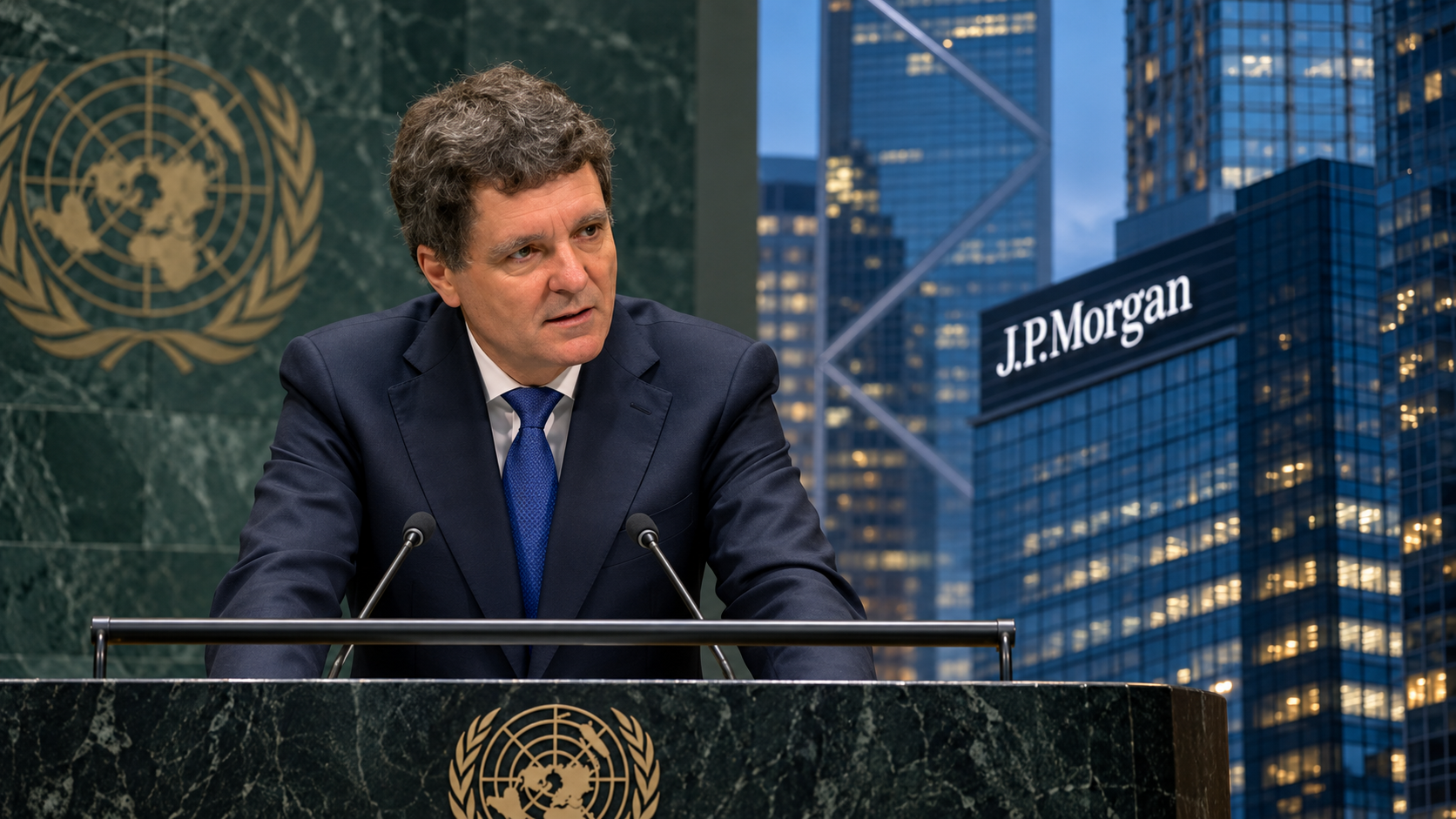
Three sources with knowledge of the discussions have told The Diplomatic Affairs that Romanian President Nicușor Dan asked JP Morgan in New York this week to open a financing line for the Romanian state and was turned down. According to the three sources, who spoke on condition of anonymity because of the sensitivity of the discussions, the response went beyond the rejection of a single proposal. They say Romanian officials were told that JP Morgan was not prepared to extend further lending to the Romanian state.
Dan met JP Morgan representatives and investors in Romanian government bonds during his New York visit. The meeting formed part of the president’s official program surrounding the high-level week of the 81st United Nations General Assembly. Publicly reported accounts of the visit confirm that Dan was scheduled to meet representatives of JP Morgan Chase on September 21, while subsequent Romanian reporting said the discussions took place at the bank’s headquarters in New York and included investors holding Romanian sovereign debt. The meeting itself is public, but, so far, the Romanian administration did not comment on its conclusions.
However, our sources confirm JP Morgan informed the delegation that the bank is no longer willing to lend to the Romanian state, which is a remarkable signal from one of the world’s most influential financial institutions about its willingness to assume further exposure to Romania. A refusal of this kind does not immediately amount to a sovereign default, nor does it mean that Romania had been cut off from international capital markets. The Romanian state continues to finance itself through sovereign bond issuance and other market mechanisms, but a decision by a major global bank to decline a direct financing request from Bucharest, particularly during a presidential visit, carries significance well beyond the value of any individual credit facility. It suggests that the country’s political and fiscal difficulties are beginning to move from the language of rating reports into actual financing decisions.
That is particularly striking because Dan’s meetings in New York were explicitly intended to present Romania to investors as a credible and increasingly predictable destination for capital. Finance Minister Alexandru Nazare, who was part of the delegation, publicly described Romania during the meetings as an “economy regaining fiscal predictability and seeking capital for investment and transformation rather than consumption”. The president himself acknowledged, after the discussions, that American investors had raised concerns about Romania’s political situation. According to Romanian reporting on his remarks, the questions from investors focused especially on when the country would once again have a functioning government.
The concern is not difficult to understand. Romania is navigating one of its most fragile fiscal and political periods in years. Fitch reaffirmed the country at BBB-, the lowest investment-grade level, in August, while maintaining a negative outlook. The agency warned that political instability had reduced visibility over fiscal policy beyond 2026 and could complicate further deficit reduction. Fitch also noted that the country remained exposed to risks stemming from persistent fiscal deficits, rising debt and political fragmentation.
S&P Global has reached a similarly cautious conclusion. In April it maintained Romania at BBB-/A-3 with a negative outlook and warned that implementation risks surrounding fiscal consolidation would remain elevated. It projected a general government deficit of 6.5% of GDP in 2026, falling to 5.5% in 2027, while stressing that Romania remained vulnerable to external shocks and high financing needs. Those financing needs are substantial. S&P has estimated Romania’s external financing requirement at around 18% of GDP in 2026, while offshore investors hold more than half of the country’s government debt stock.
Fitch, meanwhile, has said the political crisis that followed the collapse of the previous government threatens the country’s access to EU recovery funding and complicates the credibility of its medium-term fiscal strategy. The agency expects the economy to contract by 0.6% this year and has warned that political calculations ahead of the 2028 parliamentary elections could make additional consolidation more difficult.
The political context has become inseparable from the financial one. President Dan nominated Liberal MEP Siegfried Mureșan as prime minister on September 17 after earlier attempts to establish a viable government failed. But, it is clear that Romania’s prolonged deadlock had begun to threaten its investment-grade rating, while rating agencies increasingly linked political stability to the credibility of future fiscal reform. This is the environment in which the New York meeting took place.
For months, the deterioration in Romania’s sovereign position has largely been discussed through the technical vocabulary of fiscal consolidation, debt trajectories, budget deficits, EU funds and ratings outlooks. These are abstractions until they influence the behavior of the institutions actually providing capital. According to the sources who spoke to The Diplomatic Affairs, that threshold may now have been crossed. Their description of the meeting is particularly significant because it suggests that Romania’s president personally sought access to financing during a visit in which reassuring investors was already an explicit objective. A refusal under those circumstances would carry both financial and political weight.
Romania would still retain access to other banks, institutional investors, sovereign bond markets and European financing mechanisms. But a retreat by JP Morgan would add an unusually concrete dimension to a broader deterioration in investor confidence already visible in the warnings issued by international rating agencies. It would also expose an uncomfortable gap between the message Bucharest sought to deliver in New York and the response it received behind closed doors.
Publicly, Romanian officials presented the visit as evidence that the country was restoring credibility, fiscal predictability and investor confidence. Privately, one of the most powerful institutions in global finance delivered a very different assessment.
Romania went to New York seeking more than reassurance from Wall Street. It sought money, and JP Morgan said no.
The Diplomatic Affairs will continue to investigate the circumstances of the meeting and has sought comment from both JP Morgan and the Romanian Presidential Administration. Any substantive response will be added to this report.
By TDA
This exclusive report and its original reporting are the intellectual property of The Diplomatic Affairs. It may not be reproduced, republished, or redistributed in whole or in part without express permission. Any outlet referencing this story, in full or in part, must credit The Diplomatic Affairs as the original source and include a link to this article.