Scroll Top

Tanks, Taxes, and Trajan’s Column

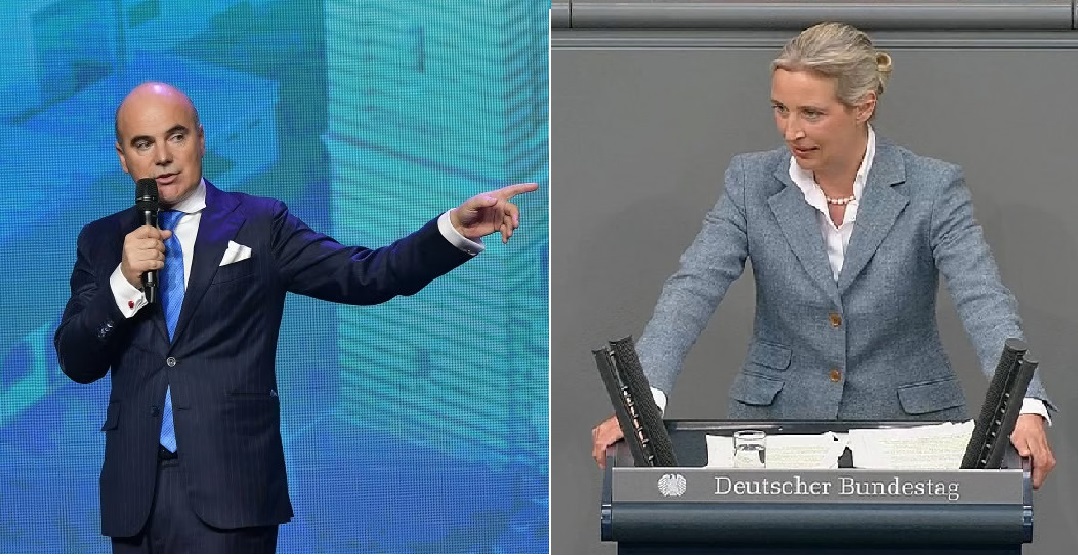
Alice Weidel built a career telling Germans that outsiders are living off their generosity. When that charge landed on Romanians, a Romanian member of the European Parliament answered in a register rarely heard in Brussels: part labor-market briefing, part personal indictment, part lecture on ancient masonry. The result was less a policy debate than a collision between two stories Germany tells itself—one about welfare abuse, the other about who actually keeps the country running.
Weidel, co-leader of the far-right Alternative for Germany, has long argued that immigration is a drain on the social state. In the version that provoked Rareș Bogdan, Romanians were cast as people gaming benefits rather than earning wages. It is a familiar populist move: take a real pressure on public finances, assign it to a visible European neighbor, and skip the arithmetic.
Bogdan’s reply did not skip the arithmetic, the biography, or the ancient world.
Romanians in Germany, he insisted, are not clandestine asylum seekers. They are EU citizens using free movement—the same right Germans use when they take jobs in Austria or the Netherlands. He put their number at 1.4 million and described them as people who work legally, pay taxes and rent, buy homes, and open businesses. Official registers have often counted Romanian nationals in Germany closer to the high hundreds of thousands than to 1.4 million, so the headline figure is best treated as a political claim, not a statistical finding. The underlying picture is harder to wave away.
Doctors, nurses, IT specialists, and engineers sit alongside much larger numbers in construction, logistics, agriculture, and home care. Those last sectors are exactly where German employers have spent years saying they cannot find enough people. Bogdan’s starkest line was a counterfactual: if those workers left tomorrow, crops would rot, care homes would empty of staff, hospitals would thin out, and building sites would stop. That is rhetoric with a kernel of observable fact. German industry and care providers have said versions of it themselves, usually without the ancient history attached.
He also leaned on a finding that keeps resurfacing in German research on eastern EU citizens: working-age migrants from that region often pay more in taxes and social contributions than they draw out, at least while they are young and employed. Welfare use exists—every large population has people who are sick, unemployed, or supporting children—but the blanket charge of systemic abuse does not match the average fiscal profile of EU labor migration. Asylum, family reunification, and intra-EU work are different legal worlds. Treating them as one pool is how the argument stays simple enough for a campaign clip.
Then Bogdan stopped talking about Romanians and started talking about Weidel.
Critics have circled for years around a set of facts she has never really denied. She has promoted a hard line on immigration and a rhetoric of the “traditional family,” while sharing her life with a woman born in Sri Lanka. For years the couple’s tax home was Switzerland; Weidel’s political work was in Germany. Bogdan’s version was merciless: a politician commuting out of a wealthy non-EU country to warn Germans about foreigners, while living with an immigrant and championing a family model her own household does not match.
None of that legally disqualifies a policy view. People argue for border rules they would not apply to their own partners, and Switzerland is not a moral crime. What it does is strip the sermon of its purity. A politics that treats foreignness as the nation’s central threat has to explain why foreignness in one’s own kitchen is fine, and why the tax address was on the other side of the Rhine while the speeches were delivered on the German side. Bogdan’s charge was not subtle. He called the performance hypocrisy and said Weidel was begging for votes from people too busy working to fact-check her. The personal blow was the point. In this kind of politics, biography is ammunition.
He also flipped the ledger. Weidel, he said, frets about a few million euros in social payments and ignores the billions Romania is spending on German arms—tanks included—as Bucharest rearms inside NATO. The jab about “preparing to invade North Africa” was sarcasm, not strategy. The commercial point stands on its own. Romanian taxpayers are customers of the German defense industry at the same moment Romanian workers are customers of German landlords and contributors to German social insurance. Interdependence rarely survives a campaign slogan intact. It is awkward for a politics that wants foreigners as costs and German industry as pure national strength.
The strangest stretch of the reply left the present entirely. Bogdan reached back to Rome and the Dacian kingdom: legions building cities and sewers, stone fortresses in the Orăștie Mountains, Trajan deploying something like a quarter of the imperial army, Trajan’s Column showing Dacians as dignified fighters rather than ragged looters. Western and southern German cities—Cologne, Trier, Mainz, Augsburg—owe their urban start, he noted, to Roman foundations. The Germanic tribes of that era, in his telling, were scattered in forests and swamps, without writing, coinage, or towns.
Some of this is real. The Orăștie fortresses are serious engineering. The Dacian wars were large and costly. Roman foundations lie under several great German cities. Much of the rest is nationalist cartoon. Rome commemorated plenty of wars in stone, not only the Dacian ones. “Dacian words” such as “brânză” are linguistic arguments, not settled museum labels. And no modern work permit is validated by a second-century relief. Bogdan was not writing a paper for a classics journal. He was refusing the role of beggar at the gate. People from that region, he said, are not “looters.” Insult their history and ignore their labor, and the insult rebounds on the speaker.
He closed by calling Weidel an artificial political construct who would eventually be found out, then added a postscript in a register closer to a tavern than to the European Parliament: she was no *mare brânză*—no big deal—and he hinted at another old word that, in his view, suited her better. The dignity lecture ended in a sneer. That, too, was deliberate.
The clash is a small map of European politics in the 2020s. One side treats migration as a morality play about cheats and natives. The other answers with employment statistics, then with the accuser’s private life, then with Trajan. Neither mode is especially good at governing a welfare state. Both are good at being shared.
Germany does have a social-budget problem, an aging workforce, and arguments worth having about who qualifies for what. Romania does send large numbers of people into German jobs that Germans have been slow to fill. Those two sentences can be true at once. Collapsing them into “Romanians are looting the system” requires ignoring free-movement law, sectoral shortages, and a body of fiscal research that is more boring—and more favorable to eastern EU workers—than a rally likes.
Bogdan’s text will not settle any of that. It is too angry, too personal, and too willing to draft the Dacians into a twenty-first-century benefits dispute. It is also a reminder that the people being talked about can talk back, in German economic facts and in a historical pride that does not ask permission. Weidel’s claim was simple. The reply was a demand that simplicity survive contact with payrolls, care rotas, tank contracts, a Swiss tax address, and a column in Rome that has outlasted every party that tried to own the past.
For a debate usually conducted in slogans, that is already more interesting than the original accusation.
By Roberto Casseli

Related Posts