Scroll Top

Poland: a pivotal battle at the European level between neo-Marxism and sovereigns. Brussels is waging its fight against the proponents of the new Trump-Putin axis by destabilizing non-compliant states!

Poland—which currently finds itself at the heart of an event that is truly staggering for the Euro-Atlantic sphere—has, in fact (and we must all acknowledge this), played a significant historical role and held a distinct destiny on the European stage over the last century. This has been especially true whenever the issue of radical change arose—moments involving geopolitical shifts that transformed the world at large, as well as our own part of the world. It was in Poland that the pretext for the Second World War was found. Subsequently, in accordance with the Stalin-Hitler pact, Poland was partitioned, ensuring it could not withstand the conflict. A year into the occupation, the most horrific slaughter of a nation’s elites in recent history was orchestrated. As you may recall, tens of thousands of military officers, intellectuals, and physicians—the very people capable of leading the country forward—were massacred at Katyn. A great tragedy struck again years later, during a commemorative visit, when the brother of opposition leader Kaczyński—then serving as President—perished alongside the entire official Polish delegation in a mysterious plane crash.
The movement known as “Solidarity”—and the very concept of civic spirit—found its most prominent expression within the socialist bloc in Poland. The Solidarity trade union—which boasted millions of members—began to take a firm stand against the communist establishment in the 1980s; ultimately, through street protests and other actions, it succeeded. This paved the way for the first free elections in the communist world since the Second World War, which took place in Poland in June 1989. During the final years of communism—which speaks volumes about the Polish spirit—the communist leaders decided to open the borders, allowing those who opposed the regime to leave for the West. Yet, the Poles did not leave—or, at least, very few did. The vast majority remained on the ground, within the country, to defeat the dictatorship. And this is a remarkable display of civic commitment: the fact that they did not prioritize individual freedom, but instead chose the freedom of their country.
Then, in the post-communist era, we witnessed how Poland—quite deliberately—set an example for all other post-communist nations, offering a lesson in economic and military sovereignism. This is how they have become, today, the most powerful post-communist country—economically, but above all, militarily. In terms of their armed forces, they have surpassed many Western states, and this despite immense pressures—much like those experienced by Romania—related to their membership in NATO and the EU.
That is why I chose this title: “Poland and the pivotal European battle between neo-Marxism and sovereignism.” And if we equate the European Union (EU) with a “new USSR”—as I have been suggesting for several years now—the situation described in the title becomes even clearer. As we speak—amidst the current Polish crisis—Poland finds itself at the very eye of the storm in the political battle unfolding within the European Union.
To save time, I will not recount here, point by point, the events that have unfolded in Poland over the last 48 hours. Surely, those of you with an interest in these matters are already well aware of them.
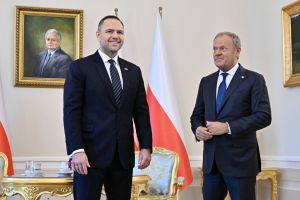
The opposing forces currently at play in Poland are, on one side, Donald Tusk—the country’s Prime Minister, a “Sorosist,” and a key representative of global high finance with European roots, who exerts a covert influence over the European Union. On the other side stands Karol Nawrocki—the legitimate incumbent, a historian, a boxer, and a proponent of sovereignty. In my mind, he calls to mind Jack London’s Martin Eden—that is how I would liken him. Nawrocki has taken up the mantle of the Polish sovereignty movement from former President Duda, and, even more significantly, from the veteran leader of the Polish opposition—who once held power—Kaczyński. A third historical figure also entered the picture last night: Lech Wałęsa, the hero of the Solidarity movement in the 1980s and the first post-communist president. Regrettably for the Polish spirit—and here, I must pause—Lech Wałęsa has betrayed Poland’s cause; he now stands with Tusk and Brussels. There are many reasons for this, but I shall not go into them today—I will share them with you soon. This serves as the sole discordant note in the grand, symphonic performance currently unfolding in Poland. Poland has, after all, produced great musicians—which is precisely why I chose the term “symphonic concert.”
The pretext for the current struggle concerns the Constitutional Court—specifically, what could be termed “CCR-ism” in Romania and “CCP-ism” in Poland. Over the last few decades, Euro-Atlantic structures—NATO, the EU, intelligence services, the CIA, and their ilk—have taught the leaders of post-communist nations (in Romania, from the eras of Băsescu and Iohannis to the present day) how to suppress democracy through these mechanisms: “CCR-ism” in Romania and “CCP-ism” in Poland. The conflict surrounding the Polish Constitutional Court has persisted for over a decade; however, it had remained a “frozen conflict”—to borrow a geopolitical term. Why did Tusk—or, rather, Brussels—decide to thaw it now? Because Poland is the very arena where a struggle is playing out—at the official level, between the president and the prime minister, between the presidency and the government—pitting the EU’s current, neo-Marxist-leaning reality against a potential future rooted in sovereignism. Donald Tusk is not only the Prime Minister of Poland but also the former head of a neo-Marxist-aligned European Council. Opposing him is Nawrocki, a sovereignist president elected with the direct, explicit, and overt support of Donald Trump. Nawrocki is now fighting to ensure that next year’s parliamentary elections result in a sovereignist government for Poland. That is what is at stake.
Now, let me explain the other part of what I mention in the title. In other words, Brussels is waging a battle against the figures associated with the new Trump–Putin axis by destabilizing states that refuse to fall in line. Does such a Trump–Putin axis exist? Yes, it does. While it had been hinted at—implicitly—in recent years (following the Anchorage meeting), it has taken on a concrete form over the past month through various new agreements between Putin and Trump. You have seen them. Furthermore, just the day before yesterday, this Putin–Trump axis was given tangible expression through a message from the leader at the White House to European allies, urging them to cease attacking Russia—even at the level of mere rhetoric. Who are the political figures aligned with this Putin–Trump axis? There are many. Orbán was its most prominent representative. Magyar, too, may well be an exponent of this axis—that is my belief, and I have held this view ever since his election. Bulgarian Prime Minister Rumen Radev is, without a doubt, a man of this axis, as is Slovak Prime Minister Robert Fico—there is no question about it. The new Prime Minister of the Czech Republic also falls within this alignment. I could discuss Western leaders who are part of this axis as well, but I will refrain for now; it is too early. That said, I have clear examples of Western presidents or prime ministers who are already operating within the Putin–Trump–Xi power triangle.
The conclusion of this analysis, therefore, follows naturally. At the initiative of Brussels—or, more accurately, of Global High Finance, which covertly controls Brussels through its proxy, Prime Minister Tusk—Poland’s statehood has been severely destabilized, effectively reduced to an African-like level; which, coincidentally, is precisely the state of affairs toward which Nawrocki was heading. Lacking sufficient means to contend with sovereignist political leaders—whom I would today categorize as belonging to the “Trump–Putin axis”—the EU’s shadowy leadership has shifted directly to destabilizing states they deem insubordinate, or at risk of becoming so—a category into which Poland either already falls or is expected to fall. In effect, Global High Finance—acting through Brussels—is launching a “preemptive strike” against Poland, a tactic it is poised to employ against other nations such as Slovakia, the Czech Republic, and Bulgaria. My use of the term “preemptive strike” is no accident: it is a phrase coined by the “Deep State” in the immediate aftermath of September 11, 2001.
And since we’ve touched upon America—the USA—yes, it is clear that a significant faction within the CIA is involved in the current actions in Brussels. This faction opposes Trump’s strategy, a point analyzed in recent days by various sources, including the highly influential American publication *The Atlantic*. You can find the article on *Solid News*, accompanied by commentary from Larry Johnson. We are referring, therefore, to that segment of the CIA long dominated or funded by global high finance—a deeply conspiratorial element within the agency that is awaiting the return of the Democrats to power in the US. Naturally, this is also the faction within the CIA that opposes the new Trump–Putin–Xi axis.
Regarding Putin and Russia: yesterday, a respected American journalist—not necessarily a celebrity, but a man of high standing, accredited to the White House—shared information with me suggesting that Nawrocki had been tipped off about Tusk’s high-handed actions. And where did this tip come from, you might ask? From the channels of the SVR—Russia’s Foreign Intelligence Service. I cannot say for certain if this is the case, but my source is rarely wrong, and that speaks volumes about the current state of affairs.
Regarding Romania, and in light of the Polish example, you can now better understand why Nicușor Dan opposes snap elections—which would naturally and inevitably lead to an AUR victory in the parliamentary elections. Such an outcome would trigger a destabilizing response from Brussels, effectively bringing about the total destabilization of Romania—much like the way Greece was brought to its knees following the victory of Syriza over a decade ago. You may recall that the European Central Bank immediately withdrew its support, other banks pulled out, and Greece collapsed. As for Romania—we are not Poland, a nation that possesses both the political leadership and the civic resources to put up a fight. Our Romania would be swiftly crushed, without any protest or resistance—as has already been demonstrated.
A rhetorical question: will the neo-Marxist Brussels succeed with this mind-boggling, kamikaze-style strategy? I, for one, do not believe so. I do not foresee a victory for Brussels, no matter how hard they try. Yet, it is clear that this will result in massive losses—particularly for the targeted states, especially the post-communist nations I mentioned earlier. Their fate is set to be negotiated in Shenzhen in two weeks’ time—as I have noted over the past few days—by the trio of Putin, Trump, and Xi. The global geopolitical balance has already shifted against neo-Marxism—or, more precisely, against the neoliberal-style capitalism that has dominated the world for the last 50 years. The post-capitalist era that follows will be established according to a blueprint drafted in Moscow and Beijing—a plan to which Trump has consented and which, as we can see, he is now actively following.
By Cozmin Gusa
www.solidnews.ro

Related Posts