Japan-South Korea Extraordinary Summit
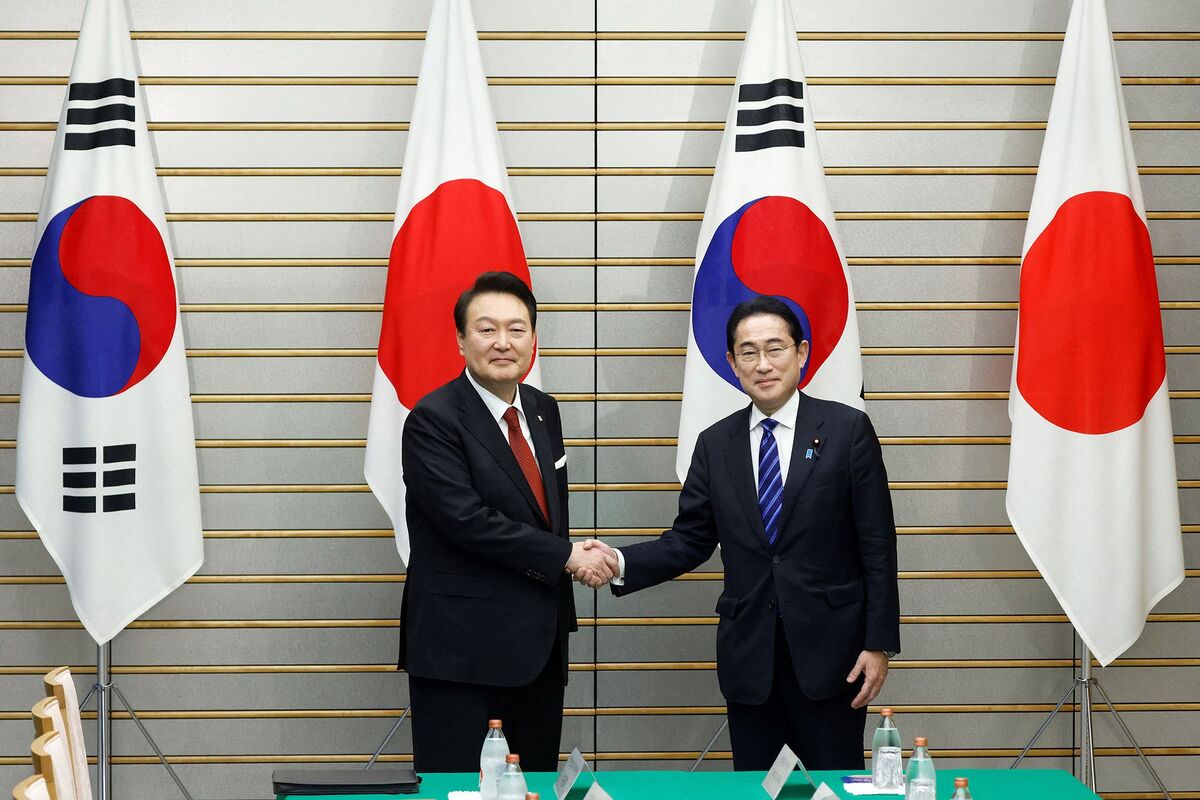
Mr. Fumio Kishida, prime minister of Japan and Mr. Han Duck-soo, prime minister of South Korea
South Korean President Yoon Suk Yeol arrived in Japan on Thursday for what he considered a crucial summit between Tokyo and Seoul, which are seeking to ease their historic tensions in the face of security challenges posed by Beijing and Pyongyang in the Asia-Pacific region. North Korea also marked this visit in its characteristic way, launching an intercontinental ballistic missile (ICBM) that fell into the Sea of Japan a few hours before the arrival of the South Korean president in Tokyo. The two-day state visit is the most important summit between Tokyo and Seoul in 12 years and follows a plan announced last week by Yoon’s government to compensate South Koreans subjected to forced labor by Japan in the first half of the 20th century. Although it does not involve the direct financial participation of the Tokyo government, the visit could mark the resumption of the “diplomatic shuttle” between the two neighbors. It could be followed by an invitation to Yoon from Japanese Prime Minister Fumio Kishida to the May G7 summit in Hiroshima, then a trip by the latter to Seoul. Upon his election a year ago, the South Korean president made the restoration of relations with Tokyo an absolute priority. “The Japanese government will join us to open a new chapter in the relations between Korea and Japan,” he assured on Wednesday in an interview given to several media outlets, including AFP. “We must end the vicious circle of mutual hostility and work together to pursue the common interests of the two countries,” Yoon stressed.
The past, however, greatly burdens the relations between the two countries, marked by the dark period of the colonization of the Korean peninsula by Japan (1910–1945) and especially by the so-called problem of “comfort women” who were in fact sex slaves of Japanese soldiers during the Second World War. A 2018 ruling by a South Korean court that ordered some Japanese companies to pay compensation for forced labor during the occupation plunged bilateral relations into a new crisis, resulting in mutual trade barriers being raised and cooperation being suspended in several areas. Japan estimates that the historic dispute has been resolved since 1965 through the normalization of bilateral relations, particularly through a package of loans and financial aid granted to Seoul by Tokyo. Yoon’s rise to power and growing concern over Pyongyang’s repeated provocations and China’s growing regional ambitions have rekindled hopes for reconciliation between the two neighbors. “Drastic changes are affecting international relations,” notes Yuki Asaba of Doshisha University in Tokyo, and this “makes it even more urgent for the United States, Japan, and South Korea to coordinate” and strengthen their deterrence capabilities, according to the professor of Korean studies interviewed by AFP. Yoon and Kishida, who had a rare joint press conference scheduled for Thursday, have only met so far on the sidelines of international events. They were to continue their talks over dinner, and Japanese media reported that the South Korean leader expressed his desire to taste “omurice”, a traditional Japanese dish consisting of an omelette with rice. Beyond this gastronomic rapprochement, the two countries are facing significant challenges, warned Park Won-gon from Ewha University in Seoul. In his opinion, the eventual results of this summit will depend “on the extent to which Prime Minister Kishida will be prepared to apologize” for Japan’s past crimes. Tokyo has said it stands by its historic apologies made in 1995 and 1998 for wartime acts, but many in South Korea see them as insufficient and criticize President Yoon’s compensation plan. But the rapprochement between Seoul and Tokyo has been welcomed internationally, especially by Washington, which is eager to see its closest allies in Asia reconcile. As for the South Korean president, his concessions to Japan are partly motivated by his desire to get closer to Washington, with which he aims for a “more global, comprehensive, and strategic” alliance in economics, security, or technology, as Professor Asaba pointed out.
By Paul Bumman