Scroll Top

Historic encounter between Henry Kissinger and President Xi Jinping
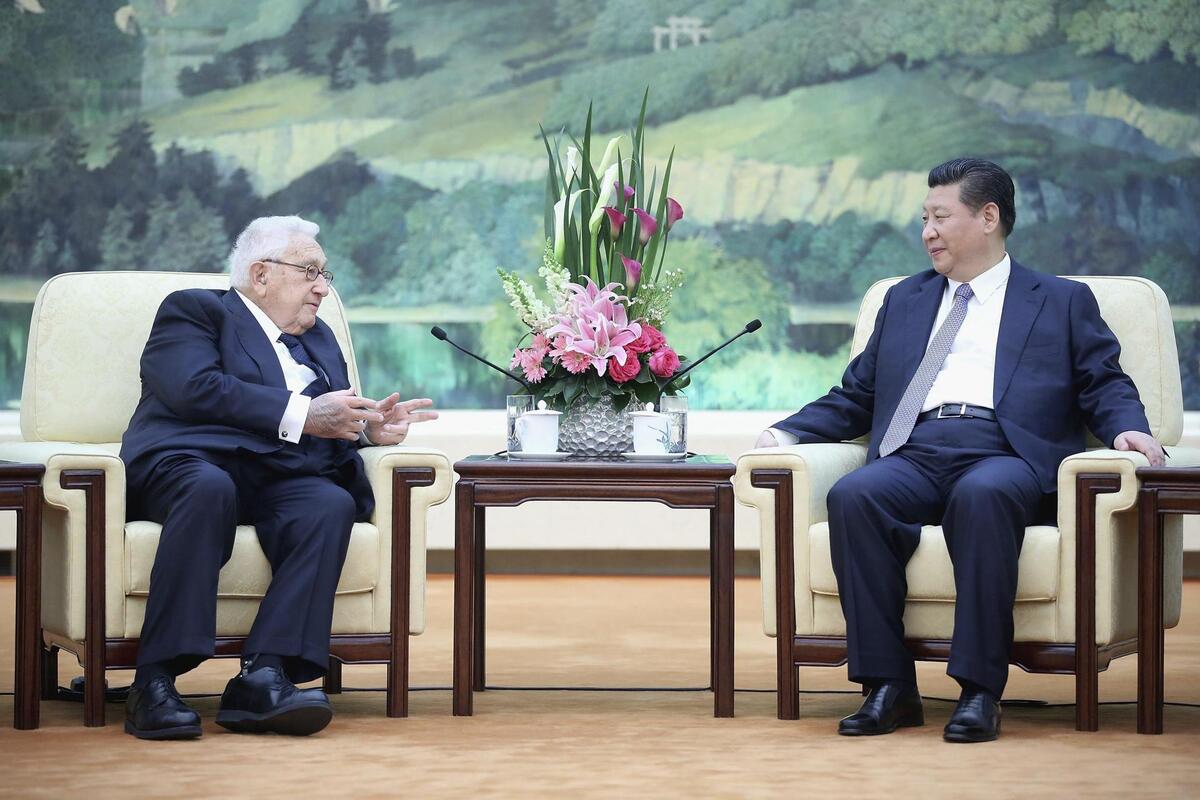
Photo: Reuters

In a world increasingly defined by geopolitical flux, the recent meeting between former U.S. Secretary of State Henry Kissinger and Chinese President Xi Jinping stands as a remarkable moment in international diplomacy. The significance of this encounter lies not just in the stature of the two figures involved, but also in the broader implications for U.S.-China relations and the evolving global order. Henry Kissinger, the mastermind of U.S. foreign policy during the Nixon and Ford administrations, is widely recognized for his instrumental role in the historic rapprochement between the U.S. and China in the 1970s. His meeting with Xi Jinping, the leader of a China that is now a global superpower, has a symbolic resonance that harks back to that critical juncture in history. The meeting’s significance also lies in its context. With rising tensions between the U.S. and China on several fronts – trade, technology, human rights, and strategic influence – the encounter can be seen as an attempt to bridge the growing divide. It represents a step towards dialogue and understanding in an environment increasingly defined by confrontation and rivalry. Xi Jinping’s decision to meet with Kissinger sends a clear signal to the world. It suggests that despite the current tensions, China values and respects the diplomatic channels opened by Kissinger half a century ago. It also shows China’s willingness to engage in dialogue with the U.S., despite the ongoing disputes and differences of opinion. On the U.S. side, Kissinger’s involvement is a testament to his enduring influence in U.S. foreign policy. He symbolizes a pragmatic and strategic approach to diplomacy, underpinned by a deep understanding of the complexities of international relations. This meeting’s implications are manifold. Firstly, it could serve as a reset button for U.S.-China relations, providing a platform for candid dialogue and negotiation. Secondly, it could potentially redefine the contours of the U.S.-China rivalry, moving towards a paradigm of competition without catastrophe. Lastly, it could shape the evolving global order, as other countries look to the U.S. and China for cues on how to navigate this era of geopolitical uncertainty.


In conclusion, the meeting between Henry Kissinger and Xi Jinping is not merely a rendezvous between two influential figures. It is a historic encounter that carries significant implications for U.S.-China relations and the broader international order. As we continue to navigate the complexities of the 21stcentury, such diplomatic engagements will become increasingly important in shaping the course of global politics. The Kissinger-Xi meeting could set in motion a series of developments in the U.S.-China relationship, potentially offering a new path to manage disagreements and disputes. This encounter could result in an enhanced understanding of the other side’s perspective, leading to a softening of rhetoric and easing tensions. While it’s unlikely that a single meeting could resolve the complex issues at stake, it’s a step in the right direction. It sends a powerful message about the importance of dialogue and diplomacy, even in the midst of an intense geopolitical rivalry. This could open the door for more meaningful engagements and negotiations in the future, ultimately contributing to the stability of U.S.-China relations.

Shaping the Global Order

The meeting could also potentially shift the nature of the U.S.-China rivalry. Rather than a zero-sum game, it could move towards a situation of ‘cooperative competition’, where the two powers compete in certain areas but cooperate in others. Such a shift would be beneficial not just for the U.S. and China, but for global stability as well. There are many global issues – such as climate change, pandemics, nuclear proliferation – where U.S.-China cooperation is essential. A shift towards cooperative competition could pave the way for meaningful collaboration on these critical challenges, contributing to global problem-solving efforts. Moreover, the meeting could influence the evolving global order. As the two most powerful nations in the world, the U.S. and China have a significant impact on the rules and norms of international relations. Their approach to managing their rivalry will set a precedent for other countries. If they choose the path of dialogue and negotiation, it could encourage other countries to do the same, potentially leading to a more stable and peaceful international environment. Conversely, if they adopt a confrontational approach, it could increase global tensions and instability. In conclusion, the Kissinger-Xi meeting represents more than a diplomatic encounter. It’s a potential turning point in U.S.-China relations, with far-reaching implications for the global order. As we watch the developments unfold, it’s clear that this meeting could shape the contours of global politics in the years to come.
By Sara Colin

Related Posts