Scroll Top

Student List Wins Serbia’s Parliamentary Election

Serbia has entered a new political era. The Student List has won the country’s parliamentary election, a dramatic breakthrough for a movement that grew out of months of student protests and, in a short span, turned itself into the country’s most important political force.
The vote was widely seen as a referendum on Aleksandar Vučić’s political dominance and on the system that has shaped Serbia for more than a decade. On the preliminary results, that referendum produced a clear answer.
The Student List won about 2.2 million votes, or 52 percent. The Serbian Progressive Party received around 1.72 million votes, or 32.3 percent. Those figures would give the Student List between 135 and 140 seats in the National Assembly — a majority large enough to form a government on its own. Vučić, former president and leader of the Serbian Progressive Party, acknowledged the outcome.
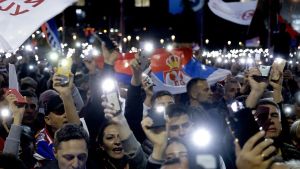

The distance between the two results is the measure of the shift. A lead of nearly twenty points is not a narrow upset. It is a transfer of parliamentary power from the party that has governed the political landscape for years to a list that, not long ago, did not exist as a national electoral force. Crossing the threshold of 126 seats means the winners would not merely enter the assembly as the largest group. They would hold the numbers to choose a government and set the legislative agenda.
The speed of that rise is as striking as the margin. The Student List came out of campus and street protest, then converted that mobilization into a nationalist, sovereignist political project and, on these numbers, into a governing majority. Few movements in recent Serbian politics have moved from protest to a parliamentary majority in a single electoral cycle.
For the Serbian Progressive Party, 32.3 percent would mark a sharp contraction after more than a decade in which it defined the terms of national politics. For the Student List, 52 percent and a projected 135 to 140 mandates would mark arrival: not a symbolic foothold, but the authority to govern.
What that authority is used for remains the open question. A majority can form a cabinet. It does not, by itself, settle the issues the campaign turned into a referendum — how power is exercised, how institutions answer to the public, and whether a movement born in protest can become a durable government. Those arguments now move from the street into the National Assembly.
If the preliminary results hold, the political cycle centered on Vučić has been interrupted, and a student list that emerged from protest would hold the mandate to form Serbia’s next government. 
By Roberto Casseli

Related Posts