Scroll Top

The Putin-Trump-Xi summit is not aimed at discussions about Ukraine, but rather at signaling a return to great-power politics

Let’s turn to the subject of Ukraine. Brussels has once again come up with some “excellent” ideas—for the rest of the world, that is, not for the European Union. This has become something of a pattern in recent years. The European Commission states that the European Union has no intention of resuming Russian gas imports, even as part of a potential peace agreement.
Washington reportedly proposed resuming transit through Ukraine, which would allow Europe to gain an economic benefit from the resolution of the conflict; however, for Brussels, the issue appears to be a matter of sanctions and energy security. And what is the message here? “We don’t want to go back to importing cheap gas; we prefer to stick with expensive gas.” A truly “wonderful” form of energy security! Especially when you’re short on cash—it’s just great to have to pay even more.
There’s no point in dwelling on this further, as we have already addressed such absurd statements many times—dozens of times, in fact—on this show. Kaja Kallas has also weighed in, suggesting that the 22nd sanctions package should include new restrictions on Russian oil—this, despite the energy crisis we are currently facing. And, as if that weren’t enough, she even took a jab at the United States—the very country we currently rely on for energy imports, given that we no longer have access to Russia and the situation in the Middle East has become so complex.
Kaja Kallas claims that, for nearly two years, American negotiators have been trying to push Ukraine toward capitulation—alleging that this is why Washington halted the exchange of intelligence, and why Trump signed a waiver preventing the implementation of the Lindsey Graham-backed legislation on sanctions against Russia. Kaja Kallas asserts that the Americans are pressuring Kyiv to accept the terms imposed by Putin. To quote her: “The reason Ukraine has not capitulated to Putin’s terms is that Europe has supported Ukraine; European partners must remain at the negotiating table to counterbalance the positions taken by the White House.”

So, in effect, we didn’t actually need the Americans—we could have supported Ukraine without them. That is what we are meant to understand from Kaja Kallas’s remarks. Yet, the situation is complex: the Americans are involved, but they have repeatedly attempted to withdraw and have tried to force the Ukrainians to capitulate.
Now, I’m not sure what to make of this idea of ​​capitulation. Which is better: losing some territory, or continuing to lose lives? It depends on your perspective, how close you live to Ukraine, whether you truly see the effects on Ukrainian society—and, ultimately, whether you even care. As for Kaja Kallas, there’s not much left to say; we’ve grown accustomed to such statements. In my view, however, they are, to put it mildly, ridiculous.
Not wanting to leave Kaja Kallas to hold the fort alone this week, Friedrich Merz also weighed in, stating—and I quote: “My greatest concern is not our economy, but Russia’s impact on our society.” Unbelievable! First of all, as a German leader, Merz ought to be far more concerned about the economy—an area where we can see tangible results. The influence of other states on one’s own society cannot be measured with the same clarity, which makes it impossible for Merz to offer any concrete solutions. What else can be said about this statement from Merz? It only goes to show that he is, politically speaking, already down and out—it hardly matters what he says anymore—yet he continues to come up with all sorts of notions that only serve to further alienate his own electorate.
The Brussels summit took place last week. I commented on the first day during this broadcast, but the following day—last Friday—Kyiv requested an additional 70 billion euros, on top of the 90-billion-euro loan that the European Union has already approved for the 2026–2027 period. Zelensky reportedly stated that the war would cost Ukraine 155 billion euros next year and that European nations need to find additional funds. Slovakia’s Fico said he would not approve of such a thing. That seems reasonable, in a way. If your own country’s economy is struggling, you cannot commit to supporting another country indefinitely—at least, that’s my take. Furthermore, Fico warned that it would be dangerous to make the financing of Ukraine contingent upon negotiations regarding the European Union’s next long-term budget. He added—quite reasonably, it seems—that Slovakia is willing to support Ukraine in areas like education, road infrastructure, and energy, but not through new loans for the war.
However, during the same summit, Zelensky chose to issue a threat toward Europe—at least, that is how I interpret it. If you are listening on YouTube or Facebook, feel free to share in the comments if you understand it differently. But here is what Zelensky said: “Russia is killing us; they do not want to stop. What will happen if we fall? I don’t know. Twenty million Ukrainians will likely come to Europe.”
So, at a summit where the issue of immigration—and all its associated challenges, including economic and social ones—is being discussed extensively, Zelenskyy hit the nail on the head. He touched upon the very point that troubles European leaders and where progressives within the European Union are losing momentum: the issue of immigration. He issued a warning: if Ukraine loses—if it fails to survive this war and does not receive unlimited support from the European Union—then another 20 million Ukrainians will head toward Europe.
I find it hard to imagine the figure being quite that high—it would be shocking, especially on top of the many, many millions who have already arrived. Yet, Zelenskyy is indeed correct. Ukraine finds itself in a very, very complex situation. From an economic perspective—which, alongside various social issues, is the primary concern for people—Ukraine is currently the International Monetary Fund’s largest debtor in Europe and its second-largest globally. According to IMF data from three weeks ago, Ukraine’s debt to the Fund stands at approximately $14.5 billion, representing 8.7% of the IMF’s total international lending—a staggering sum. The average interest rate charged by the IMF is 3.72%, but once the Fund’s additional surcharges are factored in, the actual annual cost reaches somewhere between 5% and 7%.
Just imagine the extremely, extremely high costs involved. Given the current demographic and economic crises, one might expect Zelensky and the Ukrainians to focus on peace. While Zelensky does touch upon peace in some of his statements, this week, in particular, he has focused on remarks directed at Trump—expressing a sense of betrayal by Donald Trump, citing both a deal between Russia and the U.S. regarding diesel fuel and pressure from the White House to halt attacks on Russian oil refineries.
Nevertheless, there have been certain developments that point toward progress—or at least a move—in the direction of a peace agreement between Russia and Ukraine, which will inevitably have to come about at some point.
First, there was the meeting between Steve Witkoff and Vladimir Putin. Steve Witkoff serves as a special envoy for the U.S. President—that is his official title. Notably, he did not arrive with Jared Kushner this time, as is usually the case; it is quite interesting that Kushner was not present.
What was tangibly decided as a result of this meeting? Simply that Stephen Hubbard—an American from Michigan who was arrested by the Russian military in April 2022 and subsequently imprisoned on allegations of being a mercenary—has been released and is now returning to the U.S. That is the one concrete outcome we know of. Donald Trump initially claimed that he did not have to offer anything in return; however, in subsequent interviews, he acknowledged that these agreements were the reason he decided to block the implementation of the “Lindsey Graham sanctions”—which would have imposed a 500% tariff on Russian oil—thereby keeping the door open for negotiations.
Furthermore, according to reports surfacing in the press, the Trump administration has proposed to European leaders the unfreezing of certain Russian assets, which could potentially be placed under Washington’s control as part of a future peace agreement. This suggests that we have reached a point where the Russians actually trust the U.S. regarding financial matters—a highly significant development!
At the same time, it appears the Americans are also considering easing sanctions on tankers belonging to Russia’s “shadow fleet,” with the aim of reducing maritime transport costs.
But yes, that was the main takeaway from the summit, in the short term.
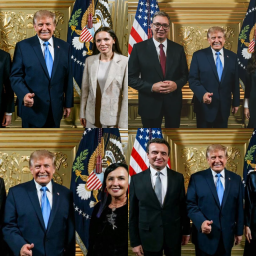
Furthermore, what is interesting is that, immediately after meeting with Steve Witkoff, Vladimir Putin also met with Li Qiang—the Chinese Premier, and the second most important figure in the Chinese state—who happened to be in Russia as well. It was revealed to me that same day that China has already begun preparations for a trilateral meeting between the leaders of Russia, the U.S., and China—namely Putin, Trump, and Xi—to take place in Shenzhen in less than a month. Discussions regarding the resolution of the war in Ukraine are also set to begin there.
The Ukrainians were upset, arguing that they, too, should be invited and that the current arrangement is not right. Yet, this trilateral meeting is highly significant, as it brings to fruition what I have been predicting for the past two years: a return to great-power politics and the division of the world into spheres of influence.
This is what we can gather from this. Even though Zelensky and European leaders have protested, there is nothing they can do. Ultimately, these are the leaders of today’s greatest powers, and only their pragmatism matters. They cannot halt these negotiations by invoking moral principles—ideals that are frequently discussed in Europe, yet not even consistently upheld by the Europeans themselves.
From Saint Petersburg, Witkoff traveled directly to Oslo, Norway, where he met with Zelensky. We are finally seeing a shift in Zelensky’s stance; he stated that, in his view, it is possible to discuss freezing military operations along the current front line—implying he might accept the loss of up to a quarter of Ukraine’s territory if it would bring an end to the war. This is highly significant! It has been a long time since we last saw an interview in which Zelensky openly discussed the possibility of making territorial concessions. Although he has done so in the past, he has refrained from such statements over the last year, which makes this development particularly noteworthy.
He further added that establishing a ceasefire is a prerequisite for initiating this process, and that he would demand robust security guarantees from the Americans and the Europeans. Regardless, this represents a significant step.
Putin has agreed to resume peace negotiations with Ukraine—with American mediation—as early as next month, while Zelensky has stated that the talks should take place as soon as possible. This is only natural, given that winter is approaching and there is a need to reassure the Ukrainian population.
But yes, we can see that there is, at last, some movement toward peace. For about a year, we haven’t seen such reactions or such dynamism in the negotiations aimed at ending this war. God willing! I truly hope something comes of this. We cannot be certain of anything, but this is the key takeaway: the three leaders are meeting to discuss more than just Ukraine. In fact, they wouldn’t even need to meet for that—everything could be handled remotely. Rest assured, they maintain numerous unofficial channels of communication, so a meeting of this kind isn’t strictly necessary. Rather, by holding this meeting, they are signaling that, from now on, the future is being shaped by the great powers—without the need for negotiations involving smaller states.
By Daria Gusa
www.solidnews.ro

Related Posts