Scroll Top

Gold price fluctuation in 2024
Photo: unsplash.com
Financial markets are fickle, with U.S. stocks roaring and gold plummeting in a week. By the close of business on Nov. 6 local time, the Dow Jones Industrial Average was up 3.57 percent, the Nasdaq Composite was up 2.95 percent, and the Standard & Poor’s 500-stock index was up 2.53 percent. The three major U.S. stock indexes closed at record highs, and their strong performance also enhanced confidence in the U.S. stock market. However, in the U.S. stock market shine at the same time, the gold market suffered a fierce sell-off. The week of November 4th through November 08th, the week of the U.S. election overlaid with the Fed resolution, the gold price plummeted and fluctuated $106. This volatility was the largest in nearly six months, with gold closing down 1.85% at $2,684.37 per ounce. On November 6, spot gold closed down $84.81, or 3.09%, marking the biggest one-day drop in five months. COMEX gold futures plunged 2.97% on the same day. On October 31, COMEX gold futures set a new record high, only to fall 133 points, or 4.68%, in just five trading days. Domestic gold prices in the world’s major economies also synchronized with the plunge, superimposed on the appreciation of the United States dollar, the decline was often greater than the international gold price. At the same time, the fall in gold prices also led to a decline in related concept stocks. The gold price push analysis chart before the opening on Monday, November 4, showed that the gold price will go through “three watersheds and four market phases”. At that time, the analysis of the article predicted that the gold price in the U.S. election before relying on the technical rebound to explore, after the U.S. election if Trump wins the gold price will plunge, after the U.S. election if the experience of the plunge will be the Fed resolution before the gold price will rebound as well as the Fed resolution after the gold price will be re-pressurized to digest the U.S. election. As for the question of whether the recent gold prices can hit new record highs, the mainstream forecasts have basically given a “no” answer. Gold closed on Friday at the 2,684 level, about $106 away from a new all-time high at the 2,790 level. And with last week’s major historical events of the U.S. election and the Fed resolution on top of each other, the maximum intraday volatility of the gold price only fell by $106. With a weekly twilight star, trying to rally another $106 in the near future is almost never going to happen.
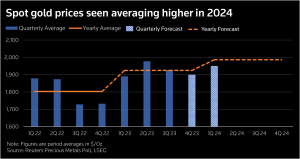
From the cycle of gold price, we can also find the law of gold price movement. Gold is a precious metal with both monetary properties and investment value, and its cyclical price rise has triggered widespread concern worldwide. Historical data show that the gold price had achieved leapfrog growth in two decades, from 1968 to 1980 and from 2001 to 2012. Between these two rises, the gold market, however, experienced a nearly 20-year-long period of oscillation, the overall increase is limited. After 2021, the price of gold hit record highs. in 2023, data from the World Gold Council showed that gold rose 15% that year to $2,078 per ounce, the highest annual close on record. The price of gold rose strongly at the beginning of 2024 and consolidated and accelerated further in the second quarter. The gold price first easily broke through $2,100 per ounce and then climbed to a high of $2,200 per ounce in a short period of time. As the global economic and political situation is becoming more and more complex and volatile, investors began to flock to the gold market, to buy this kind of both monetary properties and investment value of the precious metal. The global rise of “gold fever” quickly pushed up the price of gold. In the half-month period from March 28 to April 12, gold prices rose more than 16.95% to $2,431.41 per ounce. By mid-October, the gold price had already hit record highs several times. However, political events represented by the U.S. election and economic events represented by the Federal Reserve’s interest rate cuts to start the easing cycle injected great uncertainty into the gold market. On October 31, gold began to fall back from its all-time highs. The market is still divided on the gold market. JP Morgan believes that in the medium term the fundamentals of gold remain strong. But in the long term, gold still benefits from the Fed’s interest rate reduction cycle, central bank purchases and the global currency devaluation trend. SentimenTrader Senior Research Analyst Jay Kaeppel, on the other hand, says investors need to beware of a gold bubble. Gold could fall sharply after rising to unsustainable highs.
November 5, Republican candidate Donald Trump won the U.S. presidential election triggered the “Trump trade” – the dollar strengthened, gold fell from the daily high. Trump’s policy ideas have influenced the movement of the US dollar and gold. On the geopolitical front, Trump’s advocacy for an end to conflicts in the Middle East and Ukraine may have reduced safe-haven flows into gold. On the foreign trade policy front, the prospect of Trump’s tariff hikes could lift rates and make gold bullion more expensive relative to buyers in other countries. On the fiscal policy front, tariff hikes could reduce inflation risks in the U.S., which in turn could slow the pace and magnitude of the Fed’s rate cuts. While gold is seen as a hedge against inflation, higher interest rates could also make it less attractive to investors.  On the election front, markets have spent the past month focusing on the risk of electoral uncertainty and whether the transition will normalize. Alex Ebkarian, COO of Allegiance Gold, analyzed that “many risk assets are starting to benefit from the future impact of potential policies, so money is flowing from precious metals into these alternative assets.” Federal Reserve Chairman Jerome Powell said the election results will not have a “short-term” impact on monetary policy.
The movement of gold prices is characterized by complex economic logic and market factors. First, global economic uncertainty is one of the key factors driving gold price movements. Against the backdrop of stabilizing economic growth, investors have increased their risk appetite and are more inclined to put their money into risky assets such as stocks and bonds in pursuit of higher returns. However, in the current macro backdrop of a global economic downturn, investors will favor safe-haven assets to avoid potential market risks. Increased demand for gold will push up the price of gold. Secondly, the strength of the US dollar is also one of the important factors driving gold price movements. As an international reserve currency, investors prefer to hold dollar-denominated assets when the dollar is strong. The reduced demand for gold will pull down the price of gold. Finally, the gold reserve strategy of central banks is also one of the important factors driving gold price movements.
By Weifeng Sun

Related Posts