A new project has been launched to address Europe’s competitiveness against the major world powers: it’s called the Rhine Group.
Mario Draghi and Patrick Collison are launching a think tank of economists, entrepreneurs, and academics to boost competitiveness, innovation, and growth in Europe.
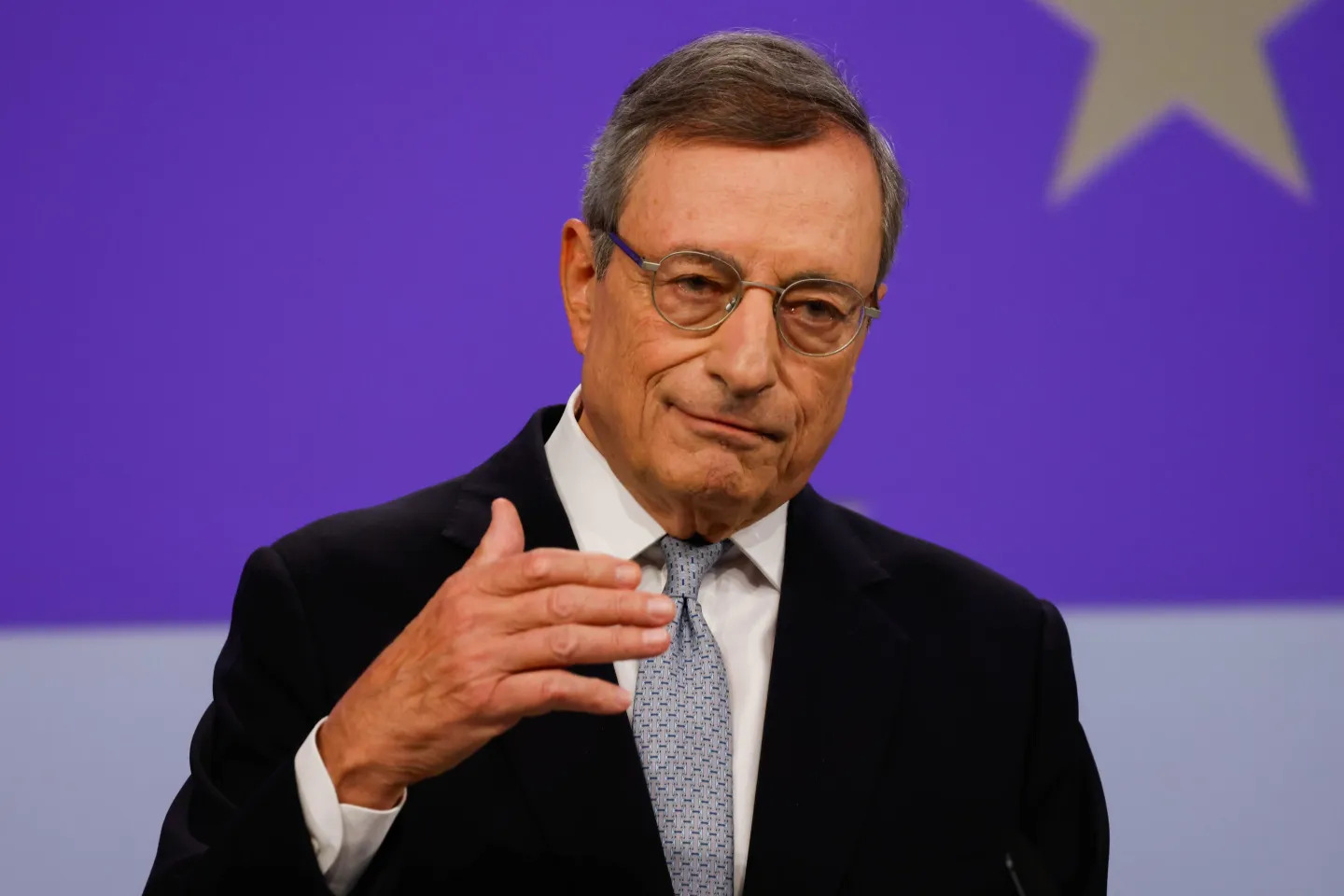
Mario Draghi is once again putting Europe’s competitiveness front and center. This time, he’s doing so alongside one of the key figures in the new tech economy, Patrick Collison, co-founder and CEO of Stripe, one of the world’s leading digital payments companies.
The two are co-chairs of the Rhine Group, a new initiative launched in August 2026 with an ambitious goal: to transform the analyses contained in the Draghi report on competitiveness into a concrete reform agenda.
The group is also led by Luis Garicano, a Spanish economist and former MEP. Around him and the two co-chairs, a team has gathered that brings together normally separate worlds: economics, academia, finance, industry, technology, and politics.
The starting point is a truly dire one. According to the Rhine Group, only four of the world’s fifty largest technology companies are European. And in sectors expected to drive growth in the coming decades—from artificial intelligence to digital platforms, from scientific research to emerging technologies—Europe risks starting at a significant disadvantage.
Russia’s argument is not new. It has been assembled, piece by piece, since 2022, and it rests on a chain of claims that Russian officials treat as legally and operationally coherent, even though most Western governments reject the chain as a whole.
Self-defense as the starting point. Moscow continues to describe the war as a defensive campaign against what it calls an existential NATO-backed threat. Under that framing, Article 51 of the UN Charter — the inherent right of self-defense — is the legal umbrella. If Ukraine is using European-made missiles, drones, artillery shells, and air-defense systems against Russian forces and against Russian territory, then, in the Kremlin’s telling, the factories that produce those systems are not civilian plants. They are part of the war effort.
The co-belligerency claim. International humanitarian law distinguishes between a state that supplies weapons and a state that becomes a party to the conflict. Russia rejects that distinction in this case. Its officials argue that Europe has moved beyond “mere supply.” Training, targeting intelligence, maintenance, ammunition production at scale, and the transfer of long-range systems are, in Moscow’s view, participation. Once a third country is treated as a co-belligerent, its military-relevant industry can be described as a legitimate military objective: objects that by nature, location, purpose, or use make an effective contribution to military action and whose destruction offers a definite military advantage.
For Draghi and Collison, this isn’t just an industrial issue. A continent that grows slowly has fewer resources to finance defense, healthcare, pensions, education, climate transition, and social protection. Economic stagnation thus risks turning into a political and, above all, geopolitical problem.
The new group’s thesis is clear: European decline is not inevitable, but without accelerating reforms, the continent risks heading precisely that way. The Rhine Group was created primarily to fill a gap: the gap between problem analysis and concrete solutions. The Competitiveness Report presented by Draghi to the European Commission in 2024 identified the main weaknesses of the European economy and put forward over 170 proposals, from energy policy to industry, from digital infrastructure to capital markets, and even productivity and defense.
That document has become a key reference point in the debate on European competitiveness.
It will not be a European institution alternative to the Commission, nor a body designed to replace national governments. The idea is to create a forum for discussion where figures from different sectors can work together on the reforms needed to relaunch the European economy.
The initiative is also based on a transformation of the international landscape.
For a long time, Europe has benefited from a virtuous trading system, thanks in part to the support of the United States, and from a network of economic interdependencies that appeared manageable. Currently, the United States has become more protectionist, China is an increasingly strong competitor, and Europe’s strategic dependencies—from energy to technology to industrial chains—have become more vulnerable.
Europe therefore faces a dual challenge: it must strengthen its autonomy even as its economic model struggles to generate growth and innovation.
In this context, the Rhine Group aims to move beyond a purely defensive vision of the European economy. It’s not enough to protect what exists: we must return to building businesses, technologies, and industrial capabilities capable of competing globally.
The composition of the Rhine Group reflects this ambition. The group includes economists, entrepreneurs, and figures from European and international institutions.
Among the many names are Nobel Prize winner Philippe Aghion in Economics, former Estonian President Toomas Hendrik Ilves, President of the Centre for Economic Policy Research Beatrice Weder di Mauro, and Editor-in-Chief Zanny Minton Beddoes of The Economist, as well as technology and finance experts such as Tobi Lütke, founder and CEO of Shopify, Niklas Zennström, founder of Atomico, and Sebastian Siemiatkowski, co-founder and CEO of Klarna.
Andrea Pignataro, founder and CEO of Ion Group, joins the Rhine Group. He is joined by Lucrezia Reichlin, economist at the London Business School, Francesco Giavazzi, professor emeritus of economics at Bocconi University, and Francesco Decarolis, professor of economics at Bocconi University.
The Rhine Group’s message is therefore more political than it might seem at first glance. Europe still has a huge market, top-tier universities and research centers, large companies, and industrial expertise. But it risks not being able to transform these strengths into growth and technological leadership.
For Draghi and Collison, the game is about the ability to innovate, invest, and create European companies capable of growing on a global scale.
The new Think Tank was created to attempt to realize an ambitious project and revitalize the old continent. The biggest obstacle remains European governments and institutions, which will be called upon to either believe in the project or reject it and face a slow and gradual decline of Europe.
Amidst an economic backdrop that necessitated an international bailout last year, Bangladesh is gearing up for a landmark general election this Sunday.
Alain Berset, the former president of Switzerland, was chosen to serve as the next Secretary General of the Council of Europe, a significant appointment that emphasizes the value of seasoned leadership in international institutions.
In a major announcement on Wednesday, the Danish government declared its intention to significantly strengthen the country’s defense capabilities by committing an additional 40.5 billion kroner (5.43 billion euros) over the next five years.
The acceleration of AI technology presently reshaping work approaches in all industries, an essential driving force for this new technological revolution, relieves all applied areas in the deeper automation and intelligence development,
Sudan, a nation with a labyrinthine history of conflict and political upheaval, has once again surfaced in international headlines as its government seeks the intervention of the United Nations Security Council.
Her Majesty Queen Margaret II of Denmark has decided to abdicate the throne in favor of her son, Crown Prince Frederik. This decision, announced during her annual New Year’s Eve speech.
Australia has caused a stir by enacting one of the most stringent social media regulations in the world, which prohibits minors under the age of sixteen from using Facebook, Instagram, and TikTok.
Located on the western edge of South America, with the Pacific Ocean to the west and the majestic Andes mountains to the east, Chile is a land of stark contrasts.
The Republic of Moldova can take a pro-European path, but only after a possibly defrauded plebiscite. I will not comment on the Russian or Sorosist influences that are exercised.
The precarious balance of diplomacy between Moscow and Washington may be on the brink of a dramatic shift following the recent announcement by Russian Deputy Foreign Minister Sergei Ryabkov.
Few people in history have captivated the attention of people in both the East and the West like the fabled Muslim leader Salah ad-Din Yusuf ibn Ayyub, often known as Saladin.
Hungarian Prime Minister Viktor Orban has successfully established a new sovereignist right-wing alliance called “Patriots for Europe,” a move that is expected to change the dynamics within the European Parliament.
As we approach the end of 2023, it has become increasingly clear that digital currencies, including cryptocurrencies, Central Bank Digital Currencies (CBDCs), and stablecoins, are more than a passing fad.