The Birth of a Nation, on Paper: Bougainville’s Long Road to Becoming the World’s Newest Country

For most of the world, Bougainville is at best a name on a map, a green scatter of islands in the South Pacific east of the Papua New Guinea mainland. For its roughly 300,000 people, it is something far heavier: a homeland that has fought, bled and voted for the right to govern itself, and that now stands closer than ever to becoming the newest sovereign state on earth. Its leaders have named the day, September 1, 2027. Whether that day produces a country, or merely another chapter in a long story of deferred hope, is one of the most quietly consequential questions in the Pacific, and almost no one outside the region is watching it.
The case for Bougainville’s independence rests on a mandate of extraordinary clarity. In late 2019, in a referendum that was transparent, internationally observed and undisputed, 97.7 percent of Bougainvilleans voted for independence over the alternative of greater autonomy. Few political questions anywhere are ever settled so decisively. Yet the vote carried a fateful asterisk: it was non-binding. Under the 2001 Bougainville Peace Agreement that made it possible, the final authority over Bougainville’s political status rests not with Bougainville but with the national parliament of Papua New Guinea in Port Moresby. A people voted almost unanimously to leave, and then had to ask permission. That single structural fact explains nearly everything about the slow, grinding drama that has followed.
To understand why the stakes run so deep, one has to understand the blood behind the ballot. Bougainville is ethnically and culturally distinct from mainland Papua New Guinea, its people historically closer to the neighboring Solomon Islands than to distant Port Moresby, and long feeling marginalized within the state they were placed in. That grievance fused with fury over the Panguna mine, a vast copper and gold operation that once generated more than 40 percent of Papua New Guinea’s exports while leaving Bougainvilleans with environmental devastation and little of the wealth. In 1988 that anger exploded into a secessionist uprising, and the decade-long civil war that followed, fought between Bougainville rebels, PNG security forces and foreign mercenaries, killed as many as 20,000 people, a staggering toll for so small a population. The 2001 peace agreement that ended the fighting promised autonomy and the referendum that would eventually deliver the 2019 result. Independence, for Bougainville, is not an abstraction. It is the promised reward for a war survived and a peace kept.
The path from that referendum to actual statehood was supposed to be a negotiation, and in 2021 the two governments agreed on a process meant to culminate in a declaration of independence by 2027. But the years since have revealed how much easier it is to vote for a country than to build one, and the timeline has already slipped once. Bougainville originally aimed for September 1, 2025, a date that came and went. Its president, Ishmael Toroama, a former rebel commander who now frames the independence date as both a political commitment and a moral promise to those who died, has reset the target to September 1, 2027. On present evidence, even that date is far from secure.
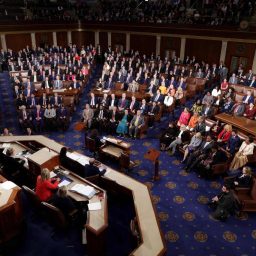
 PNG Opposition Leader James Nomane is calling for MPs to take more time to study Bougainville’s 2019 independence referendum before deciding whether to ratify the 97.7 per cent vote.
The central obstacle sits in Port Moresby, and it is not mere obstruction. Papua New Guinea’s national government, led by Prime Minister James Marape, has kept its position deliberately ambiguous, insisting that Bougainville’s future can only be decided through the constitutional processes laid down in the peace agreement, which means ratification by a PNG parliament that has shown no urgency to grant it. Behind the procedural caution lies a genuine fear, both of the precedent a peaceful secession would set for other restive parts of a famously fragmented country, and of the practical consequences of cutting loose a territory that cannot yet pay its own way. In mid-2026, Port Moresby made its counter-position concrete, proposing a three-stage pathway that would push full independence out to 2030 rather than 2027, a direct challenge to Toroama’s date and a sign of how wide the gap between the two governments remains.
That gap is not only about politics. It is about money, and here the honest assessment is sobering. A state must be able to sustain itself, and Bougainville, by the frank acknowledgment of even sympathetic analysts, has very low levels of socio-economic development and cannot currently fund anything close to its own budget. The obvious answer to that problem is also the source of its original trauma: Panguna. The shuttered mine still holds an estimated five million tonnes of copper and 19 million ounces of gold, worth billions of dollars, and reopening it is widely seen as the key to economic viability. An exploration licence was granted in early 2026, and Toroama speaks of significant progress and abundant opportunity for investment.
But reopening the very mine whose grievances started a war that killed 20,000 people is a delicate and dangerous undertaking, and no firm date for resuming operations has been set. Bougainville’s independence may ultimately depend on its willingness to reopen the wound that made independence necessary in the first place.
There is, finally, a wider Pacific dimension that has begun to draw the region’s institutions into what was long treated as a purely internal PNG affair. The Pacific Islands Forum and the Melanesian Spearhead Group, the region’s main intergovernmental bodies, have signalled a readiness to take a more active role in helping resolve the dispute, and the Melanesian Spearhead Group in particular has recalled that one of its founding objectives was to assist those yet to attain independence.
Symbolically, recent talks between the two sides were held at Burnham Military Camp near Christchurch in New Zealand, the very site of the 1997 negotiations that helped end the civil war, a reminder that the region has a long institutional memory of this conflict and a stake in seeing it end well. Bougainville’s leaders have also raised the possibility of internationalising their case, a move that would test whether the Pacific family treats self-determination as a principle or an inconvenience.
What Bougainville reveals, in the end, is how much more there is to nationhood than a flag, a border or even an overwhelming vote. Independence, as the island’s own experience is teaching it, is a matter of recognition, capacity and participation, of being acknowledged by the state you are leaving, of being able to fund and govern yourself, and of being admitted into the community of nations.
Bougainville has the mandate. It has the history, the distinct identity, the moral claim earned in a brutal war. What it does not yet have is the consent of Port Moresby, the economic foundation to stand alone, or the guarantee of international recognition that would make a declaration more than words. September 1, 2027 remains the date its people are working toward, the day they hope to become the world’s newest country.
Whether it arrives on schedule, slips to 2030, or dissolves into further negotiation, Bougainville has already demonstrated something the rest of the world rarely pauses to consider: that the birth of a nation is less a moment than a long, uncertain labour, and that a people can vote for a country and still have to wait years to be allowed to have one.
By I. Constantin