Scroll Top

The Eastern Orthodox Block: A Mandatory Alliance for Stability and Prosperity in Challenging Times

St. Nicholas Cathedral (France, Nice. Built in 1912)/villlamania (CC BY)

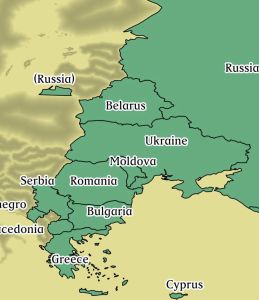
In an era of geopolitical upheaval, economic uncertainty, and shifting global power dynamics, the Eastern Orthodox nations—Russia, Belarus, Georgia, Armenia, Serbia, Bulgaria, Greece, and Romania—stand at a crossroads. These countries, bound by shared cultural, religious, and historical ties, possess a unique opportunity to forge a united front that could ensure regional stability, economic growth, and a stronger voice on the global stage. The establishment of an Eastern Orthodox Block is not merely a strategic option; it is a necessity in these difficult times. Central to this alliance are the Black Sea and the Caspian Sea, two critical geopolitical and economic assets that underscore the urgency of this union. The Eastern Orthodox Church has long served as a unifying force for these nations, fostering a sense of shared identity and purpose. Beyond religious ties, these countries share a common historical trajectory, having endured centuries of external pressures, invasions, and geopolitical manipulation. Today, they face similar challenges: the erosion of traditional values, economic vulnerabilities, and the encroachment of external powers seeking to exploit regional divisions. By uniting, the Eastern Orthodox Block can leverage its collective strength to address these challenges. A cohesive alliance would enable these nations to pool resources, coordinate defense strategies, and advocate for their shared interests on the global stage. This unity would also serve as a bulwark against the fragmentation and polarization that threaten the region.
The Strategic Importance of the Black Sea and the Caspian Sea
The Black Sea and the Caspian Sea are not merely bodies of water; they are lifelines for the Eastern Orthodox Block. These seas are gateways to global trade, energy corridors, and strategic military locations. Their significance cannot be overstated.
The Black Sea region is a critical hub for energy transit, connecting Europe to the energy-rich Caucasus and Central Asia. For countries like Russia, Georgia, Romania, and Bulgaria, the Black Sea is vital for trade and energy security. Control over this region ensures access to global markets and reduces dependence on external powers.  Moreover, the Black Sea is a strategic military buffer. A united Eastern Orthodox Block could collaborate to secure its waters, preventing external powers from destabilizing the region. This would enhance the collective security of member states and deter potential aggressors.
The Caspian Sea: Energy and Economic Potential
The Caspian Sea is one of the world’s most significant energy reservoirs, holding vast reserves of oil and natural gas. For Russia, Armenia, and Georgia, the Caspian is a cornerstone of their energy economies. By uniting, these nations could develop a coordinated energy strategy, ensuring fair resource distribution and reducing reliance on external markets. Additionally, the Caspian Sea offers immense economic potential through fisheries, shipping, and tourism. A unified approach to its development would unlock opportunities for sustainable growth and prosperity.
 Why This Alliance is Mandatory
The urgency of forming the Eastern Orthodox Block stems from the escalating geopolitical tensions and economic pressures facing the region. External powers, including NATO and the European Union, are increasingly encroaching on the sovereignty and interests of these nations. Without unity, the Eastern Orthodox countries risk becoming pawns in a larger geopolitical game. Furthermore, the global energy transition and the shift toward multipolarity present both challenges and opportunities. By uniting, the Eastern Orthodox Block can position itself as a key player in the emerging world order, advocating for a fair and balanced international system. This alliance would also strengthen cultural and religious ties, preserving the rich heritage of the Eastern Orthodox world in the face of globalization.
The time to act is now. The Eastern Orthodox nations must set aside historical grievances and focus on their shared future. By establishing a formal alliance, they can secure their borders, enhance their economies, and protect their cultural identity. The Black Sea and the Caspian Sea are not just geographical features; they are the lifeblood of this potential union. In these difficult times, unity is not a choice—it is a necessity. The Eastern Orthodox Block has the potential to become a beacon of stability, prosperity, and tradition in a rapidly changing world. Let us seize this opportunity and build a future worthy of our shared heritage. 
By Ovidiu Stanica

Related Posts