Scroll Top

Ukraine is the main beneficiary of Romanian money from the UE-SAFE program

The pro-European administration in Bucharest, brought to power by blocking a patriotic candidate from coming to power – a constitutional institution invalidating an unprecedented electoral process in progress – is willing to make any sacrifice imposed by Brussels when it comes to the Ukrainian cause. No one has seriously investigated the cash flow through Romania to Kyiv, even though at least two treasury car drivers admitted in an audio recording that they carried bags across the border between the two states. Many analysts in Romania, supporters of Donald Trump, announced on various media – repeatedly – that the FBI will come to investigate „the money per metre” of Americans taken through Mihail Kogălniceanu Airport to the destination of Kyiv, a situation that has not been confirmed. 
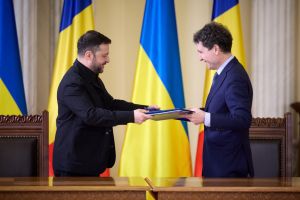
Although the aid given by Romania to Ukraine, apart from the international aid, is kept secret, sources of power claim that over 20 billion euros have taken the path of the broken pockets of Zelensky’s people. Few media outlets in the West have reported corruption by the Zelensky administration.
„The outstretched hand that doesn’t tell a story doesn’t get alms! Be professional, what the fuck!”, says the main actor in Nae Caranfil’s movie, Philanthropy.
And Zelensky came to Bucharest to tell the story of resistance against Russian invaders, begging for new alms, but this time much more consistent. Money, credits, and factories for his oligarchs. Yes, not only Russia has oligarchs, but Ukraine as well.
Few people know that Romania has taken the second-largest slice of the SAFE (Security Action for Europe) cake of the European Union, money lent to states for military endowment and infrastructure development: 17 billion euros, whose destination is partially known.
Although a member of the party that provides the prime minister of Romania, Nicoleta Pauliuc, president of the Romanian Senate’s defence, public order and national security committee, publicly raised concerns about how the SAFE funds will turn into concrete benefits for the Romanian industry. „Of every euro spent through SAFE, how much actually remains in Romania?”, asked Pauliuc in recent discussions about defense financing.
Romanian unions fear that, although the Army staff has developed 21 strategic projects validated by the European Commission, the money will be destined for businesses from which Romania will not even recover its investment, as has happened before with the PUMA helicopters, with Iveco vehicles painted only in Romania, with the Piranha armored vehicles drowned in the Danube, or with the purchase of Abrams tanks, which no one in the world wants anymore because new fronts use missiles, drones, satellites, and cyberattacks.
To top it off corruption, in 2024, Romania, in the same month as Poland, purchased 32 F-35 Lightning II fifth-generation aircraft for the sum of 6.5 billion dollars, while the Warsaw executive paid Lockheed Martin 4.2 billion dollars for the same number of planes, but also with an offset agreement—that is, the production of components in the country.
Hundreds of camouflaged army vehicles pass through Romania so that citizens do not know what equipment is carried in them. Due to a lack of information, there are all kinds of suspicions.
The government in Bucharest triumphantly presented the granting of the 17 billion euros without telling the population that the money is given by the European Commission as a loan for 45 years, with ten years of grace. The interest rate is 3% per year. Starting next year, interest payments will flow, at about 450 million euros per year.
4.2 billion euros will be invested in the highways connecting Romania with Ukraine and Moldova. The obligation is for them to be completed by 2030.
For the most part, Romanians believe that they are made to facilitate the transport of heavy machinery to Ukraine.
Zelensky’s visit to Bucharest is starting to pay off. 
The company Interpipe, owned by the Ukrainian oligarch Viktor Pinchuk acquired AMTP Roman (formerly Petrotub), which produces seamless pipes, from the global giant ArcelorMittal. Last year, another Ukrainian oligarch, Rinat Ahmetov, also bought AMTP Iasi.
Ahmetov seems willing to buy the largest steel plant in Galati, Liberty, bankrupted by Gupta, Mittal’s cousin, the Indian industrialist who has almost a monopoly in Europe. Gupta left only debts to the state of over 300 million euros.
For the Galati plant, the Romanian builder Dorinel Umbrarescu also signed up for the auction, but will probably drop out of the race because “Romanians are foreigners in their country,” writes George Scarlat.
Sources of power say the government will wipe out debt if any Ukrainian oligarch plans to take the compound, once one of the largest in Europe, which in 1989 had 35,000 metallurgists.
Representatives of the government in Bucharest claim that the state is powerless in private transactions. This is totally false. Any foreign investment of more than 2 million dollars can be made only with the approval of the government, according to an amended law following Regulation (EU) 2019/452 of the European Parliament and of the Council of 19 March 2019, through which foreign investments of more than 2 million dollars must be approved by the government, lest the Russians, the Chinese, Hezbollah investors, or whoever else the author writes about.
After an unexpected visit by Prime Minister Ilie Bolojan to Germany, Rheinmetall AG announced that it was coming to open the most modern powder factory in the world, although Romania was the leader in this segment in the last century. Half of the investment money is from European funds. It is not said, but it is suspected from what loan.
If the prime minister is approved by Berlin, the president of Romania is approved by Paris. The French industry is also watching the Romanian budget, having prepared contracts for delivery to the Greek calendars of Mistral missiles and Airbus helicopters.
A former director of Automecanica Moreni recently admitted to us that he had discussions with large companies in the US, Turkey, and the UK for the production of armored vehicles, but they were all demanding firm orders from the state.
Ukraine seems to have stolen the start of the competition for the money of Romanians borrowed for decades. Ursula von der Leyen uses Zelenskyy as a pretext to blow money into the air.
“What does it mean to be an asshole? Give your neighbor money to buy your apartment and then kick you out,” says a commentator on Facebook.
By Marius Ghilezan

Related Posts