Rising of US Economic Supremacy over the EU
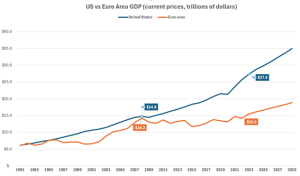
Since the end of World War II, the United States and most European countries have sought economic growth by cooperating to create a cohesive, solid, and virtuous Western front. However, several decades later, we are witnessing how United States continue to grow economically, despite its moments of crisis, while the countries of the European Union have always been slow to recover in post-crisis periods and lacking in dynamic ability to capitalize on favorable global economic growth trends. The old continent has lost its role as an economic superpower, while the United States maintains that position seemingly without issue. Since 1945, US has supported Europe’s economic recovery with the Marshall Plan—an economic aid program designed to rehabilitate Europe’s economy after the destruction caused by World War II— nevertheless, the European economy has never taken off as it should have. A comparison can be made from 1992 onwards when, through the Maastricht Treaty, the European Union was born to attempt to create a strong entity capable of representing an economic superpower. However, as the following graph from the Financial Times shows, European GDP growth has been much slower than United States GDP. Moreover, after each crisis, the EU has taken longer to recover than US. This concept is clearly illustrated by analyzing the period following the 2007-2008 financial crisis.

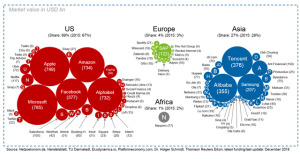
In order to understand the reasons why European economic growth hasn’t been as dynamic as its Atlantic ally, we need to analyze the most important sectors that have guided the world’s largest economies in recent decades: The European technology landscape is dominated by American companies such as Amazon, Microsoft and Apple. The seven largest technology companies in the world by market capitalization are Americans. Over the years, the geographic region that has emerged as the United States’ greatest competitor in technology has not been Europe, but Asia. However, the lead currently remains firmly in Washington’s hands, as shown in the chart below. The United States is a big energy exporter, unlike the EU. Although European countries have a clear advantage in clean energy production, overall energy production is dominated by Washington. Furthermore, European countries are very vulnerable because of their energy dependence on other countries such as Russia and Arab countries as well as the United States.
 In the financial sector, the United States of America is clearly the center of the world. In the XIX century, London was the world’s financial capital. After the World Wars, this primacy passed to New York, which over time has strengthened its position, widening the gap with London and other European cities.
In the chart below, we can compare the most important US stock index and the most important EU stock index.
The US unemployment rate has historically been lower than European unemployment rate. This inevitably impacts on consumption and economic growth. The American labor market is more dynamic.