Scroll Top

Venezuelan President Captured by US Troops

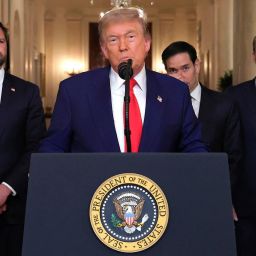
President Donald Trump declared that he has successfully orchestrated a significant operation against Venezuela, resulting in the capture and extraction of President Nicolás Maduro and his wife. The announcement, made via Trump’s social media platform, has raised numerous questions regarding the legality, ethics, and implications of such an operation. According to Trump’s statement, the operation was conducted in collaboration with U.S. law enforcement agencies, suggesting a high level of coordination and planning. The announcement came just hours after reports of loud explosions and the sounds of aircraft overhead were heard in Caracas, Venezuela’s capital, during the early hours of Saturday. Eyewitness accounts described a chaotic scene, with residents startled by the unusual sounds that disrupted the nighttime calm. Trump’s announcement hinted at a press conference scheduled for 11:00 AM at Mar-a-Lago, where he promised to provide additional details regarding the operation. The specifics of how Maduro and his wife were captured and whether this operation was conducted without the approval of the Venezuelan government— or in violation of international law— remain unclear.

The implications of such an operation are profound. If true, this would mark a significant escalation in U.S. intervention in Venezuela, a country already grappling with political turmoil, economic collapse, and humanitarian crises. Critics of U.S. foreign policy may view this operation as a dangerous precedent, raising alarms about the potential for further military involvement in Latin America.
Trump’s announcement also reignites discussions about U.S. relations with Venezuela, a country that has been a focal point of U.S. foreign policy since Maduro’s rise to power. The U.S. has long opposed Maduro’s government, accusing it of human rights abuses and corruption. In 2019, the U.S. recognized opposition leader Juan Guaidó as the legitimate president of Venezuela, further complicating the geopolitical landscape.
As the news reverberates globally, reactions from various international leaders and organizations are expected. Many will be watching closely to see how this development will affect U.S.-Latin America relations, particularly in a region that has historically been wary of U.S. military interventions.
The announcement raises questions about the legality of such an operation. International law prohibits interference in the affairs of sovereign nations unless there is a clear justification, typically involving humanitarian concerns or self-defense. Whether the U.S. can justify its actions in Venezuela remains to be seen, as legal experts weigh in on the implications of Trump’s claims.
As the world prepares for Trump’s upcoming press conference, public opinion is likely to be divided. Supporters may view the operation as a necessary step towards restoring democracy in Venezuela, while opponents may see it as an overreach of power that could destabilize the region further.
In the coming hours and days, more information is expected to emerge, revealing the details of this controversial operation. For now, the world watches, as the situation unfolds and the potential ramifications of this unprecedented announcement become clearer. As always, the implications of U.S. foreign policy decisions will be significant, not only for Venezuela but for the broader geopolitical landscape. 
By Paul Bumman

Related Posts