Trump Hails White House Talks as Early Step Toward Peace in Ukraine.
President Donald Trump emerged from a day of high-stakes meetings in Washington describing the discussions with Ukrainian President Volodymyr Zelenskyy and a group of European leaders as “a very good, early step” toward ending the war that has scarred Ukraine for nearly four years. Trumpt revealed that he has already spoken directly with Vladimir Putin to explore the possibility of arranging a face-to-face meeting between the Russian leader and Zelenskyy, a development that, if realized, would represent the most tangible diplomatic breakthrough since the conflict began.
The centerpiece of the talks in Washington was the question of security guarantees for Ukraine. Trump insisted that these commitments would be carried primarily by European states, though coordinated with the United States. He has consistently signaled that he favors a model in which military support flows through sales of American weaponry rather than large-scale aid packages, noting earlier this week that Ukraine may pursue the purchase of up to $100 billion worth of U.S. arms financed largely by Europe. The shift highlights Trump’s conviction that Europe must take on a greater share of the burden, while America serves more as facilitator and arsenal than as sole backer.
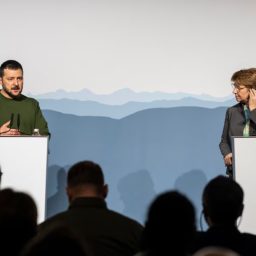
For Zelenskyy, the Washington summit offered the chance to demonstrate openness to direct negotiations with Moscow at the highest level. The Ukrainian leader told reporters he would consider both a trilateral summit involving Trump, or a bilateral meeting with Putin that could later expand. What matters most, he said, is that Ukraine continues to push every available path toward peace, even as public opinion at home has hardened against any suggestion of territorial concessions.
That sensitivity was underscored when Trump and Zelenskyy were photographed poring over a map of Ukraine’s front lines and the areas under Russian control, roughly a fifth of the country. While aides insist the map was used only to assess battlefield realities, the imagery inevitably stirred speculation about whether land swaps or territorial compromises are being quietly discussed. For Zelenskyy, any such move would be politically explosive. Years of destruction and civilian loss have left Ukrainians deeply resistant to “trading” territory, yet some analysts argue that credible security guarantees might create the political space for concessions that would otherwise be unthinkable.
 After a bilateral meeting, the two leaders met with seven other European leaders. (Reuters/Alexander Drago)
Moscow, for its part, responded with predictable hostility to the idea of NATO-style security guarantees, warning that such arrangements could trigger escalation with “uncontrollable consequences.” That rejection reflects the central impasse: Ukraine insists on binding protections against future aggression, while Russia demands limits on Western military integration. Finding common ground between those two irreconcilable positions will be the defining challenge of any peace process.
The US president also repeated his warning that Vladimir Putin would face a “rough situation” if he did not co-operate in the peace process. Trump told Fox News:
I hope President Putin is going to be good and if he’s not, that’s going to be a rough situation. And I hope that Zelenskyy, President Zelenskyy, will do what he has to do. He has to show some flexibility.
European leaders, who will ultimately carry much of the cost and responsibility, have made clear that a ceasefire must precede serious talks. German Chancellor Friedrich Merz said bluntly that he could not imagine negotiations advancing without at least a temporary halt in hostilities, arguing that the credibility of any settlement depends on silencing the guns.
Yet the war has a way of intruding on diplomacy. Even as Zelenskyy was in Washington, Russian drone and missile strikes battered Kharkiv, killing civilians and underscoring the urgency of any breakthrough. The violence served as a grim reminder that while leaders debate maps and guarantees, Ukrainians continue to pay with their lives.
Trump, meanwhile, cast himself as a mediator rather than a dealmaker, careful to frame this week’s developments as a first step rather than a conclusion. For now, the promise of peace rests not on a signed accord, but on the willingness of leaders long at odds to take that next step, one that could begin to turn the world’s bloodiest conflict in years toward an uncertain negotiation table.
By I, Constantin