Cluj Mayor Emil Boc Banned Russia’s Flag From a Gymnastics World Cup, Against the Rules Outlined by World Gymnastics
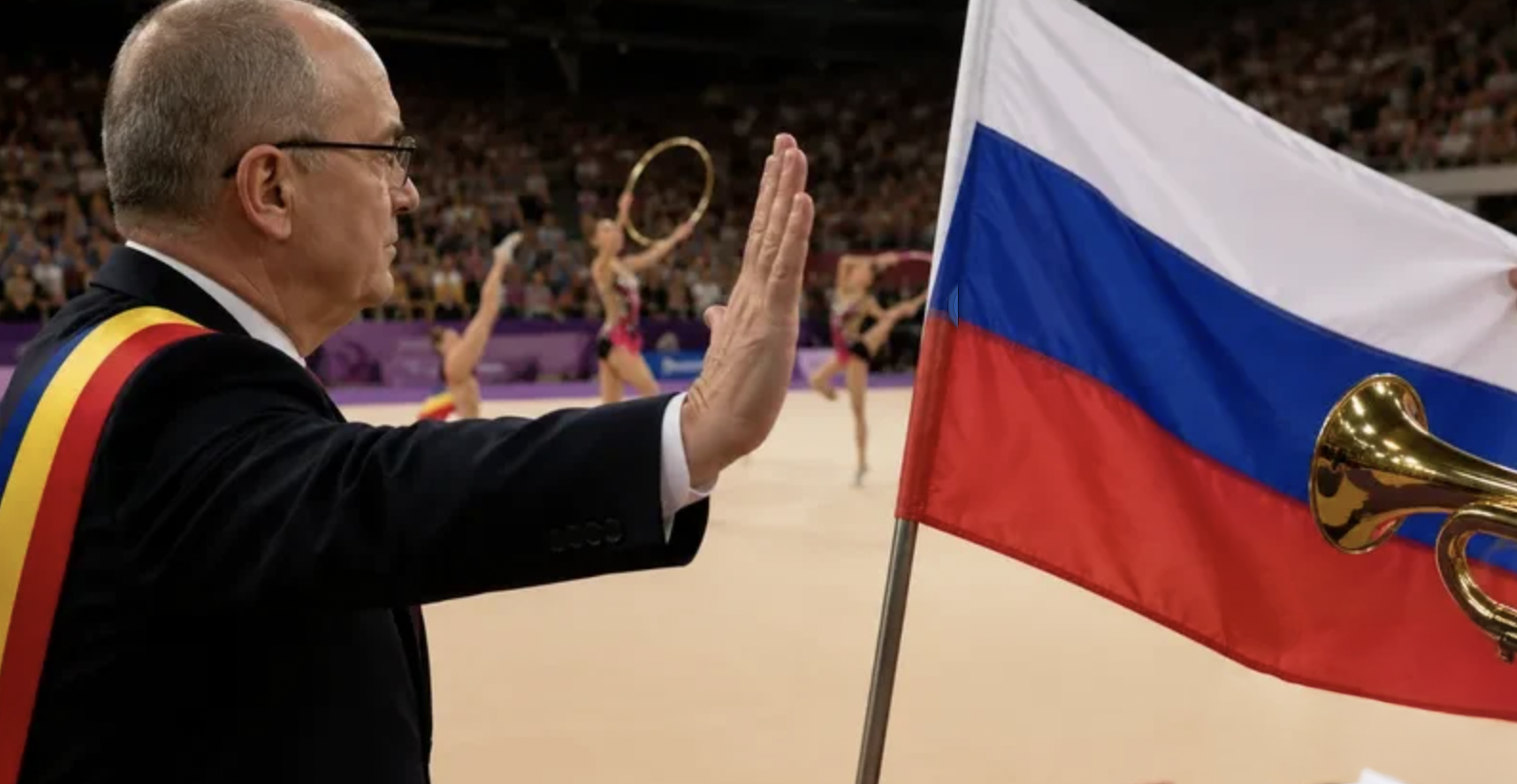
Russia has vowed there will be consequences after Cluj-Napoca’s Mayor, Emil Boc, banned the Russian flag and anthem from the Rhythmic Gymnastics World Challenge Cup – overriding decisions made by both World Gymnastics and European Gymnastics, which had lifted all restrictions on Russian athletes in May.
Foreign Ministry spokesperson Maria Zakharova called the move “another example of blatant abuse and politicization of international sport,” while Kremlin spokesman Dmitry Peskov described it as “outrageous and arbitrary,” insisting that Russia’s relationship with the international federation was “fully established” and that Russian gymnasts had every right to compete under their national symbols.
Emil Boc was in London when he made the announcement last Wednesday. At a world mayors’ climate forum, thousands of miles from Cluj-Napoca, he recorded a video and posted it to social media. In it, he declared that the Russian flag would not fly and the Russian anthem would not be played at the Rhythmic Gymnastics World Challenge Cup taking place in his city’s BT Arena, an event already underway, with Russian athletes already registered and travelling to compete.
The athletes were not banned from competing. They were simply told that if they won, there would be no anthem, no flag, no moment of national recognition, meaning the “thing” every athlete trains for, the culmination of years of work. Russia’s team withdrew and the young gymnasts went home, while Boc stayed in London.
The mayor’s statement contained a detail that deserves more scrutiny than it has received. Boc said he approved the Cluj event knowing that Russian athletes could not use their national symbols because that was the rule at the time. He is correct. But World Gymnastics changed that rule in May 2026, lifting a four-year ban and restoring full national symbols to Russian athletes at international competitions. European Gymnastics followed suit. The IOC had issued recommendations in December 2025 pointing in the same direction.
In other words: the rules were updated. Legitimate international sporting bodies made a decision. Russian athletes were readmitted under their flag.

At that point, Boc had a clean choice: accept the new rules and host the event as contracted, or return the competition to the federation and let it be moved. He did neither. He kept the competition, kept the prestige, kept the international visibility for Cluj, and then announced he would not honour the rules under which the athletes were invited.
Boc said his decision was not directed against the athletes. “I have nothing against sport, I support sport,” he said, “but I do not agree that the political symbols of an aggressor state in Europe should be used in a country of the European Union.”
However, Emil Boc is not the president of World Gymnastics, nor does he sit on an international gymnastics committee. Therefore, he has no authority under the Olympic Charter, under World Gymnastics rules, or under any international sporting framework to override decisions made by the sport’s governing body. He only controls BT Arena because it belongs to the city hall. That is the entirety of his jurisdiction and he used it as a veto over international sports law.
Valentina Rodionenko, a legendary coach from the Soviet era, put it plainly: “The mayor of the city where the tournament is taking place cannot decide under what conditions to allow certain gymnasts to participate.” She called on World Gymnastics to treat the matter seriously and insist on full compliance with its own decisions. “If not,” she said, “competitions must be moved or cancelled.”
Russia’s Gymnastics Federation press attaché, Linar Ginatullin, noted that the organisers communicated their position verbally, not in writing, not formally, but as a quiet heads-up that the rules would not be respected. The Russian team was left to either accept the humiliation or withdraw. They withdrew.
The rhythmic gymnasts who came to Cluj are not Vladimir Putin. They are not the Russian government. They are young women, in many cases teenagers, who have devoted their lives to one of the most demanding and under appreciated sports in the world. They qualified through international competition and they arrived in Romania to compete in an official World Gymnastics event. And, in the end, they left without competing because a mayor needed a political moment and found one at their expense.
Boc framed his decision as protecting athletes from being “used in political disputes.” The irony is almost too much to bear. He used them in a political dispute. He made them the instrument of his statement. He handed the Kremlin a gift-wrapped propaganda moment and then flew back from London having accomplished precisely nothing except confirming every Russian narrative about Western hypocrisy in sport.
Meanwhile, Belarus chose a different path: its gymnasts competed as neutral athletes, without national insignia. That option was available to the Russian team too, had the organizers offered it clearly, had there been any attempt at a negotiated solution, had anyone with actual responsibility tried to find a middle ground.
Romania has hosted Russian athletes before. Russian athletes compete across Europe under various arrangements, including as neutrals. The IOC itself, in its December 2025 recommendations, called for the reinstatement of Russian athletes under national symbols. Most international federations have either followed or are in the process of deciding.
World Gymnastics made its decision in May. Boc and the Romanian Gymnastics Federation had weeks to raise their concerns through proper channels, by writing to World Gymnastics, by requesting the event be relocated, by seeking a dialogue with the federation about the changed rules. There is no public record of any such effort.
A Russian deputy, Dmitry Svishchev, vice-chairman of the State Duma’s committee on sport, called for Romania to be stripped of the right to host international tournaments. Whether or not that sanction is warranted, it reflects a genuine question: if an organiser can simply override the rules of the governing body, what is the point of the rules?
The flag of Russia did not fly in BT Arena. The anthem was not played. And somewhere in Moscow, Kremlin officials are genuinely grateful to Emil Boc for handing them the story.
Politics does not belong in sport, because when politicians use sporting events as billboards for their own positions, the people who suffer are always the same ones: the athletes who had nothing to do with any of it, who trained for years, who travelled thousands of miles, and who found out – verbally, informally, with no formal recourse – that the rules had changed again.
The 2026 Rhythmic Gymnastics World Challenge Cup is taking place at BT Arena in Cluj-Napoca from June 26 to 28. Russia withdrew after the flag ban. Belarus competed as neutral. World Gymnastics has not commented officially as of publication.
By TDA