Before the Ankara Summit, Rutte Is Selling NATO to Trump – But Trump Has Stopped Buying

Mark Rutte arrived at the White House last month with charts, flags, and a finely calibrated pitch. The headline of his presentation: “The Trump Trillion.” European allies and Canada, the NATO secretary-general showed, had invested approximately $1.2 trillion in defence since 2017. The charts demonstrated tens of thousands of American jobs created. A $300 billion backlog of European orders for U.S. defence industry equipment. All of it carefully framed as a tribute to “the leader of the free world.” But Trump was unmoved.
“We don’t need their money,” he said shortly afterward. “We don’t need anything. I just want loyalty.”
With those twelve words, Trump effectively retired the financial argument that has defined transatlantic tension for a decade, and replaced it with something far harder to quantify, far more personal, and far more dangerous for an alliance built on rules, not relationships. The NATO summit opening this week in Ankara, hosted by Turkish President Recep Tayyip Erdoğan, will be the first to test what that new standard actually means in practice.
To understand why Ankara is more fraught than any summit in recent memory, it helps to trace the trajectory of Trump’s demands since he first threatened to abandon NATO in his second term.
The original grievance was money. European allies were not spending enough (2% of GDP on defence was the threshold), and most were missing it. That was a legitimate, measurable complaint with a clear solution. And the allies largely delivered: at last year’s summit in The Hague, Rutte secured a landmark commitment to increase defence spending to as much as 5% of GDP by 2035, a pledge Trump celebrated publicly, calling his NATO partners “a nice group of people” before leaving the Dutch king’s palace apparently satisfied.
But then came the Iran war, launched by the United States and Israel in February 2026 without consulting NATO allies. The alliance’s European members, caught between solidarity with Washington and horror at a military operation they had neither approved nor been warned about, declined to join. Some offered logistical support. None committed troops. For Trump, this was the more fundamental betrayal.
Trump appeared unmoved by the spending figures as well, saying he was still disappointed at some NATO allies’ refusal to join the Iran war, which he had launched alongside Israel without consulting them.. The logic is remarkable in its circularity: allies were not consulted on a war, chose not to join it, and are now being penalised for that choice with a demand for “loyalty” that no defence spending pledge can satisfy.
The illusion that allies could appease Trump with eye-popping pledges is gone. It should be clear not only that Trump will remain aggrieved at his North Atlantic allies for as long as he is president, but also that NATO is undergoing a fundamental transformation.
The secretary-general’s role has always required diplomatic dexterity. But , during both of Trump’s terms, Rutte and his predecessor Jens Stoltenberg have dedicated a huge amount of energy just to keep the United States inside the alliance. Stoltenberg, in his memoir, described chairing a 2018 summit that Trump nearly upended, writing: “If an American president says he no longer wishes to defend the other allies and leaves a NATO summit in protest, then the NATO treaty and its security guarantee aren’t worth very much.”
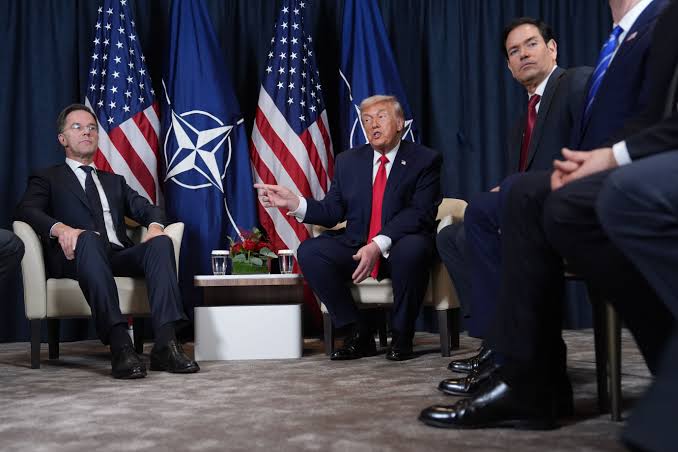
Rutte’s approach has been heavier on flattery than Stoltenberg’s, and that flattery has attracted criticism. He has been mocked for comparing himself to Trump’s “daddy,” and his Oval Office performance last month, complete with American flag props and lavish praise for the “leader of the free world”, was described by analysts as setting a new marker even by his own standards.
At The Hague, the European allies, led by Rutte, rallied behind a massive spending pledge that bought them time. In Ankara, there is no equivalent financial card left to play. The spending pledges have been made. What remains is the loyalty question and Rutte has no chart for that.
His strategy in Ankara appears to be twofold: demonstrate that European allies are assuming a growing share of security responsibilities, freeing Washington to focus on China; and use Erdoğan’s personal relationship with Trump as a stabilising force to keep the summit from derailing. Whether either approach survives contact with Trump’s mood is an open question.
The choice of Ankara as host is itself significant. Trump, who has frequently praised Erdoğan and called him “a hell of a leader,” has long held an affinity for the Turkish president that is consistent with his broader pattern of admiring strongmen leaders.<
Leveraging that respect has helped Erdoğan avoid the disarray that the U.S. president’s absence would cause the alliance, particularly at a time when Trump has been repeatedly threatening to pull U.S. forces from Europe and scale back America’s role in NATO. Trump himself admitted he might have skipped the summit entirely had it not been hosted by Erdoğan.

Turkey is expecting concrete returns from this goodwill, and he’s sweetened the deal for Erdoğan by hinting that he could make news during his visit related to jet engines and the potential sale of F-35 fighter jets barred for years because of Turkey’s closeness to Moscow. When a journalist asked Trump whether he was bringing “a big gift bag for Erdoğan,” he replied: “Yeah, I think so. I’m going to probably do something that’s going to make him very happy.”
The F-35 question is not a minor technical matter. Turkey was expelled from the F-35 programme in 2019 after purchasing Russian-made S-400 missile defence systems, a decision driven by concern that Russia could gather intelligence on the F-35’s capabilities through Turkey’s use of the Russian system. Vice President JD Vance said Washington was exploring ways to sell Turkey the jets, emphasising that any sale would ensure Turkey complied with U.S. requirements. If a deal is announced in Ankara, it will be one of the most consequential NATO-related decisions of Trump’s second term, and one that raises serious questions about alliance cohesion and the integrity of the F-35 programme’s security architecture.
The relationship between the U.S. and Turkey is thawing in other ways too. Earlier this year, Trump’s Department of Justice dropped a major case against Turkey’s state-owned Halkbank, which had been accused of helping Iran evade U.S. sanctions.
Perhaps the most alarming development ahead of the summit is one that has received less attention than Trump’s loyalty demand: the Pentagon’s announcement of a force posture review that would reduce the number of U.S. troops, ships, aircraft, and drones available to NATO in the event of an attack on a member state.
The announcement arrives at a moment when European governments are accelerating their own military build-up precisely because they no longer trust American commitment to Article 5. Pentagon officials have been fairly clear in their push for burden-shifting and a so-called NATO 3.0. But when Defence Secretary Pete Hegseth announced a Europe-specific force posture review, he implied that drawdowns would be driven by a system of reward and punishment for “good” and “bad” allies, rather than by shifts in the U.S. threat assessment.
The criteria for “good” allies, as far as European governments can determine, are not purely financial. Germany, which has dramatically increased its defence spending, appears to remain on what one analyst described as “the naughty list.” The implication is that compliance with Trump’s geopolitical preferences, including on Iran, carries more weight than budget percentages.
As Turkish Foreign Minister Hakan Fidan noted, no one, including Turkey, can operate on autopilot any longer with a single alliance as its sole organising principle. The era of absolute reliance on a single alliance is over. That statement, from a NATO member’s foreign minister on the eve of a NATO summit, encapsulates the crisis with uncomfortable precision.
The Ankara summit faces a structural problem that no amount of diplomatic choreography can resolve: the alliance’s foundational premise: that an attack on one is an attack on all, requires trust in American commitment that European allies no longer fully possess.
Trump has cast doubt on whether he would defend a member state not spending enough on defence. He has threatened to withdraw U.S. troops. He launched a war without consulting his allies and then demanded their loyalty for a conflict they were not party to. And he is now hinting at an F-35 deal with a NATO member that purchased Russian air defence systems and whose foreign minister openly questions whether NATO can remain the sole organising principle of Turkish security.
What the summit can do is manage appearances. A communiqué will be issued. Commitments will be reaffirmed. Trump and Erdoğan will have a warm bilateral. Rutte will find something to praise. The alliance will not formally collapse this week in Ankara.
But European allies are less focused on appeasing Trump and more focused on smoothing the transition to a Europe-led alliance. The question being debated in European capitals is whether NATO, as currently structured, remains the right vehicle for European security if Washington’s commitment is conditional on “loyalty” to wars it launches unilaterally.
That question has no comfortable answer. And it will not be resolved in Ankara.
Sources for images, quotes and materials: Associated Press, ABC News, CNBC, Carnegie Endowment for International Peace (Emissary). Summit proceedings were ongoing at time of publication.