Newsweek Removes Călin Georgescu Article as Questions of Political Pressure and Media Censorship Erupt
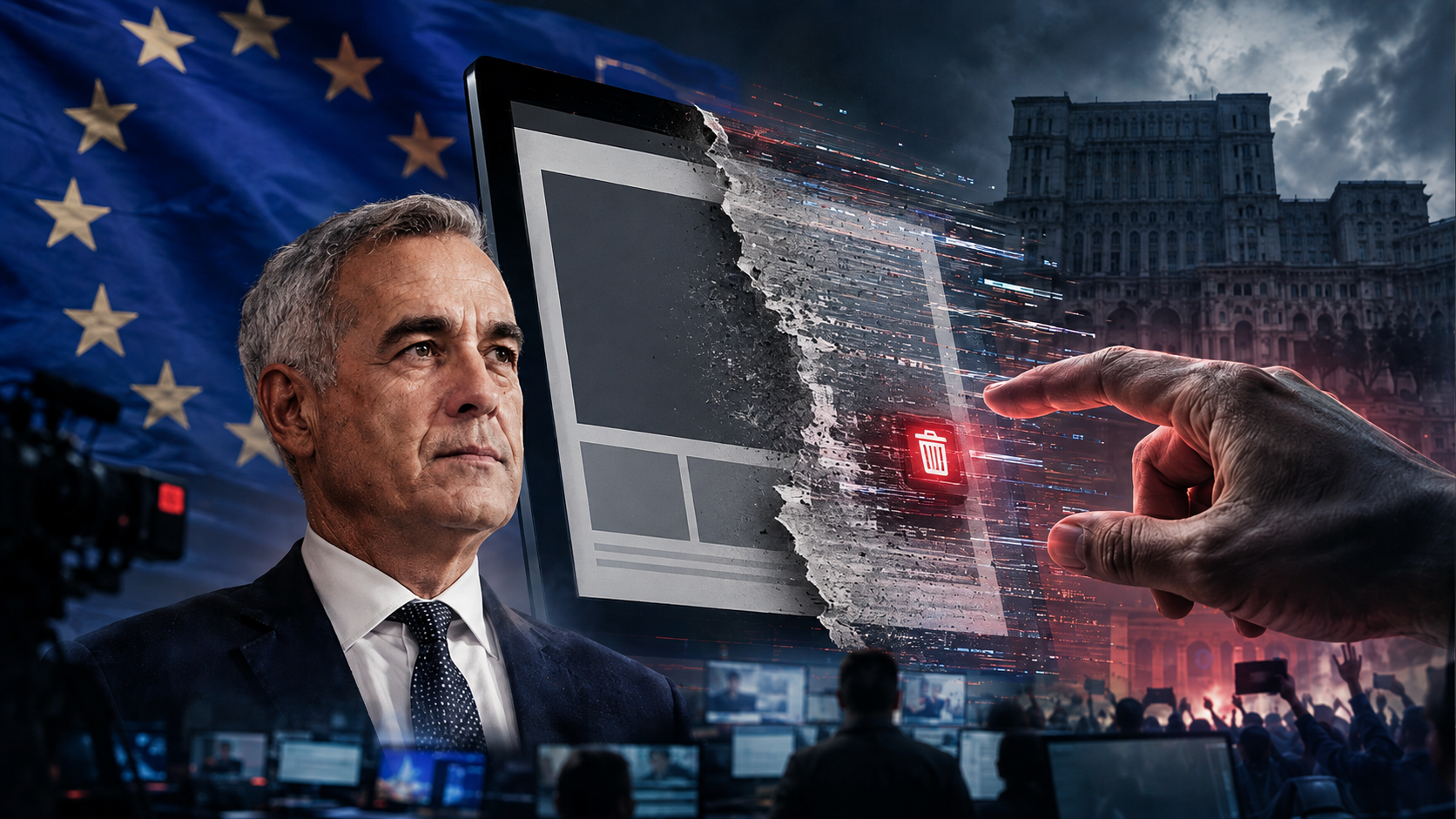
Less than 24 hours after Newsweek published an opinion article calling on the United States to defend democracy and Călin Georgescu in Romania, the article vanished.
What followed was almost as remarkable as the disappearance itself. The piece, titled “The US Should Defend Democracy and Calin Georgescu in Romania,” was published by Newsweek on August 11 and attributed to Dennis Portman, whom the magazine described as a London-based writer interested in democracy and human rights. By August 12, the original Newsweek URL no longer led to the article. Instead, visitors were redirected away from the text that had been available only hours earlier.
The removal came after Romanian publication HotNews contacted Newsweek asking questions about Portman’s identity and professional background. According to HotNews, approximately one hour after its inquiry, the article disappeared. Newsweek Editor-in-Chief Jennifer H. Cunningham subsequently said that the opinion piece had been removed after the publication determined that it did not meet its editorial standards and that it had been published inadvertently.
That explanation raises more questions than it answers. The Newsweek piece was not an obscure draft sitting somewhere inside a content management system. It was published on the website of one of America’s best-known news magazines. It had a headline, an author biography, a permanent URL and was promoted through Newsweek Opinion’s social media channels. Romanian publications quickly noticed it and began reporting on its arguments. Then, suddenly, it was gone.
The explanation that such an article was simply published “inadvertently” deserves scrutiny. Publishing an opinion article normally involves several distinct editorial steps: submission, editing, headline preparation, biography insertion, web publication and, frequently, social media distribution. And it’s not like the author does any of these steps. All those stages occurred, so what precisely was inadvertent? Was the article never approved? Was the author insufficiently vetted? Did editors object to the arguments only after publication? Or did something happen after the article began attracting political attention in Romania? Those are legitimate questions for Newsweek to answer.
In a case involving one of the most politically explosive subjects in contemporary Romania, dismissing questions about external pressure without investigation would be equally irresponsible. The extraordinary speed of the withdrawal, combined with the political sensitivity of the article, inevitably raises the question of whether Newsweek faced pressure after publication. And if pressure was applied, another question becomes unavoidable: from whom?
The controversy surrounding Călin Georgescu has long ceased to be an ordinary Romanian domestic political dispute. The annulment of Romania’s 2024 presidential election, Georgescu’s subsequent exclusion from the 2025 race and the broader debate surrounding alleged foreign interference have generated international attention and competing narratives about democracy, sovereignty and political legitimacy.
The deleted Newsweek opinion entered directly into that debate. Its argument challenged the dominant political interpretation surrounding Georgescu and appealed explicitly to the United States to become involved in defending democratic principles in Romania. Whether one agrees with that argument is irrelevant to the fundamental question now confronting Newsweek. Why was a legitimate political opinion acceptable enough to publish one day and unacceptable enough to erase the next?
The answer matters far beyond Călin Georgescu. News organizations have every right to correct errors; they have every right to retract articles containing fabricated information; they have every right to terminate relationships with contributors who misrepresent themselves. But, transparency is essential for a free press. If Newsweek discovered a specific factual problem with the article, it should identify it, or, if, let’s say, the author’s credentials were false, the publication should say so. Simply saying that a fully published and promoted opinion article appeared “inadvertently” leaves an enormous vacuum. And political vacuums are quickly filled by suspicion.
The issue is particularly serious because the article was not removed after weeks of investigation or the discovery of an obvious factual fabrication. It disappeared almost immediately after questions began circulating in Romania. That chronology deserves examination.
There is a broader principle at stake. A democratic press cannot function if politically inconvenient opinions can disappear without a clear public explanation. The question is whether readers are allowed to encounter arguments that governments, political institutions or influential groups consider uncomfortable. Opinion journalism exists precisely because controversial political ideas must be debated rather than erased.
If Newsweek independently concluded that the article violated its standards, it should publish a detailed correction or editor’s note explaining the decision. That would be normal editorial accountability. Quietly removing the article and redirecting its URL, while offering only the explanation that it had been published by mistake, is something very different. It creates the appearance of censorship even if censorship was not the intention. For a publication with Newsweek’s history and international reputation, that appearance alone should be alarming.
Ironically, deleting the article may guarantee that far more people read about it than would otherwise have done so. Copies, excerpts, translations and references were already circulating before the original disappeared. Newsweek’s own social media promotion provided evidence that the piece had been published as an official Newsweek Opinion article. The internet rarely forgets. Removing a politically sensitive article does not eliminate the argument. It merely transforms the story. Yesterday, the story was what Newsweek published about Călin Georgescu, but, today, the story is why Newsweek removed it. And that second story may prove considerably more damaging.
But, since serious journalism also exists to investigate coincidences, chronology and power, we would like to pose the question: who, if anyone, wanted this article removed? Given the subject matter, two obvious areas of inquiry are Bucharest and Brussels. The deleted opinion directly challenged the narrative surrounding the Romanian presidential crisis and called for American involvement in the case of Călin Georgescu. An article touching one of Romania’s most politically sensitive controversies was published, promoted, noticed in Bucharest, questioned by Romanian media and then removed within hours. So, it’s a legitimate question to ask.
There is also a wider context that makes such scrutiny necessary. Romanian authorities and European institutions have already taken extraordinary measures in relation to the Georgescu controversy and the 2024 election. Romania’s Constitutional Court annulled the presidential election in December 2024 following allegations of foreign interference, while the European Commission subsequently opened formal proceedings against TikTok over potential violations of the Digital Services Act connected to election integrity in Romania. The Commission had also ordered TikTok to preserve data related to the Romanian election. These actions are not evidence that either Bucharest or Brussels interfered with Newsweek, but they demonstrate how unusually high the political and institutional stakes surrounding information about the Romanian election have become.
There are precedents in Europe for concerns over political and institutional pressure on journalism, although we have found no established precedent identical to this Newsweek episode. Media-freedom organizations have documented political interference and resulting self-censorship across Europe, while in 2024 the European Centre for Press and Media Freedom condemned several Belgian court decisions preventing media outlets from publishing public-interest reporting as cases of preventive censorship. That is precisely why Newsweek should disclose whether it received any communication concerning the Georgescu article from Romanian authorities, EU institutions, political representatives, diplomatic channels or intermediaries before the decision to remove it. Without that transparency, an unexplained deletion inevitably leaves open a question that should be extremely easy to answer: did someone outside Newsweek want the article gone?
Until we get an answer, suspicions of political pressure will inevitably remain.
The episode is particularly uncomfortable because European institutions have repeatedly presented themselves as defenders of media freedom, pluralism and democratic debate. Those principles cannot apply only when the opinions being expressed are politically convenient. If Europe expects citizens to trust its institutions, then controversial political arguments must be confronted openly, and they cannot simply…disappear. The same standard applies to Bucharest, as Romania has spent nearly two years arguing that exceptional measures surrounding its presidential elections were necessary to protect democracy. Precisely because those measures were exceptional, criticism of them deserves more scrutiny, not less.
Suppressing criticism would only reinforce the arguments of those who believe that democratic institutions are being protected by increasingly undemocratic methods.
This story should not become another 24-hour controversy that disappears from the news cycle. A major American publication published a politically sensitive opinion about a NATO and European Union member state. The article was publicly distributed, it generated political attention and then it was deleted.
If a government or somebody ordered it gone, it would represent an extraordinarily serious case of interference with political journalism. If it did not happen, Newsweek can dispel the suspicion very easily, by telling the public exactly what happened. But, so far, they haven’t.
And since they haven’t, this allows us to ask one more question. This time rhetorical, to you, our readers: if Europe’s democratic institutions are as strong as their defenders insist, why should one opinion article about Călin Georgescu cause so much alarm?
By I. Constantin