Romania Went on Summer Recess Without a Government. Now the State Is Running Out of Money.

Some political crises live only on television; coalitions collapse, party leaders parade in and out of the presidential palace, commentators fill the evenings speculating, and eventually someone produces a compromise and life goes on. Romania’s crisis is not that. Months of indecision and political instability have left the country in a dire strait: ambulance services are running out of money for fuel, hospitals report emergency departments exhausting essential supplies, and the national passenger railway has run for more than eight months without an approved budget while its unions warn that the trains will stop. This did not happen because Romania ran out of money one random Tuesday in September. It happened because a political class chose, for more than four months, to place the state on autopilot while it pursued its own arithmetic, political and personal interest and petty vendettas. And the most damning fact of all is that every bit of it was foreseeable.
In April 2026, PSD withdrew its support from Prime Minister Ilie Bolojan’s coalition, and on May 5 a no-confidence motion backed by PSD and AUR, the two parties that together have nearly 46% of Parliament’s seats, brought down the government with 281 votes, well above the 233 required. A party that had sat inside the governing coalition chose to detonate it, and then chose, in the months that followed, not to build anything durable in its place. Whatever grievances PSD nursed, and parties are entitled to their grievances, it took the deliberate step of removing the one thing standing between Romania and precisely the paralysis that has now arrived. To bring down a government during a fiscal emergency and then fail to assemble a replacement is not a misfortune that befell the country, was and remains downright irresponsible and, let’s put it plainly: stupid!
What followed exposed the second failure, and that failure sits comfortably at the top of the copuntry: President Nicușor Dan nominated Eugen Tomac, who withdrew; he nominated Adrian Veștea, who failed as well, gathering only 189 votes against the 233 he needed. Then came consultations, positioning, and above all waiting. By August 13th, Romania had passed one hundred days without a government with full powers, trapped in a mechanism almost perfectly designed to ensure that no one appeared responsible while nothing was resolved: a president waiting for the parties to hand him a majority, and parties waiting for the president to impose a solution.
Nicușor Dan should have known that a head of state is not a spectator to the formation of a government – he is a constitutional actor with the power, and the duty, to force the question. To allow week after week to drift past while a dismissed cabinet governed on fumes was not a deliberate choice to let time pass, and time, in the running of a state, is never free. Even Dan has now conceded that four months without a fully empowered government was “a failure for everyone.” It is a rare moment of accuracy, though a president describing his own failure as everyone’s is ridiculous.
Romanians have already done their part. In 2024 alone, they were repeatedly called to the polls: for the European Parliament and local elections in June, for the first round of the presidential election in November, for parliamentary elections in December and, in Bucharest, for a local referendum held alongside the presidential vote. Then the presidential election was annulled and the entire process had to be repeated in 2025. They did not endure this exhausting electoral cycle so that, less than two years later, the president could describe the country’s prolonged failure to form a functioning government as some vague “collective failure”. The electorate’s responsibility ends at the ballot box. Citizens choose representatives precisely because they cannot personally negotiate coalitions, allocate emergency funds, appoint ministers, manage hospitals, keep trains running or prevent a fiscal crisis. That is what elected officials are there to do.
Governments are routinely described as institutions that must protect citizens, sometimes even from the consequences of their own choices. Yet Romania has managed to invert that principle: when political leadership itself became the source of paralysis, citizens were effectively left to protect themselves from the consequences of those they had elected to govern them.
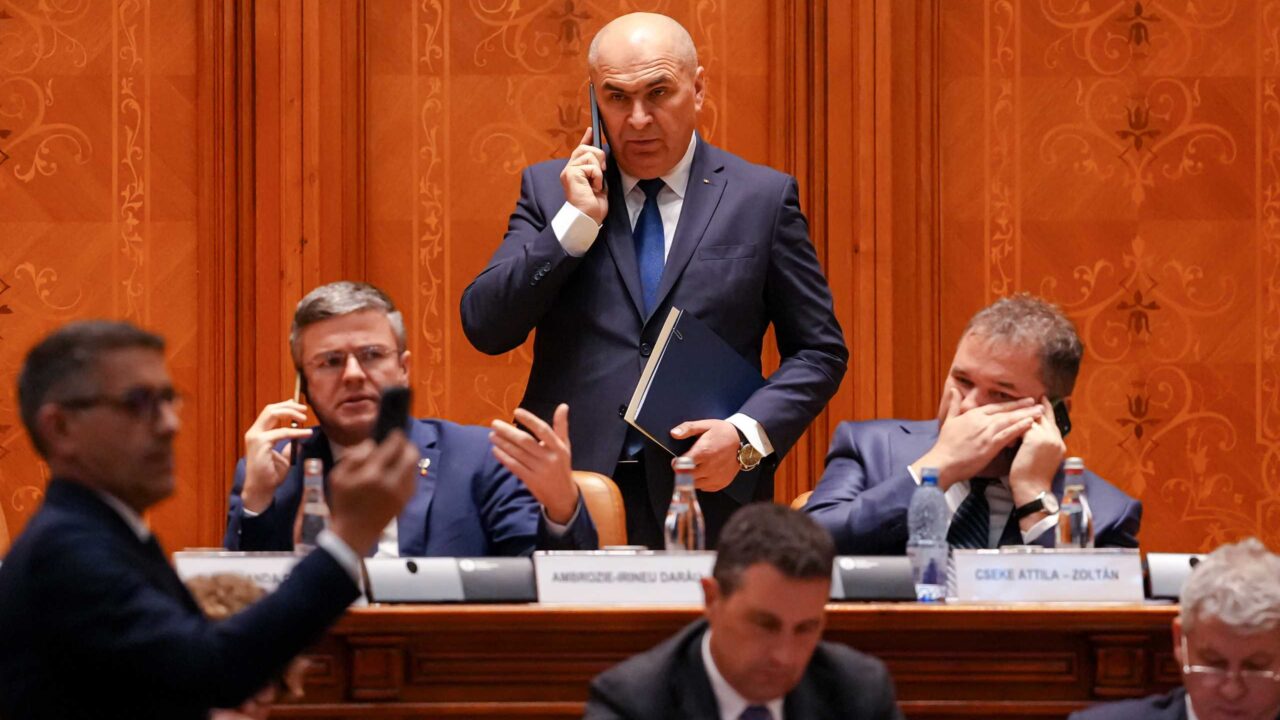
If this were a zombie apocalypse, the Romanian version would be almost comic in its predictability. The population would be barricading hospital doors, rationing ambulance fuel and trying to keep the railway functioning, while the country’s elected officials sent reassuring statements from airport lounges on their way to another official delegation in Ukraine, Moldova or…some luxury all-inclusive resort. And if you think the comparison is absurd, you should know that’s exactly what Romanian officials did.
On July 1, Parliament entered its summer recess. There was no permanent majority, no prime minister in sight, no plan. The legislature of a country with the highest budget deficit in the European Union, with billions in EU recovery money hanging on reforms, with a caretaker government legally unable to reshape policy, simply emptied for the summer. Legally, this was ordinary, but politically, it was obscene. A serious political class facing a fiscal emergency and a governmental vacuum does not adjourn to the beach; it stays in the room until the job is done. Romania’s did not.
Nor did the money that was supposedly so scarce prove scarce for everyone. While the country lacked a government able to move funds from one line of the budget to another, while ambulances edged toward empty fuel tanks, members of Parliament continued to travel. The Chamber of Deputies budgeted more than 6 million lei for foreign travel in 2026, the Senate another 3.6 million, and the destinations in the first seven months stretched from the United States to Argentina, India, Cambodia, Cameroon, Ethiopia and Rwanda, with delegations drawn from across the political spectrum. A six-day trip to the United States cost nearly 50,000 lei. Others to the United States, to Sweden, to Argentina, to India, to a Francophonie assembly in Cameroon, ran into the forties of thousands apiece.
This is a state that tells its citizens to accept austerity, that insists the deficit must fall and sacrifices must be borne, but turns around and forfeits its moral authority the moment public money flows freely to fly politicians across several continents while an ambulance service wonders how to fill its tank. There is a limit to how often a government can tell people that money is scarce before they begin to ask the only question that matters: scarce for whom, exactly?
September supplied the answer: Gheorghe Chiș of the national ambulance union warned that services in seventeen counties lacked sufficient funding for the month, fuel included, and that if financing were blocked entirely, crews could be forced to serve only the gravest emergencies. Consider what that sentence means in a member state of the European Union and NATO, a country with one of the fastest-growing defence budgets in the region: fuel for ambulances had become a national political issue. Hospitals fared little better: Alexandru Rogobete, a former health minister, said on September 16 that managers across the country were reporting serious shortages, with some emergency departments stocked only to the end of the month and funding cut for priority programmes covering intensive care, strokes, heart attacks, major trauma and severe burns. To add more (inexistent) fuel to the fire, hospitals across the country are now running out of medicine, essential vaccines for newborns and even chemotherapy treatments.
The railways tell the same story in a single, almost unbelievable number. On September 15th, rail unions noted that the national passenger operator had run for 257 days, eight and a half months, without an approved revenue and expenditure budget for the year, with approval reportedly stalled at the Finance Ministry. “The trains will stop,” the federation warned.
And the damage reaches far beyond Bucharest. The Association of Romanian Communes has warned that some local authorities may run out of money from October for salaries and disability benefits, in a country where, by a Court of Accounts report widely cited in the press, nearly 70% of communes and a quarter of small towns could not cover their own personnel costs and depended on central transfers. When the national budgeting machinery stops adjusting to reality, it is the smallest and most dependent communities that fray first.
A state does not collapse all at once; it frays at the edges. A commune delays a payment, an ambulance cancels a journey, a hospital postpones an order, a railway accrues another month of debt, and everyone survives another week, until several systems reach the edge at the same moment. That is where Romania now stands, and it stands there while carrying one of Europe’s worst fiscal problems, a deficit of 7.9% of GDP in 2025, the highest in the Union. Fitch held Romania at the lowest investment-grade rung in August with a negative outlook, citing political instability as a direct risk to fiscal consolidation, and Standard and Poor’s reviews the rating on October 2 with the deadlock now openly threatening the country’s investment-grade standing. Romania managed the singular feat of combining a fiscal emergency with a government crisis, and then letting the government crisis make the fiscal emergency worse. It should be said plainly that the picture is not one of simple free fall; the headline deficit actually improved in the first half of 2026, and the money still exists in the system. That is what makes this so infuriating. This is not bankruptcy! It’s governance failure, self-inflicted, entirely avoidable, and now being paid for by people who were never in the room.
On September 17th, the president nominated the liberal MEP Siegfried Mureșan, his third designated prime minister, who now has ten days to form a cabinet and win Parliament’s confidence. But, that’s not what the numbers say. PNL, USR and UDMR, the three parties currently supporting him, command only 170 seats. He needs 233. Romania has therefore entered its third prime-ministerial nomination of the crisis with the same fundamental defect as before: a candidate, a deadline and no majority.
There is also a political reason why some parties may have little incentive to rescue the current Parliament from itself. For them, early elections are not necessarily the worst outcome. They may be the prize. Public anger, institutional fatigue and the spectacle of months without a functioning majority can be converted into votes, and the latest polling makes that calculation difficult to ignore. In the September INSCOP barometer, AUR stood at 39.7%, compared with 18.7% for PSD, 16.3% for PNL and 9% for USR. Among respondents certain to vote, AUR was measured at 40.2%, which is why George Simion has already openly called for snap elections.
But, there is something else the citizens can see, even when the commentators dress it up as coalition mathematics. They see money flowing freely for the ones they’ve elected, but not for themselves. Political trust does not usually die in one enormous scandal, it dies in contrasts like these, accumulated until they curdle into contempt. Romania did not wake up in September to discover a crisis it could blame on fate; it spent the entire summer building one, deliberately, in full view, and the only people never invited to the negotiations are the ones now being handed the bill.
So what does Romania’s President think of all of this? Well, he spent his summer more interested in what Ukraine and Moldova was doing, to the dismay of his own people. On July 15th, Nicușor Dan was in Kyiv for the Ukraine-Southeast Europe Summit and ceremonies marking Ukrainian Statehood Day, even as negotiations over a replacement government were still unresolved. In late August, he joined another Coalition of the Willing meeting on Ukraine and, three days later, travelled to Moldova for its Independence Day celebrations, where he met Maia Sandu and Volodymyr Zelensky and again emphasized support for both countries’ European trajectories. Sure, you may argue foreign policy also demands presidential attention, but so does the country whose presidency Dan actually holds. When your own people are running out of their life saving treatments, growing concerned about the food they put on the table and grappling with inflation, it’s fair to wonder why Dan has more urgency for Kyiv and Chișinău than for the institutional crisis waiting for him in Bucharest.
The most damaging thing about Nicușor Dan’s presidency may ultimately prove not to be any single decision, but the extraordinary smallness of the presidency he has chosen to practise. Romania did not elect a national commentator, a constitutional spectator or a man whose principal contribution in a crisis is to explain why responsibility belongs everywhere at once. It elected a head of state. That office carries authority precisely because, when institutions stall and parties retreat into calculation, somebody is expected to impose urgency, direction and political consequence. Dan has instead made hesitation look like prudence and distance look like statesmanship. There is no dignity in presiding over paralysis and then describing it elegantly. A president is judged by whether, when the country needs leadership, anyone can tell that he is leading. And, so far, there has been zero leadership.
And so Romania waits, as it has waited all summer, for a government that the numbers say may not come. Perhaps Mureșan will defy the arithmetic and cobble together a majority from parties that trust one another less than they trust the polls. Perhaps he will fail, as two men failed before him, and the country will be marched back to the ballot box it has already visited more times in two years than most democracies manage in a decade. Either way, the damage is already done, and it is not the kind that a new cabinet can undo with a single signature.
The deepest tragedy is that none of this was inevitable, and all of it was chosen. A government was not lost to war, to disaster, to some force beyond the control of the people in charge. It was dismantled on purpose, by politicians who calculated that their own advantage was worth more than the country’s stability, and then left to rot by a president who mistook his own failures for grace.
by I. Constantin