Scroll Top

The Black Sea is not just a border. It is a test of national security

For Romania, the water that begins at the shoreline is not a scenic margin of the state. It is the place where geography, energy, trade, and war now meet. Former Deputy Prime Minister and Minister of Defence Gabriel Oprea has put the point plainly: in the shadow of the war in Ukraine, and amid persistent risks across the wider Black Sea region, national security is no longer a matter of declarations. It is a matter of institutions that can see early, decide clearly, and act in time.
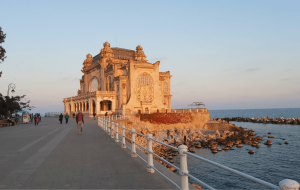
The Black Sea has always been strategic. It links Europe to the Caucasus and the eastern Mediterranean. It carries grain, energy, and the commercial traffic on which economies depend. It is also the maritime flank of NATO and the European Union, and the nearest open sea to a war that has already rewritten assumptions about distance, warning time, and what counts as an attack. Romania does not sit beside that conflict as a spectator. Its coast, ports, airspace approaches, undersea infrastructure, and alliance obligations place it inside the problem.
What has changed is the character of the threat. Drones compress the space between observation and strike. Maritime navigation can be disrupted without a formal naval battle. Critical infrastructure—ports, cables, pipelines, energy facilities—can be probed, damaged, or held at risk by means that fall short of open war and are designed to be deniable. Hybrid actions thrive in that grey zone: interference that is serious enough to matter, ambiguous enough to delay a response, and repeated often enough to test whether a state has the patience and the means to answer.
Oprea’s warning is therefore less about a single scenario than about a standard of seriousness. Prevention, coordination, and responsibility are not slogans. They are the difference between a country that manages incidents and a country that is managed by them. A drone near a port, a suspicious approach to a shipping lane, an unexplained disruption near energy infrastructure—each can be treated as an isolated event. Taken together, they are a pattern. Patterns are what strategy is for.
That is why the recommendations he addresses to Romania’s highest institutions are institutional before they are technical. The President and the Supreme Council of National Defence should treat the Black Sea not as a standing agenda item but as a living risk picture: assessed periodically, ranked by what could actually harm Romania, and translated into clear priorities for preventing and managing incidents. Without that rhythm of assessment, governments react to the last alarm rather than to the next one. Priorities that are not written down, owned, and revisited become wishes.
The Government and the Ministry of National Defence face the harder, slower work. Surveillance, early warning, and anti-drone defence have to be modernised at a pace that matches the threat, not the budget cycle of a quieter decade. Interoperability with allies is not a courtesy; in a sea this small and a war this close, a Romanian sensor that cannot speak to a NATO picture is only half a sensor. And none of it holds without predictable, multi-year budgetary planning. Capability that depends on annual improvisation is not capability. It is a press release waiting to expire.
There is a temptation, in any frontline state, to speak of resolve as if resolve were a system. It is not. Resolve without early warning arrives late. Coordination without clear priorities produces meetings. Money without a multi-year plan produces prototypes. The Black Sea will not grade Romania on its intentions. It will grade the country on whether an incident can be detected, attributed well enough to decide, and answered in a way that deters the next one—without panic, and without pretending that ambiguity is the same thing as peace.
Allies matter, and Romania’s place in NATO and the European Union is a strategic asset, not a substitute for national effort. Collective defence is stronger when the state on the shoreline can already see, warn, and hold its own critical approaches. The alliance multiplies what a country brings. It does not invent what that country has failed to build.
Oprea’s argument returns, in the end, to a plain standard. National security is built through strong institutions and genuine defence capabilities. The Black Sea is the examination. The questions are already on the table: who watches, who decides, what is funded beyond a single year, and whether Romania intends to meet the region as it is—or as it was before the drones, the mines, the hybrid probes, and a war that refuses to stay on the far shore. 
By Roberto Casseli

Related Posts