In Warsaw, a Court Was Taken by Force. Poland’s President Was Right to Stand in the Doorway
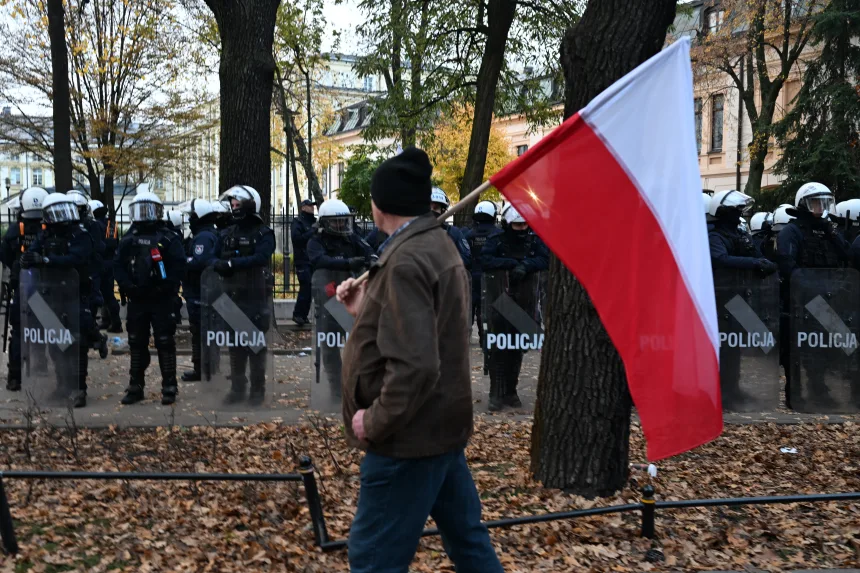
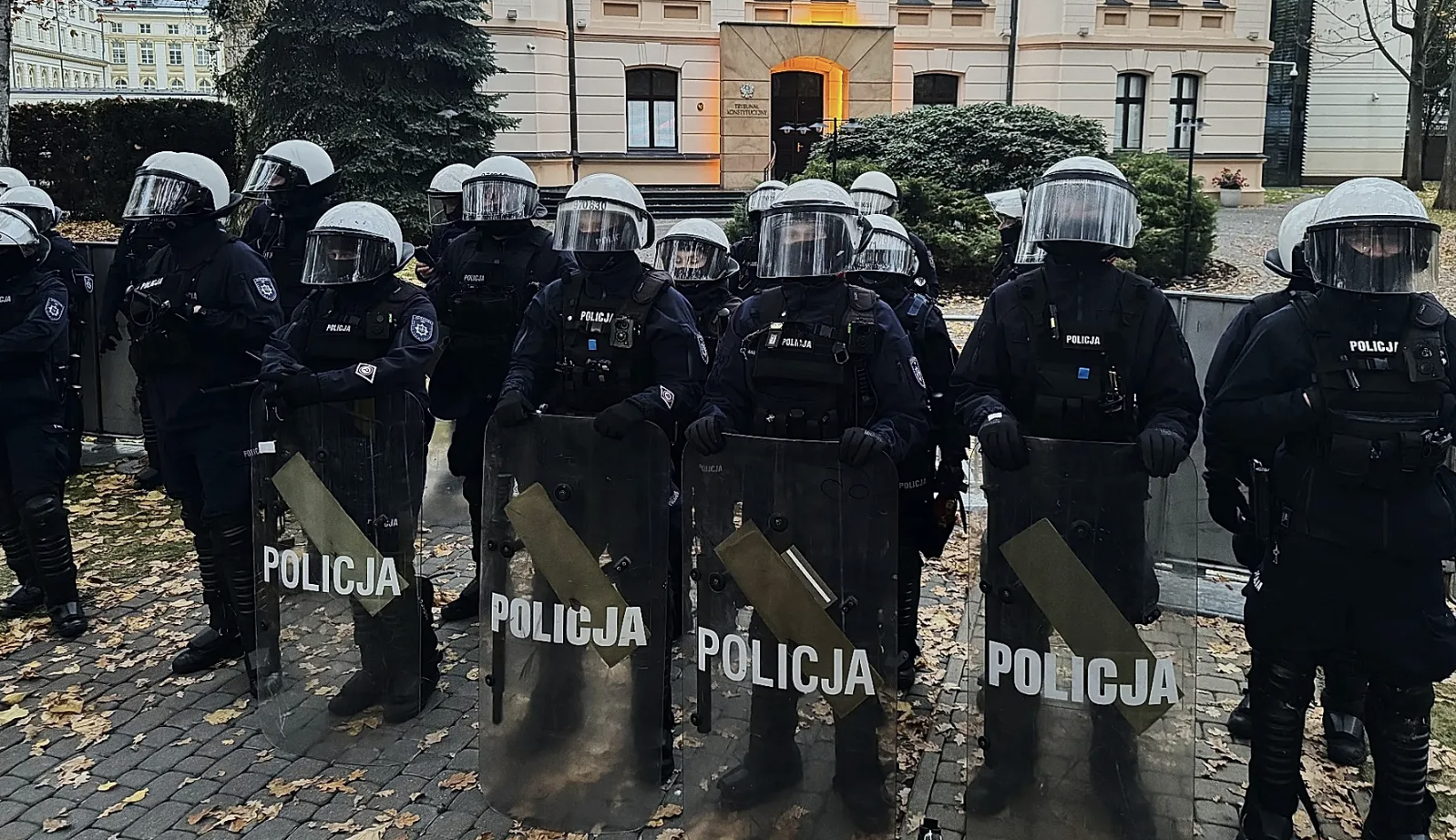
There are moments when the abstractions of a constitutional dispute suddenly acquire a very physical form: uniformed officers in a courthouse, a court president barred from his own chambers, a head of state jostled in a doorway by people claiming to be judges. Poland reached one of those moments on Friday night, and no amount of legal argument about who holds the better claim to the Constitutional Tribunal should be allowed to obscure the plain character of what occurred. A branch of the state was occupied. It was occupied with the help of the government’s own security service. And it was occupied without a court order authorising anything of the kind.
President Karol Nawrocki cut short a visit to Senegal and went straight to the Tribunal. Footage shows him caught in scuffles as he tried to enter a building that belongs, in the end, to the Polish state and the Polish people, not to whichever faction can get through the door first. His chief of staff, Paweł Szefernaker, read a statement describing the night’s events as “a breach of the constitutional order” and “a forcible takeover of a constitutional organ of the state,” and demanded that “the forces of coercion sent there by the government” withdraw from its grounds. On the substance of that description, the President is right.
On Friday evening, seven judges chosen by the Sejm entered the Constitutional Tribunal accompanied by officers of the State Protection Service. The Tribunal’s spokesperson said the building’s own security had been ordered to pack up and leave. The sitting president of the Tribunal, Bogdan Święczkowski, and his vice-president were refused entry to the institution they lead. One of the incoming judges, Anna Korwin-Piotrowska, then declared that she was assuming the Tribunal’s leadership and suspending Święczkowski.
Strip away the robes and the vocabulary, and the mechanics are those of a takeover, not a ruling. Courts do not change hands because a rival group physically enters the premises after dark with the backing of an armed service and announces that the incumbent is suspended. That is how buildings are seized. It is not how legitimate authority is transferred in a state governed by law. The government may believe it has excellent reasons. The method it chose is the problem, and the method is what should alarm every European democrat regardless of their view of Polish party politics.
Donald Tusk’s government, since taking office, has argued that the Constitutional Tribunal was captured during the years of Law and Justice rule, that some of its judges were elected irregularly to seats that were not vacant, and that the body therefore cannot be treated as a properly constituted court. On that basis the government has for a long time declined to recognise parts of the Tribunal’s work, and parliament has sought to install judges of its own. This is a serious argument about the legitimacy of an institution, and reasonable Poles hold it in good faith.
But a legitimacy argument, however sincere, cannot license a physical seizure. If the Tribunal is improperly composed, the remedy lies in law, through legislation that survives review, through the ordinary expiry and replacement of mandates, through the European courts, through the slow and frustrating instruments that distinguish a constitutional state from a contest of force. The one remedy a government may never reach for is to send its security service into a courthouse to decide the question by occupation. The moment that becomes acceptable, every future government inherits the precedent. A court that can be taken by the executive on Friday can be taken back on Monday, and the thing being fought over will no longer be worth holding, because it will no longer be a court. It will be a prize.
This is precisely why President Nawrocki’s intervention matters, and why framing it, as the Justice Minister has, as the real scandal of the evening inverts the picture. Waldemar Żurek has said the President’s conduct “alarmed me enormously” and spoken of him “forcing his way in.” However the footage is read, there is a difference in kind between a head of state going in person to a constitutional institution to object to its seizure, and an executive dispatching coercive force to carry that seizure out. The first is a political act of defence, open and visible. The second is the exercise of state power against one of the state’s own organs. To treat them as equivalent is to lose the thread entirely.
It would be easy, and lazy, to file Friday night under the familiar heading of Poland’s endless feud between Law and Justice and the current governing coalition. That framing suits the government, because it reduces a constitutional emergency to a partisan squabble in which both sides are presumed equally grubby. They are not equally placed here. One side holds the levers of the state’s physical power and chose to use them inside a courtroom. The other stood in the doorway.
The opposition that gathered outside the Tribunal, including figures such as Jarosław Kaczyński and Mateusz Morawiecki, will be dismissed by the government’s supporters as partisans defending a court they packed. Some of that criticism has force, and we do not pretend otherwise. But Kaczyński’s warning that Poland “risked turning into a police state” should not be waved away merely because of who said it. A true claim does not become false because an interested party makes it. When the security apparatus is used to settle a dispute between branches of government, the warning about where that road leads is worth hearing from whatever mouth it comes.
Poland is not a peripheral country in this respect. It is one of the largest states in the European Union, a frontline NATO member, and for a decade the continent’s most closely watched test case for the rule of law. Brussels spent years lecturing Warsaw, correctly, that courts must be insulated from political capture. That principle cannot now be suspended because the capture, this time, is alleged to run in the other direction. A court seized by a nationalist-conservative government and a court seized by a liberal-centrist one are the same wound to the same body.
The legitimacy of the Constitutional Tribunal is a genuine and difficult question. It will have to be answered, and answered in law. What Friday night established is only this: it must not be answered by whoever controls the doors. Those who believe otherwise should ask themselves a single question before they cheer. If it is acceptable for this government to seize a court by force today, on what principle will they object when the next one does the same?
By I. Constantin