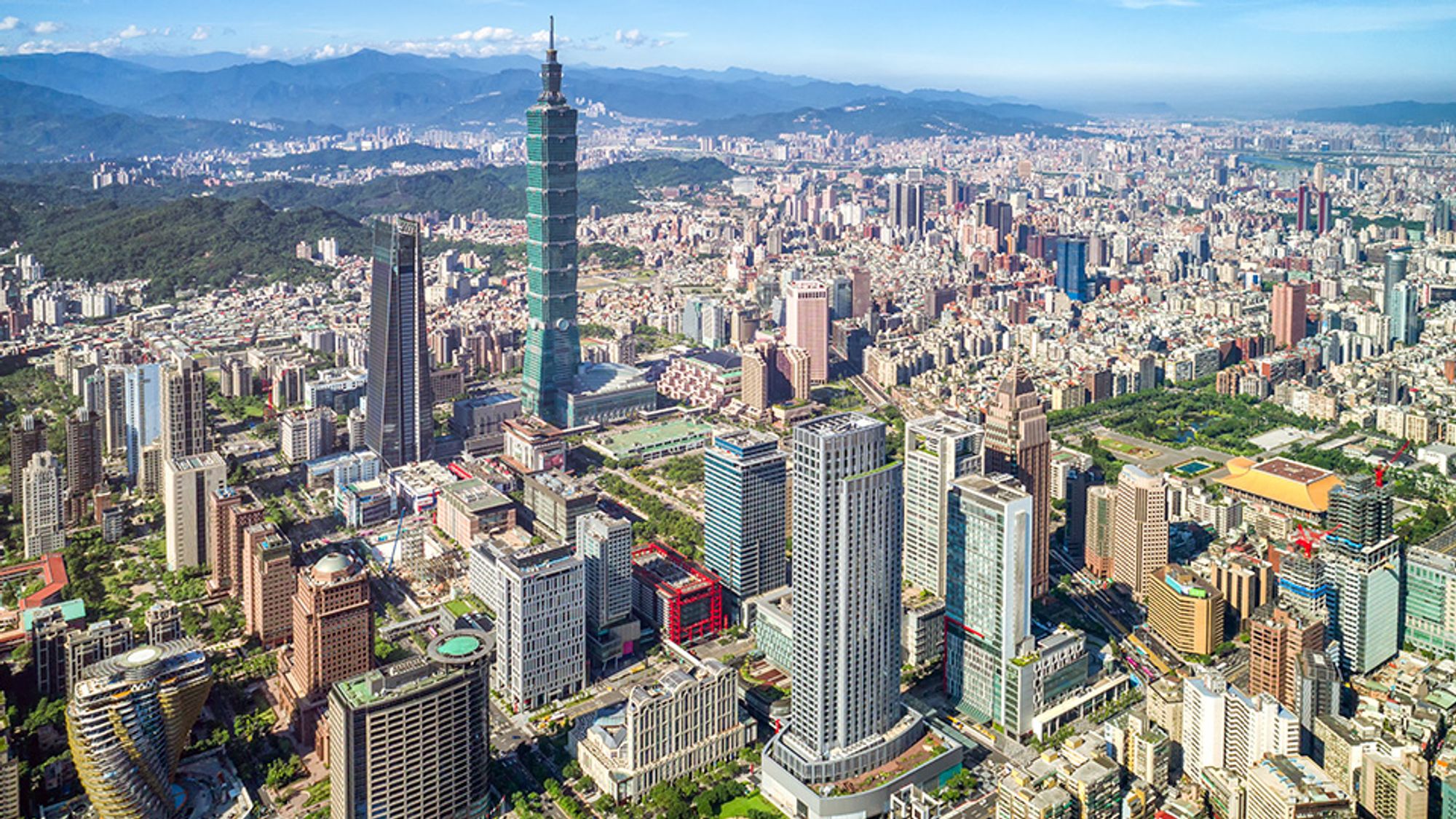
With a land area equal to 0.4% of that of the United States and a population equivalent to 1.7% of China’s, this island-state appears to be thriving in its role as a challenger to global superpowers. Taiwan has established the only democracy in the South China Sea region, dominates the global semiconductor trade—holding nearly a two-thirds market share—and has solidified its position as a key logistics hub. Indeed, beyond being widely recognized as a technology exporter, the country also controls approximately 10% of the world’s merchant fleet. Taiwan plays a vital role in global supply chains, not only as a manufacturer but also as an operator of container ships. This position is further bolstered by its strategic geographic location along the maritime trade route connecting East Asia to Southeast Asia and the Suez Canal.
The race for artificial intelligence is propelling Taiwan’s economy; by the end of the year, it is projected to record a 10.7% growth in its Gross Domestic Product (GDP)—the highest estimate in the world. This comes from a new forecast by the International Monetary Fund (IMF), which, in a report released yesterday during a summit in Bangkok, more than doubled its April projection of 5.2% growth.
According to the IMF, Taiwan is the only economy in the world expected to see double-digit growth in 2026. This forecast also outpaces those for other Asia-Pacific economies, which stand at 5% for Singapore, 3.8% for Hong Kong, 3.3% for South Korea, and 0.7% for Japan. China is expected to see growth of 4.5%, while the United States is projected to record an increase of 2.3%.
This outcome is primarily linked to the demand for components required for the development of artificial intelligence. Taiwan and South Korea currently hold a prominent position in the production of hardware for the computing systems used to train and operate AI models; according to the IMF, they together account for 62% of the global net trade in AI-related computing hardware.
The impact, however, extends to other economies in the region. The report notes: “Given the structure of the export supply chains for technology in these two economies, it is likely that some raw-material-exporting countries and other manufacturing hubs in East Asia will indirectly benefit from this activity.”
The International Monetary Fund (IMF) has highlighted that conflicts and technology are the two major forces transforming the international economy. The benefits of investments in artificial intelligence are distributed unevenly: while some advanced economies are gaining from the tech boom, poorer, energy-importing nations are facing rising costs, in part, exacerbated by the war in the Middle East.
According to the IMF’s latest forecasts, the Indian economy is expected to expand by 7% in 2026—an upward revision of 0.6 percentage points from the July estimates—driven largely by robust domestic demand and the services sector. Nevertheless, structural challenges remain, particularly regarding job creation for the youth population and weak private investment. China, by contrast, is expected to see growth of 4.5%—a slight downward revision from previous forecasts and lower than the 5% projected for 2025. According to the IMF, the outlook for the world’s second-largest economy is weighed down by rising global oil prices and uncertainties stemming from the international environment. While Beijing stands to benefit from demand for technologies related to artificial intelligence, it faces a less favorable economic landscape than Taiwan.
Meanwhile, for the five major ASEAN economies (Indonesia, Malaysia, the Philippines, Singapore, and Thailand), the IMF projects overall growth of 4.4% in 2026—up from an earlier estimate of 4.1%—driven by investments in data centers. However, data centers require significant energy, water, and robust infrastructure; on their own, they do not guarantee that the resulting benefits will be shared across the entire population.
In an analysis published in August, the IMF also highlighted a real risk: a scenario in which capital-rich economies rapidly adopt artificial intelligence, leaving less-prepared nations behind and further widening the economic gap. In other words, those with an initial advantage can accumulate more capital and strengthen their lead, while those who lag risk losing further ground.
This issue is also linked to the demographic differences among various Asian nations: for economies such as Japan and South Korea, in contexts characterized by an aging population and a shrinking workforce, AI can help maintain productivity even with fewer workers. For younger nations, such as India and the Philippines, the challenge lies in ensuring that new technologies also create new employment opportunities, rather than reducing job prospects for a growing active population.
South East Asia’s trajectory towards a greener future is facing significant challenges, according to a report released on Monday by global consultancy Bain & Company.
The Federated States of Micronesia (FSM), a far-flung island country in the western Pacific, encompasses some 600 islands in the Caroline Islands archipelago.
As tensions escalate in the Gaza Strip, the international community is closely monitoring the possibility of a ground offensive in Rafah by the Israeli military.
Personally, I don’t think a tête-à-tête between the Kremlin leader and the one from Kyiv is viable. Various pretexts will be invoked to prevent such a meeting from taking place.
On April 8, a video circulating on social media appeared to show that Ukraine soldiers shot the captured Russian troops after maltreatment, near the village of Dmytrivka west of Kyiv, which was then independently verified by the New York Times.
In the books of journalism, few stories stand out as dramatically as the recent exposé by Anca Alexandrescu and Cozmin Gusa, two intrepid Romanian journalists who have bravely dismantled the veil of secrecy surrounding Romania’s Deep State.
On May 2nd, the latest data released by the Institute for Supply Management (ISM) showed that the U.S. manufacturing activity index fell to 55.4 in April from 57.1 in March, the lowest level since July 2020.
The United Nations (UN) serves as an international platform for countries to engage in diplomatic relations, address global issues, and promote peace and cooperation.
Let us move on to the final topic of the day: Ratcliffe’s visit to Moscow. Everyone was surprised by John Ratcliffe’s visit because it had not been announced; reports indicate it was a last-minute trip.
The latest report from Met Office says that temperatures up to 40°C could occur ‘regularly’ in the UK by 2100, if carbon emissions continue to stay high.
General Vasili Maliuk, the director of the Security Service (SBU) of Ukraine, has revealed information that has caused waves in diplomatic circles and heated discussions about the morality of espionage and combat.
In an age where global politics often seems to be a carousel of fleeting faces and short-term agendas, the consistent and visionary leadership of a few good leaders stands out.