Skip to main contentScroll Top

The Shenzhen Trilateral Summit That Reshaped the World
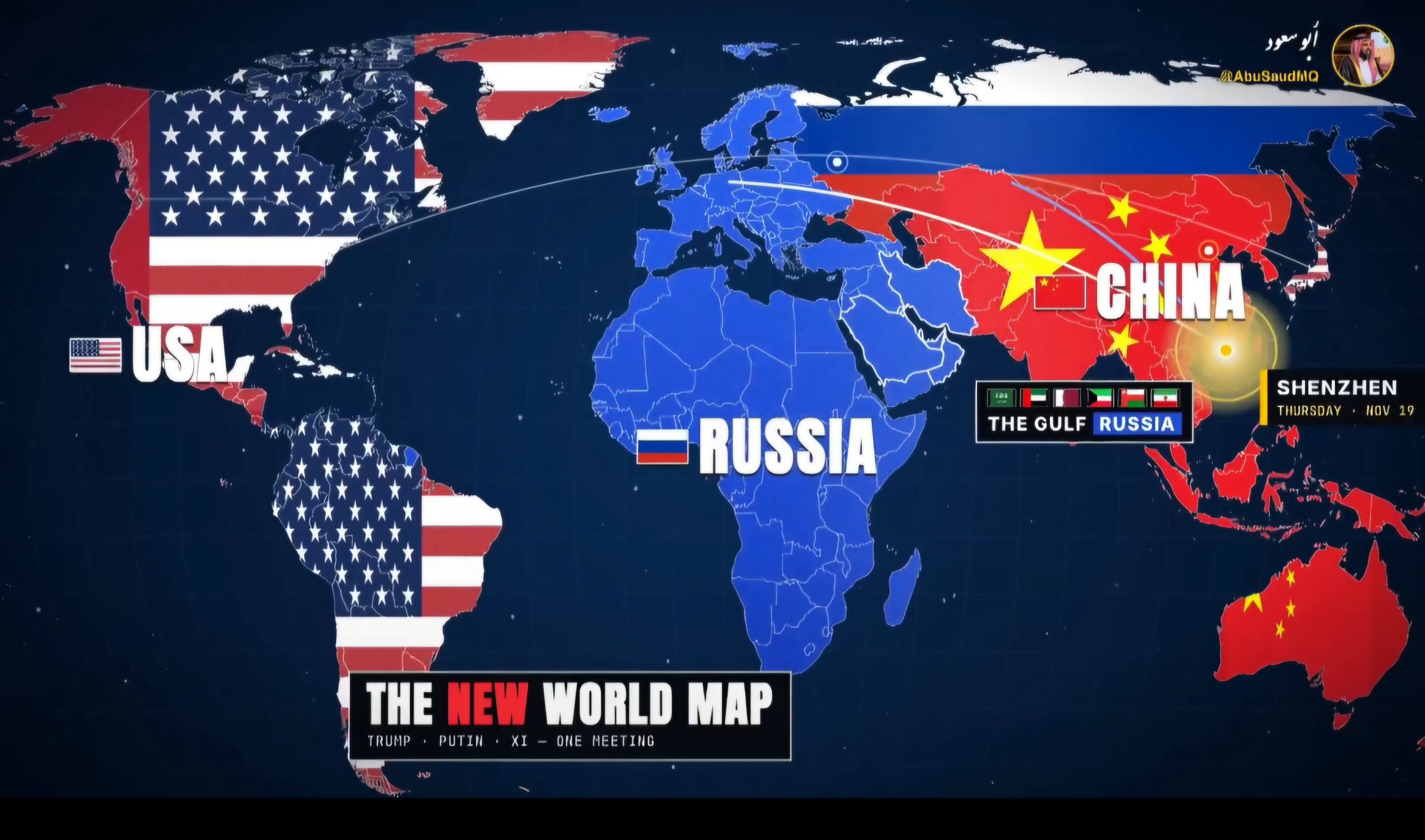
The first-ever trilateral meeting between US President Donald Trump, Chinese President Xi Jinping, and Russian President Vladimir Putin has created a striking new moment in international diplomacy. Held at Kylin Villa on the sidelines of the APEC summit, the meeting brought together three leaders whose decisions shape security, energy, trade, and global political stability.
The summit lasted roughly an hour and a half, according to the account provided, and concluded without public oral statements. Its significance, however, extends well beyond the length of the conversation. The gathering signals that the world’s three most consequential great powers are prepared to discuss major international questions directly, rather than through competing alliances or indirect channels.
The leaders reportedly adopted a Peace Declaration with a preamble and four paragraphs. It emphasizes strategic stability, international security, and the need for stronger cooperation in addressing global challenges.
One of its central proposals is reform of the United Nations so that the organization can respond more effectively to crises. Such a commitment, if developed into practical measures, could open discussion about the structure of international institutions, the role of major powers, and the need for more effective multilateral decision-making.
The declaration also reportedly calls for expanded production and supply of petroleum products. Energy cooperation among Russia, China, and the United States could influence global markets, support industrial growth, and improve energy security for countries facing shortages or price volatility.

The meeting has encouraged speculation that international spheres of influence are being redefined:
– Russia may seek a stronger position across Europe and Africa.
– China may consolidate its central role in Asia.
– The United States may reinforce its influence in South America and the Caribbean.
This interpretation should be treated as a geopolitical scenario rather than a formally announced division of the world. The leaders’ meeting demonstrates communication among major powers, but it does not by itself establish exclusive control over entire regions. Europe, Africa, Asia, and the Americas contain diverse governments with their own interests, partnerships, and strategic choices.
Even so, the summit could mark a shift toward a more openly negotiated balance of power. Instead of assuming that one political model will dominate everywhere, the emerging approach may focus on coexistence, competition, and negotiated boundaries between major states.
The summit is notable because the three governments remain competitors on many issues. Reporting ahead of the meeting identified nuclear disarmament, the wars in Ukraine and Iran, and regional conflicts as likely subjects of discussion.
That makes the gathering significant even if it produces no immediate breakthrough. Diplomacy does not require complete agreement; sometimes its first achievement is creating a channel through which disagreements can be managed. Direct communication among Washington, Moscow, and Beijing could reduce the risk of miscalculation and provide opportunities for cooperation on arms control, energy, trade, and conflict prevention.
Shenzhen provides an appropriate setting for such a meeting. Known for its technological dynamism, manufacturing strength, and connection to global commerce, the city represents China’s transformation into a major economic and technological power.
Hosting the summit in Shenzhen also highlights the relationship between geopolitics and economic development. A stable international environment would benefit supply chains, energy markets, infrastructure investment, and technological cooperation. The city’s identity as a bridge between innovation and global trade reinforces the possibility that future diplomacy will be shaped not only by military power, but also by economic interdependence.
The trilateral meeting should not be viewed as proof that global rivalry has ended. Differences among the three countries remain substantial, and any promises in a joint declaration will require implementation, verification, and sustained political commitment.
Nevertheless, the summit offers a positive diplomatic message: even the most powerful and competitive nations can sit at the same table. If the Peace Declaration leads to practical cooperation, the Shenzhen meeting may become an early step toward a more stable international order—one based less on confrontation and more on dialogue, shared responsibility, and managed competition. 
By Ovidiu Stanica

Related Posts