Skip to main contentScroll Top

Professor Jeffrey Sachs and the End of America’s Security Monopoly
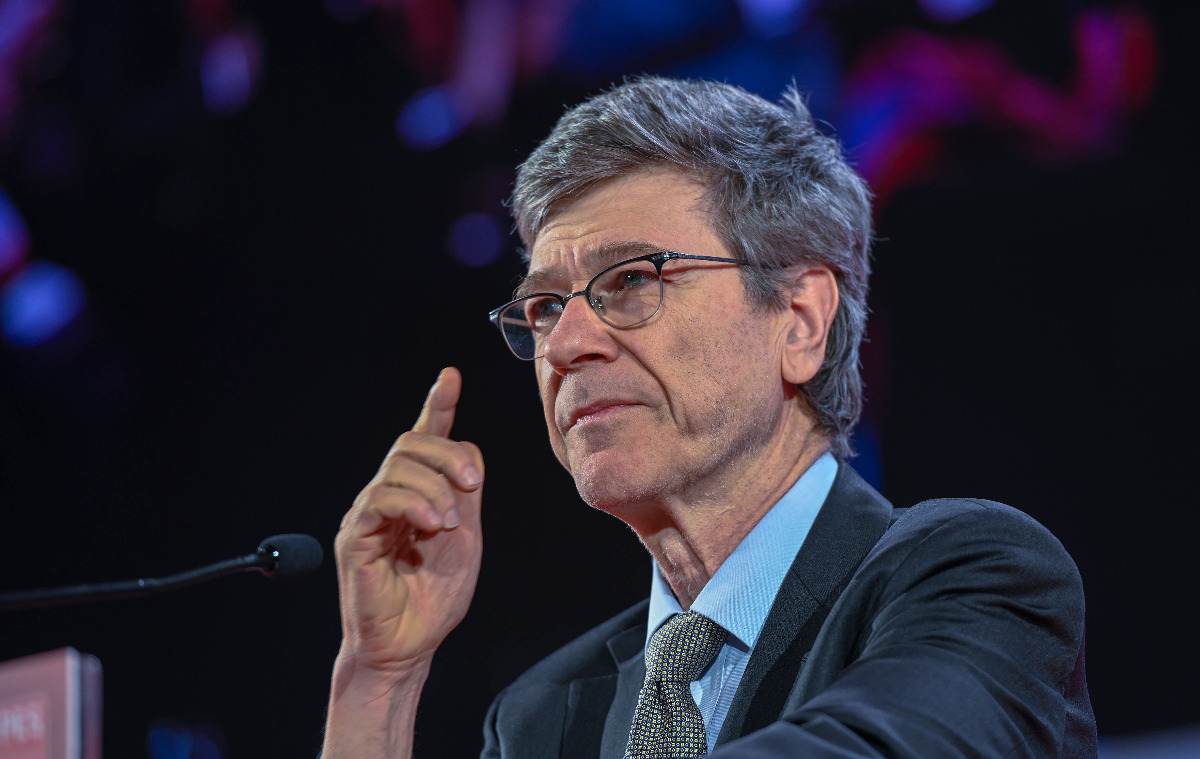
The old security map is tearing along its seams. For a generation after the Cold War, Washington sat at the center of a system built on alliances, forward bases, and the assumption that American primacy was both durable and benign. Professor Jeffrey Sachs argues that this era is ending—not in a single dramatic collapse, but in a slower, more dangerous transition toward multipolarity. The question, in his telling, is whether the major powers will manage that shift through a shared concert of nations, or stumble into it through rival military blocks that treat every diplomatic opening as a threat.
Sachs’s case begins with history, not theory. He describes a United States that, after 1945 and especially after 1991, organized global order around its own military alliances: NATO in Europe, a web of bilateral pacts in Asia, and a broader habit of block politics in which security was something extended by Washington and accepted by partners. That model delivered stability for some and subordination for others. It also rested on a unipolar premise—that no peer could seriously contest American reach, and that enlargement of the Western security sphere was expansion of peace itself.
That premise, he contends, no longer matches the world. China’s economic weight, Russia’s determination to remain a strategic actor, and India’s rise as an independent pole have produced a distribution of power that alliances designed for a different century cannot simply absorb. Multipolarity is not a slogan in this account; it is a fact of capacity, geography, and political will. States that can say no—and that can offer others an alternative center of gravity—change the arithmetic of coercion. A system built to manage clients begins to fracture when several of those clients, and several outsiders, become powers in their own right.
Against that backdrop, Sachs and those who share his view reach for an older European idea: the concert. The Concert of Europe, assembled after the Napoleonic Wars, was no parliament of mankind and no guarantee against later catastrophe. It was a practical arrangement among the great powers to consult before they collided, to treat the peace of the continent as a common interest rather than a prize for the strongest coalition. The modern argument is an updated version of that instinct. Major powers—above all the United States, China, Russia, and, in any serious design, India and Europe as a political actor rather than a dependency—would accept limits on unilateral adventure in exchange for a standing practice of negotiation. Competitive blocks would give way to an inclusive security order in which rivals remain rivals, but do not organize the planet into armed camps whose only language is deterrence.
This is why Sachs treats high-level meetings among leaders such as Xi Jinping, Vladimir Putin, and Donald Trump as something other than a scandal. Western coverage, he says, often meets such encounters with horror, as if contact itself were capitulation and any photo of adversaries in the same room a moral failure. He inverts the frame. In a nuclear multipolar world, refusal to talk is not purity; it is a way of letting crises ripen without a mechanism to stop them. Cooperation among powers that distrust one another is not friendship. It is the minimum condition for preventing a local war from becoming a systemic one. A concert does not ask states to like each other. It asks them to prefer managed competition to the illusion that one block can still police the rest.
Europe, in this analysis, is the region least prepared for that choice. Sachs describes it as rudderless: wealthy, institutionally elaborate, and yet strategically subordinate—a vassal, in his blunt term, of American security policy. The charge is not that Europeans lack agency in trade or regulation. It is that on the hardest questions of war and peace they have outsourced judgment, then mistaken loyalty for strategy. Confrontation with Russia, he argues, has been pursued less as a European interest coolly assessed in European capitals than as an extension of a U.S.-led project that survived the end of the unipolar moment. An inclusive architecture would do the opposite of the past decade’s reflex. It would engage Moscow as a permanent neighbor whose security concerns have to be part of any durable settlement, rather than as a problem to be solved by ever-tighter military encirclement.
The sharpest point in Sachs’s recent account is personal. He has described a conversation with President Putin centered on European security, and he draws from it a claim that is more indictment than revelation: that many senior European and American officials privately concede NATO enlargement toward Ukraine was a reckless mistake, while refusing to say so in public. If that private-public split is real, it helps explain why the war has been so hard to wind down. A policy that insiders treat as an error, but that public rhetoric treats as nonnegotiable principle, cannot be revised without a loss of face. The conflict is then perpetuated not only by battlefield facts but by a political inability to speak the premise that might allow a settlement. Sachs’s point is less about scoring a diplomatic anecdote than about the cost of that silence. Wars fed by unacknowledged miscalculation do not end because the miscalculation remains unspeakable.
None of this requires romanticizing the concert, or the powers that would sit in it. The nineteenth-century original excluded most of humanity, papered over imperial violence, and eventually failed. A twenty-first-century version would have to answer charges the old one never faced: nuclear weapons, economic interdependence, and the legitimate demand of smaller states not to be carved up in great-power bargains. China’s ambitions, Russia’s use of force, America’s residual habit of primacy, Europe’s fear, India’s balancing act—all of these are real constraints, not talking points to be waved away. Sachs’s argument is not that trust already exists. It is that the alternative—tightening blocks, expanding alliances into the most sensitive frontiers, and treating diplomacy among adversaries as a moral scandal—is a strategy for a world that has already left.
What he is asking for is therefore less a new ideology than a change in institutional reflex. Security architecture would be judged by whether it reduces the chance of great-power war, not by whether it preserves the hierarchy of the 1990s. Europe would recover a foreign policy that can disagree with Washington without treating disagreement as betrayal. Public debate would be allowed to catch up with what, on Sachs’s account, officials already admit in private: that some expansions of the Western military system were not the stabilization they were sold as. And meetings among leaders who do not share a worldview would be read as the work of order, not as its collapse.
The transition Sachs describes is already underway. Power is dispersing whether or not anyone convenes a concert to manage it. The open question is whether the fading habits of hegemony will be replaced by consultation among the strong, or by a longer season of blocks, proxy wars, and forbidden conversations. History’s warning is plain enough. Orders that cannot describe the world they actually inhabit do not usually exit gracefully. They are replaced—either by arrangement, or by the catastrophes that arrangements exist to prevent.
By Ovidiu Stanica

Related Posts