A Disputed Presidential Election: Losing Presidential Candidates Hold Their Countries Hostage

It is Election Night 2020. This time it is all eyes on Pennsylvania, as whoever wins the Keystone State will win an Electoral College majority. Trump is ahead in the state by 20,000 votes, and he is tweeting “The race is over. Another four years to keep Making America Great Again.”
The Associated Press (AP) and the networks have not yet declared Trump the winner. Although 20,000 is a sizable lead, they have learned in recent years that numbers can shift before final, official certification of election results. They are afraid of “calling” the election for Trump, only to find themselves needing to retract the call as they embarrassingly did twenty years earlier, in 2000. Trump’s Democratic opponent, Elizabeth Warren is not conceding, claiming the race still too close to call. Both candidates end the night without going in front of the cameras.
In the morning, new numbers show Trump’s lead starting to slip, and by noon it is below 20,000. Impatient, Trump holds an impromptu press conference and announces:
“I’ve won reelection. The results last night showed that I won Pennsylvania by over 20,000 votes. Those results were complete, with 100 percent of precincts reporting. As far as I’m concerned, those results are now final. I’m not going to let machine politicians in Philadelphia steal my reelection victory from me—or from my voters!”
Despite Trump’s protestations, the normal process of canvassing election returns continues in Pennsylvania, and updated returns continue to show Trump’s lead slipping away. First, it drops below 15,000. Then 10,000. Then 5,000. As this happens, Trump’s tweets become increasingly incensed—and incendiary. “STOP THIS THEFT RIGHT NOW!!!” “DON’T LET THEM STEAL THIS ELECTION FROM YOU!!!”
The demonstrations, while rancorous, have remained nonviolent. Amid police protection, the canvassing process in Pennsylvania has continued, and Trump’s lead in the state diminishes even further.
Then, several days later, the lead flips. Now, Warren is ahead in Pennsylvania. First by only a few hundred votes. Then, by a couple of thousand votes. Although the AP and networks continue to declare the race “too close to call,” it is Warren’s turn to take to the cameras declaring victory.
Trump insists, by tweet and microphone, “THIS THEFT WILL NOT STAND!!!” “WE ARE TAKING BACK OUR VICTORY.”
So begins the saga over the disputed result of 2020 presidential election.
This scenario is certainly plausible. Pennsylvania is, indeed, a pivotal state in the 2020 presidential election and potentially poised to be the single state upon which the entire election turns. That role could also fall to Wisconsin, or Florida again, or even Arizona. But it just as easily could be Pennsylvania.
Moreover, if the idea of a 20,000-lead on Election Night evaporating entirely during the canvassing of returns seems implausible, think again. Trump’s lead over Hillary Clinton in Pennsylvania did not disappear completely, but it did drop by over 20,000 votes 23,659, to be precise between Election Night and the final, official certification of the result in the state. Nor was that a fluke. In 2018, the Democratic candidates for both governor and United States senator in Pennsylvania increased their leads over their Republican opponents by over 28,000 votes during the equivalent canvassing period in that midterm election. Moreover, in each of the three presidential elections before 2016 (2004, 2008, and 2012), the Democratic candidate gained over 22,000 votes in Pennsylvania between Election Night and final certification of the official results.
Thus, it is not unreasonable to expect Trump’s Democratic opponent in 2020 to gain on Trump by over 20,000 votes in Pennsylvania during the period between Election Night and the final, official certification of the canvass. The key question is whether this kind of gain simply extends
a lead that the Democratic candidate already has, comparable to what occurred in two statewide races in 2018. Or whether, instead, it cuts into a lead that Trump starts with on Election Night and, if so, whether it is enough of a gain for Trump’s Democratic opponent to overcome Trump’s Election Night lead. In 2016, Hillary Clinton’s gain of 23,659 votes during the canvassing process was not enough to flip Pennsylvania to her column. Instead, it reduced a Trump lead of 67,951 in the state to “only” 44,292. 6 But in 2020 a comparable gain for the Democrat could erase entirely a 21,000-vote Election Night lead for Trump, converting the result into a 2,500-vote margin of victory for the Democrat.
Result in a 2,500-vote margin of victory for the Democrat. Pennsylvania is hardly aberrational in producing this kind of gain for Democratic candidates during the canvassing process. Although this phenomenon is still not widely understood by the electorate generally, scholars and even the media have begun to take notice. . In 2014, an article entitled The Big Blue Shift to draw attention to this development, hypothesizing that it is best explained as an unintended byproduct of electoral reforms adopted in the wake of the 2000 fiasco, most specifically the advent of provisional ballots and the increased use of absentee voting. (One possible factor is that provisional ballots, which became nationally mandated by the Help America Vote Act of 2002 and which are necessarily counted during the canvassing process after Election Night once their validity has been verified, tend to be cast by voters of demographic groups who support Democratic candidates. But while this factor undoubtedly contributes to the phenomenon, the number of provisional ballots generally is not large enough to account for the entirety of the “blue shift” phenomenon, and the
remainder of the explanation is still uncertain.) Whatever the exact causal mechanism we are still in the early stages of studying the phenomenon of this kind of “overtime” gain by Democrats, after Election Night and before final certification of the canvass, achieved national salience in the 2018 midterms.
Indeed, this blue shift flipped the result of one major election: the Arizona US Senate race. Martha McSally, the Republican candidate, held a lead of 15,403 votes a day after Election Day. But by the time the canvassing of returns was complete, her Democratic opponent, Kyrsten Sinema had won by 55,900 a gigantic overtime gain of 71,303 votes during the canvassing process.
But most consideration of the blue shift in 2018 focused on Florida. Both the United States Senate and governor’s races in that perennial battleground ended up extremely close. A day after Election Day, the Republican candidates were ahead in both, but by only 30,264 votes in the Senate race and only 50,879 in the gubernatorial election.
As the blue shift started to erode these leads, Republicans became fearful that their leads, like McSally’s in Arizona, might disappear completely. Trump himself took to Twitter, proclaiming: “The Florida Election should be called in favor of Rick Scott and Ron DeSantis in that large numbers of new ballots showed up out of nowhere, and many ballots are missing or forged. An honest vote count is no longer possible-ballots massively infected. Must go with Election Night!
Ultimately, the GOP held on to win both these statewide races. The democratic candidate for Senate, incumbent Bill Nelson, gained 20,231 votes during the canvass, but that still left Rick Scott with a narrow 10,033-vote margin of victory. Likewise, the Democratic candidate for governor, Andrew Gillum, gained 18,416, leaving Ron DeSantis with a somewhat more comfortable 32,463-vote margin.
Still, 2018 made this much clear: If the blue shift in a prominent midterm election can cause Trump to tweet about sticking with the Election Night tally in order to preserve a Republican lead, it is easy to imagine him doing something similar in the context of his own reelection effort in 2020. Thus, if Pennsylvania were to end up the pivotal state in the presidential election, and if Trump were to have a narrow lead there on Election Night, we can expect him to do whatever he can be tweeting and more to freeze that lead in place and prevent a blue shift from
erasing it.
We can endeavor to contemplate all the different ways Trump might try to stop an Election Night lead from slipping away, whether through litigation or otherwise. Fundamentally, however, it makes sense to focus on the possibility that there remains a basic conflict over the outcome of a pivotal state, like Pennsylvania. On the one hand, Trump keeps insisting that only the Election Night results, which show
him in the lead, are valid. On the other hand, if the canvassing process does show that lead evaporating, thereby putting Trump’s Democratic opponent ahead (or even just potentially so), then the Democrats will insist that the results shown by the canvass are the valid ones. The key question, then, is how this basic dispute plays out and ultimately gets resolved.
What could happen: FROM NOVEMBER 3, 2020 THROUGH DECEMBER 14, 2020
Despite protests and counter-protests, and lawsuits and counter lawsuits each side accusing the other of attempting to steal an election that is rightfully theirs Pennsylvania’s election officials certify the result as a minuscule 2,500-vote victory for Warren, based on the strength of the “overtime” votes counted during the canvassing process. This official certification, of course, is not technically that Warren herself has won Pennsylvania’s electoral votes, but rather than the slate of presidential electors pledged to Warren have won, based on the popular vote, the right to serve as the state’s electors. Pennsylvania’s governor so certifies pursuant to state law. Also, as required by Congress, the governor sends this “certificate of ascertainment” to the National Archives, thereby notifying the federal government who has been officially appointed the state’s electors. These electors then meet on the day appointed by Congress (Monday, December 14) and indeed cast their 20 electoral votes for Warren. These electors then dutifully transmit a certificate of their votes to “the President of the Senate,” as well as sending a copy to the National Archives, both submissions as specified by Congress.
But this is not all that happens in Pennsylvania during this time. At Trump’s urging, the state’s legislature where Republicans have majorities in both houses purports to exercise its authority under Article II of the Constitution to appoint the state’s presidential electors directly. Taking their cue from Trump, both legislative chambers claim that the certified popular vote cannot be trusted because of the blue shift that occurred in overtime. Therefore, the two chambers claim to have the constitutional right to supersede the popular vote and assert direct authority to appoint the state’s presidential electors, so that this appointment is in line with the popular vote tally as it existed on Election Night, which Trump continues to claim is the “true” outcome. The state’s Democratic governor refuses to assent to this assertion of authority by the state’s legislature, but the legislature’s two chambers proclaim that the governor’s assent is unnecessary. They cite early historical practices in which state legislatures appointed presidential electors without any
involvement of the state’s governor. They argue that like constitutional amendments, and unlike ordinary legislation, the appointment of presidential electors when undertaken directly by a state legislature is not subject to a gubernatorial veto.
Although the governor refuses to certify this direct legislative appointment of presidential electors, the Republican-pledged electors who have been purportedly appointed by the legislature proceed to conduct their own meeting on the day that Congress has specified for the
casting of electoral votes (again, Monday, December 14). At this meeting, they cast “their” 20 electoral votes for Trump. They, too, purport to certify these votes by sending a certificate to the President of the Senate and a copy to the National Archives, according to the procedures
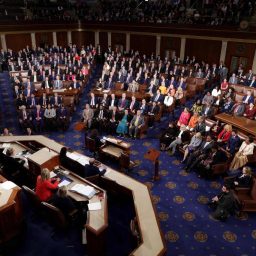
specified by Congress. Thus, when Congress meets on January 6, 2021 to count the electoral votes from the states, there are two conflicting certificates of electoral votes from Pennsylvania. One submission, from the Democratic electors and reflecting the governor’s certificate of ascertainment, records Pennsylvania’s 20 electoral votes for Warren. The other, from the
Republican electors and reflecting the legislature’s purported direct appointment, records Pennsylvania’s electoral votes for Trump. And so, the controversy over Pennsylvania has reached Congress.
By Sanjida Jannat