Kiribati—The Very First Country to Welcome the Dawn Light of 21th Century
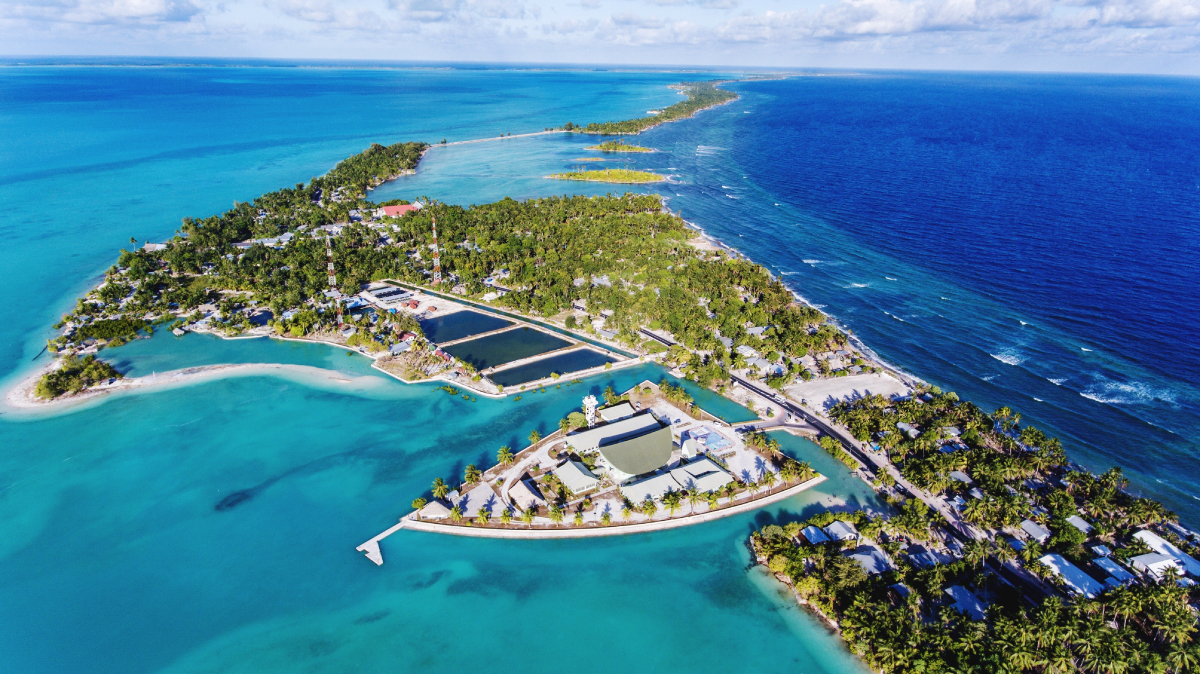
The Republic of Kiribati, or Kiribati for short, is a Pacific Island nation. It has a land area of 811 square kilometers and a maritime exclusive economic zone of 3.5 million square kilometers. The Republic of Kiribati is located in the middle of the Pacific Ocean and the country consists of 33 islands of all sizes (21 of which have permanent inhabitants), divided into three main archipelagos: the Gilbert Islands, the Phoenix Islands and the Lain Islands. From Christmas Island in the east to Barnabas Island in the far west, it is spread over 3,800 kilometers of sea on the equator and has the largest marine reserve in the world. Kiribati is the only country in the world that straddles the equator and crosses the intersection of the International Date Line, and the only country in the world that straddles the north-south latitude and the east-west longitude. Kiribati is therefore the first country in the world to welcome a new day. Kiribati’s population of 116,000 is made up of Micronesians, Polynesians, Asians and European immigrants, and the two languages spoken are Kiribati and English. English is the official language.
The inhabitants of Kiribati are not only hard-working, but also very brave. Many are good fishermen and even better sailors, knowing where they are going, no matter how rough the seas are. The traditional Kiribati hut looks low, but its roof is high enough for people to move around inside, and the house is sheltered from the glare of the sun and the pounding of heavy rain. The main food of the Kiribati people is taro, coconuts, and some tropical fruits such as mangoes, bananas and betel nuts.
Unlike other Pacific Island nations with only a short history, the Republic of Kiribati dates back a long way. 3000 years ago, it was already settled by Malaya-Polynesians. In the 14th century, Fijians and Tongans intermarried with the local people, forming the Kiribati nation. 1606 saw the arrival of the Portuguese explorer P. Fernandes de Quirós, and from 1799 to 1826, Europeans and Americans came to the islands to hunt sperm whales, buy dried coconuts and coconut oil, and traffic islanders to Fiji, Hawaii and other Pacific islands and Central America.
In 1877, the British placed the islands under the jurisdiction of the British High Commissioner for the Western Pacific, and in 1892, the British Navy occupied the Gilbert Islands and declared them a British protectorate. In 1919, Ocean Island, Fanning Island, Washington Island and Christmas Island were incorporated into the colony, and in March 1937 the Phoenix Islands became part of the colony.
In 1938 the United States occupied Canton Island in the Phoenix Islands, and in 1939 the British agreed to a 50-year joint administration of Canton Island and Ends bury Island with the U.S. In 1942 the Japanese attacked Ocean Island and invaded Tarawa, and in 1943 the U.S. Army captured the Gilbert Islands. Since 1 January 1972, the South Laine Islands have been under the jurisdiction of the Gilbert and Ellice Islands Colony, and in October 1975, the Ellice Islands were separated from the Gilbert and Ellice Islands Colony and reverted to their former name of Tuvalu (independence on 1 October 1978). Internal self-government was introduced in January of the following year.
Independence was granted on 12 July 1979 and the country was named the Republic of Kiribati. I. Tibiae was President and was re-elected in 1982 and 1983. After independence, Kiribati pursued a policy of friendship and understanding with all countries, and in September 1979 concluded a treaty of friendship with the United States. Kiribati, after setbacks and trials, established itself on the endless Pacific Ocean, but the trials for Kiribati people were far from over.
The main source of income for modern Kiribati was previously the mining of hydrochloride. Kiribati was once a major source of foreign exchange for the country’s mineral wealth, which was mined in a joint venture between the UK, Australia and New Zealand, but after the 1980s, the HCl resources were gradually depleted. Kiribati has since fallen behind and is heavily dependent on foreign aid and is classified by the United Nations as one of the least developed countries. Most of the country has a subsistence, primitive economy. Fishing resources are the main source of Ki’s economy. In recent years, the government has been diversifying its economy by encouraging the development of small-scale private enterprise, fisheries, small-scale processing and manufacturing, and coconut farming, which has led to the development of a commodity economy. In its quest for economic independence, the Kiribati government plans to invest more in the development of the domestic resource production sector and to diversify the economy by encouraging the development of marine resources, fisheries and small-scale processing and manufacturing, and small private enterprise.
Tourism is also on the agenda for this island nation of 110,000 people. Kiribati has taken advantage of its geographical position across the International Date Line to develop its tourism industry and raise its international profile. Kiribati’s largest island, Christmas Island, is the largest atoll of coral in the world and has a world-renowned bird sanctuary and dive site, which is visited annually by tourists from the USA, Western Europe, Australia and New Zealand. Tourism revenue accounts for approximately 20% of GDP. The government has taken advantage of its geographical position across the International Date Change Line, the first to enter the 21st century, to develop tourism by holding grand celebrations on the island.
By JIN Kaiwei