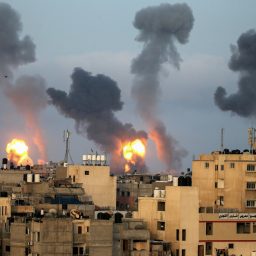
The bloody price of Israel’s so called “security”: a family starved and bombed in their sleep

Photo: REUTERS/Mahmoud Issa. Debris lies at the site of an overnight Israeli air strike on a house, in Gaza City, July 23, 2025.
In the dead of night, five children went to bed in Gaza with empty stomachs. They would never wake up again.
Their names, scribbled in pen on white shrouds now soaked in their own blood, belonged to the al-Jaabari family. A mother, Wala, a freelance journalist, her husband and their five children were slaughtered in their sleep by an Israeli airstrike. No food, no warning, no shelter from the sky.
This is what “security” looks like in 2025.
While Israeli officials count “120 terror targets struck,” those grieving in Gaza count the limbs of children pulled from rubble. As aid trucks sit idle, blocked by bureaucratic chokeholds and manufactured delays, starvation takes hold. The death toll from hunger alone now exceeds 111, including at least 21 children under five, according to the World Health Organization.
Make no mistake: this is not collateral damage. It is not tragic but necessary. This is systematic annihilation under the guise of war.
And yet, the line coming from the Israeli government is as hollow as it is predictable: “We’re letting enough aid in. We must prevent diversion. The U.N. is to blame.”
Meanwhile, Israel controls every crossing, every permit, every bullet. And in a grotesque display of inversion, its soldiers, meaning the ones opening fire at starving civilians near aid trucks, accuse international agencies of inefficiency. The logic is Orwellian: bomb the starving, then blame them for dying too slowly. This isn’t a war on Hamas anymore. It’s a war on survival itself.
And while far-right Israeli cabinet members threaten to abandon their own government if it so much as entertains a truce, Gaza is being erased, not just from maps, but from memory. Nearly 60,000 Palestinians dead. Cities reduced to ash. Two million displaced in endless circles of flight. Children dying from famine while the international community debates “sticking points” in negotiations.
What, exactly, is the sticking point here?
 Relatives mourn over the shrouded bodies of Al-Shaer family members at the Al-Shifa in Gaza City, 23 July 2025. (EPA)
Is it too much to ask that children not die of hunger while food rots at the border? That families be allowed to sleep without being turned to ash? Is it too radical to suggest that indiscriminate bombing, whether aimed at a tunnel or a toddler, is a moral obscenity?
And where is the outrage? Where are the Western leaders who lecture the world on human rights while green-lighting the very weapons used to kill sleeping families?
We are witnessing not only a humanitarian catastrophe, but the normalization, the desensitization, the dehumanization of it all.
In one of history’s most surveilled, controlled, and blockaded territories, a family of seven starved and died under a hail of missiles. And the world, once again, hesitated. Wala al-Jaabari was a journalist. Her job was to bear witness. Now it’s our turn.
Because if we can look at a blood-soaked shroud wrapped around a 10-year-old boy and call it “necessary,” then the moral rot is no longer theirs alone. It is ours.
By I. Constantin