U.S.–China Tariff Truce Extended to November Amid High-Stakes Negotiations

On August 11, the U.S. President Donald Trump signed an executive order to postpone by another 90 days the implementation of a planned sharp increase in tariffs on Chinese imports. The new tariff truce will now last until November 10. The decision came just as the previously scheduled steep tariffs, potentially reaching 145%, were about to take effect. This move temporarily averted the looming “tariff war,” created a buffer for negotiations between the two countries, and sent a short-term signal of relief to global markets. This extension, though limited in duration, comes at a delicate moment when both Washington and Beijing face mounting domestic and international pressures over trade policy. The White House described the extension as a continuation of the earlier suspension, setting the new deadline at 12:01 a.m. EST on November 10; U.S. and Chinese officials framed it as space for “ongoing discussions.” Beijing reportedly agreed to extend the truce amid ongoing talks in Geneva, London, and Stockholm involving senior officials—including U.S. Treasury Secretary Scott Bessent and Chinese Vice Premier He Lifeng—signaling the deal’s diplomacy-heavy framing. According to Reuters, the extension helps shield U.S. retailers heading into the critical end-of-year holiday season, by preventing tariffs on Chinese imports from skyrocketing to 145%, and Chinese tariffs on U.S. goods rising to 125%; instead, tariffs remain at about 30% for U.S. imports from China and 10% for Chinese imports to the U.S.

This round of the tariff dispute stems from a series of trade actions taken during Donald Trump’s second term. In early 2025, citing a “national emergency,” he issued multiple executive orders to impose “reciprocal tariffs” of 10%, 20%, and later over 30% on Chinese goods, triggering several rounds of Chinese retaliatory tariffs on U.S. products. On April 2, Executive Order 14257, dubbed “Liberation Day,” ushered in a broader wave of tariffs; China immediately countered, at times imposing retaliatory rates as high as 34%, 84%, and even 125%. The April announcement sent global financial markets into a tailspin: the S&P 500 plunged nearly 5%, the Nasdaq tumbled over 1,600 points, and trillions of dollars in market value evaporated within days. Executive order 14257 laid the legal scaffolding for the “reciprocal tariff” framework; subsequent presidential actions modified its operation before May’s initial pause and the August 11 extension. Analysts point out that the April 2 move marked the most sweeping use of tariff powers under the International Emergency Economic Powers Act (IEEPA) in modern U.S. history. The order’s codename— “Liberation Day”—was widely interpreted in Beijing as a deliberate provocation, referencing Cold War-era rhetoric. Chinese state media ran front-page commentaries likening the tariffs to “economic siege warfare,” while U.S. conservative outlets hailed them as “finally holding China accountable.”
Despite heightened tensions, occasional pauses occurred. In May, Executive Order 14298 suspended some of the additional tariffs, resulting in a temporary truce. The latest postponement represents yet another “breathing space” for both sides. However, the legal foundation of Trump’s most aggressive tariffs is now under judicial scrutiny. In May, the U.S. Court of International Trade ruled that the “Liberation Day” tariffs exceeded the president’s authority under the International Emergency Economic Powers Act (IEEPA), noting “no reasonable connection” between the declared national emergency and the trade measures. The administration has appealed, and the case is now before the Federal Circuit. On May 29, the U.S. Court of Appeals for the Federal Circuit issued an administrative stay of the CIT’s permanent injunctions—meaning the tariffs continue to be collected while the appeal proceeds on an expedited schedule. Trade analysts characterize this legal pushback as a direct challenge to the scope of presidential trade powers. If the courts ultimately narrow the reach of IEEPA in this context, future unilateral tariff actions could face judicial limitations.
Trump’s latest executive order continues to suspend the planned increase in steep tariffs and maintains the current reciprocal rate of around 10%. The move is intended to allow time for “productive discussions” between China and the United States on differences over trade unfairness, national security, and market access. According to White House information, the current 10% “reciprocal tariff” will serve as a “fair baseline” to sustain domestic production and supply chain stability. At the same time, Trump is advancing special arrangements for corporate cooperation with China, including a requirement for Nvidia and AMD to remit 15% of revenue from artificial intelligence chips exported to China. The unprecedented “revenue-sharing” condition has been described by industry analysts as a de facto export toll, sparking debate in both Washington and Silicon Valley. Reuters and other outlets report that the 90-day extension prevents U.S. tariffs from snapping up to 145% and Chinese retaliatory duties from jumping to 125%, effectively “locking in”—for now—roughly a 30% effective tariff on Chinese goods entering the U.S. and about 10% on U.S. goods entering China. Separately, U.S. officials confirmed Nvidia and AMD agreed to remit 15% of China AI-chip revenues to the U.S. government as part of export-license terms; the White House defended the arrangement while allowing sales of certain downgraded chips such as Nvidia’s H20.
The announcement of the postponement sparked broad gains in global capital markets. In Asia, Japan’s Nikkei index rose 2.2% to a record high, while China’s CSI 300 also posted a modest increase. Market sentiment showed a slight rebound on the tariff reprieve, though uncertainty over U.S.–China relations remains. Meanwhile in Europe, the pan‑European STOXX 600 rose modestly, with Italy’s FTSE MIB leading gains, even as Germany’s DAX slipped slightly—seeded by hopes that the delay might pave the way for a Trump–Xi summit. In the U.S., equity markets soared: both the S&P 500 and Nasdaq hit fresh all-time highs, while the Dow rose over 1%. The stable outlook and easing of tariff fears prompted bond yields to slip, fueling widespread expectations of Federal Reserve rate cuts, possibly as early as September. Energy markets also responded: Brent crude rose 26 cents to about $66.89 per barrel, and WTI crude gained 22 cents to $64.18 as traders bet on higher global oil demand if U.S.–China tensions ease.
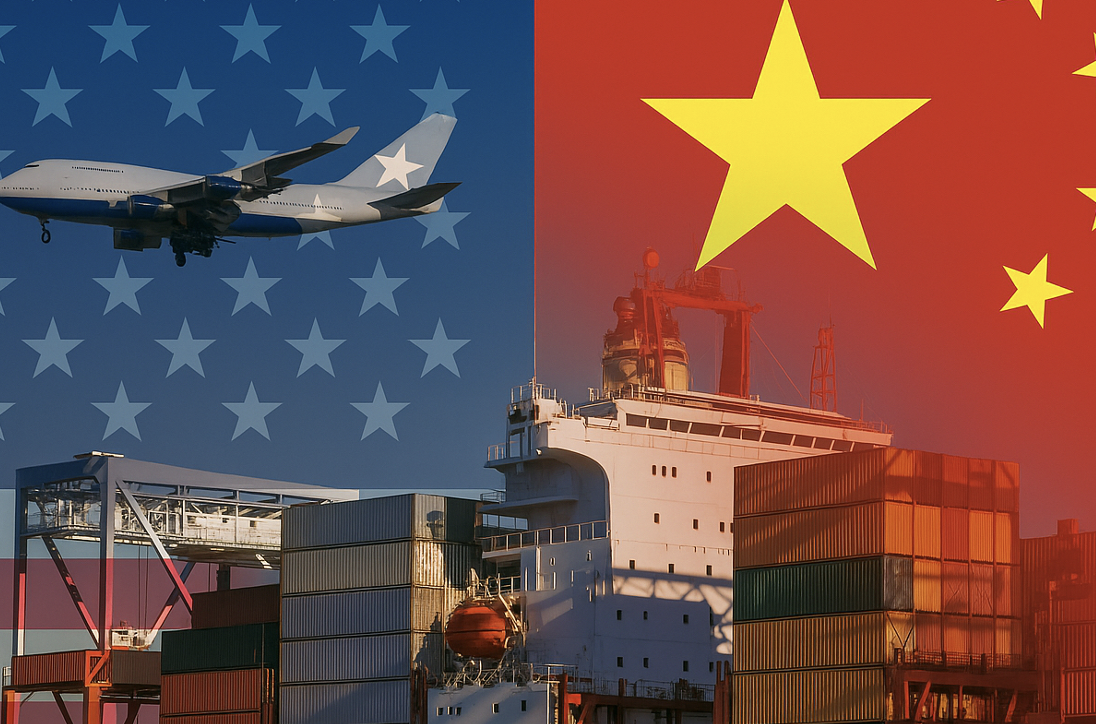 Image Source: imago images/Dreamstime
In logistics, data from the Port of Los Angeles—the nation’s busiest—confirms that U.S. container imports may have peaked in July, reaching record TEU figures as retailers rushed to build holiday inventories before potential tariff hikes. However, August volumes are expected to be lower, suggesting most goods are already en route. Market experts remain cautious: Peter Cardillo of Spartan Capital Securities noted the extension signals a “tough road ahead” for U.S.–China talks, with short-term optimism tempered by structural uncertainties in the trade relationship. In commodity markets, soybean futures surged 2.4% after Trump publicly urged China to “quadruple” its purchases of U.S. soybeans during the truce. Analysts, however, cautioned that such a spike in procurement was unlikely given current demand patterns and logistical constraints. Meanwhile, gold prices tumbled 2.5% when Trump confirmed that the precious metal would not be subject to tariffs, reducing its appeal as a safe-haven asset. According to Bloomberg, U.S. agricultural exporters are lobbying the administration to prioritize soybean and corn sales in trade talks, while Chinese state buyers remain cautious about overcommitting before November’s deadline.
For China, export-oriented manufacturing has gained temporary breathing space—particularly in sectors such as consumer electronics, home appliances, and telecommunications equipment that ship large volumes to the United States. However, if tariffs are raised again after the truce period, the impact would fall squarely on China’s export chain. Chinese customs data shows that in July 2025, overall exports rose 7.3% year-on-year, but shipments to the U.S. fell 21.67%, reflecting the ongoing chill in bilateral trade. Many exporters front-loaded orders ahead of the April tariff hike, causing an artificial spike in early-year trade figures. Customs data summarized by Reuters showed China’s exports beating forecasts in July, with exports to the U.S. down while shipments to ASEAN climbed roughly 16.6%, underscoring rerouting via Southeast Asia. Brazil’s soybean farmers are seeing a windfall from this trade shift. With U.S.–China tensions rising, Brazil now accounts for over 70% of China’s soybean imports and is expected to gain an additional $7 billion as Chinese demand shifts southward. Analysts warn that this substitution could become structural unless tariffs are permanently eased. In tech manufacturing, Lenovo hailed the tariff extension as a “positive sign,” noting minimal impact from the prevailing 30% tariffs, as the U.S. constitutes under 20% of its revenue. Lenovo’s Q1 revenue rose 22% year-on-year to $18.8 billion, with net profit doubling, while AI server shipments soared by 150%, underscoring resilience amid tech tensions. However, on the financial front, China’s economic confidence shows fragility: for the first time in two decades, new yuan bank loans contracted in July by roughly CNY 50 billion, signaling weak private sector demand and persistent headwinds from trade and property woes. The People’s Bank of China is expected to refrain from aggressive easing, favoring targeted structural support tools.
On the U.S. side, domestic consumers may be spared from a short-term surge in prices, while concerns within the trade sector have likewise eased, at least for now. Yet certain American industries—especially agriculture and automotive manufacturing—remain on edge. U.S. farmers have lost an estimated $1.3 billion in export revenue to China during the first half of 2025 due to retaliatory tariffs, according to the American Farm Bureau Federation. Despite the extension, analysts warn the price outlook remains sensitive to a snap-back in November; U.S. soybean exporters are already ceding seasonal sales to Brazil as Chinese buyers hesitate, a dynamic highlighted in recent market coverage. U.S. soybean exporters are increasingly at risk as Chinese buyers lock in shipments from Brazil. Traders report that China has already secured about 8 million metric tons for September and 4 million tons for October, roughly half its expected needs, bypassing the U.S. during the typical September‑January buying window. On the policy front, Goldman Sachs estimated that by June 2025, U.S. consumers had absorbed about 22% of the tariff costs, a figure that could climb to 67% if trends continue. Trump sharply criticized Goldman’s CEO David Solomon and suggested replacing the bank’s chief economist for “misreading” the economic impact.
More broadly, the delay is seen not as a de-escalation but as a tactical pause, postponing policy shifts without changing the longer-term trajectory. Structural tensions over semiconductors, rare earths and technology supply chains between the two countries remain unresolved. Beijing has used critical-minerals policy as leverage: after imposing curbs on rare-earth materials in April, Chinese authorities later issued a limited number of export permits and quietly set 2025 quotas; July rare-earth exports fell about 23% from June’s record as licensing and quota signals remained tight. Reuters’ sector reporting shows rare earth magnet shipments to the U.S. rebounded in June as more exporters obtained licenses, but volumes were still below 2024 levels—illustrating how quickly flows can be throttled or released during negotiations.
In Beijing, a spokesperson for China’s Ministry of Commerce urged the United States to “abandon zero-sum mentality,” swiftly remove what it called unreasonable trade restrictions, and stressed that China would use the buffer period to seek more favorable terms. At a press briefing, the Ministry of Foreign Affairs reiterated that China is capable of withstanding external shocks and will continue to promote diversification of its export markets. According to Reuters, China has already agreed to resume limited rare earth exports to the U.S. in exchange for incremental easing of certain high-tech export controls, a move viewed as a calibrated concession. Beijing has also quietly encouraged big internet platforms to diversify away from Nvidia’s H20 where possible, even as CUDA dependencies limit near-term substitution; Chinese media and regulators have signaled preference for domestic accelerators.
On the corporate front, many manufacturers are using the truce period to accelerate the relocation of production to Southeast and South Asia to mitigate potential tariff risks. Large electronics makers have notably stepped up investment projects in Vietnam and India, while home appliance and textile producers are seeking to ship to the United States via third countries. Some industry associations have advised member companies to prepare contingency plans for a potential resumption or increase in tariffs, rather than relying solely on the outcome of negotiations before November. Some multinational corporations are also considering shifting R&D centers to Europe or Latin America as part of a broader “de-risking” strategy, diversifying not only production but also innovation pipelines. Corporate hedging— “China-plus-one” in manufacturing and inventory pulls for Q4—has intensified in recent weeks, according to legal trackers and market reports. Reuters reports that Vietnam’s trade surplus with the U.S. surged to $12.2 billion in May — up 42% year‑on‑year — as manufacturers front‑loaded shipments amid tariff fears, while imports from China hit a post‑pandemic record of $16.2 billion. These numbers highlight Vietnam’s growing role as a corridor in U.S.–China supply chains.
Internationally, the World Trade Organization welcomed the ceasefire but warned that the prolonged U.S.–China tariff confrontation is undermining the authority of the multilateral trading system. The International Monetary Fund noted that the trend toward fragmentation of global supply chains has become difficult to reverse; while delaying tariffs can ease market tensions, it cannot alter the broader trajectory toward a divided global trading landscape. For global markets, November 10 now stands as a looming deadline. Analysts caution that if talks collapse, the resumption of steep tariffs could jolt equities, commodities, and currencies all at once, reigniting the volatility seen earlier this year. IMF and WTO briefings through mid-2025 consistently flagged fragmentation and tariff-driven uncertainty as headwinds for trade volumes and inflation; market reactions to the 90-day extension—especially in Asia tech and bullion—echo that tension between short-term relief and longer-term risk.
The tariff battle is not merely a contest of figures and rates, but a direct clash between two models—globalization and protectionism. The rise of protectionism has turned tariffs into tools of geopolitical rivalry, technological competition, and even diplomatic bargaining. For China, this represents both pressure and a catalyst for structural economic reform. Industrial upgrading, the strengthening of domestic supply chains, and the expansion of diversified export markets will all be priorities for the coming decade. For the United States, the policy experiment of using IEEPA-based tariffs has also broadened into a novel “monetize permissions” approach in tech, where limited export approvals come with fiscal conditions like the 15% revenue share; supporters call it pragmatic leverage, critics call it an ad-hoc tax that risks copycats abroad.
The latest tariff delay has provided the United States, China, and global markets with a brief breathing space, but it has not fundamentally changed the situation. In the coming months, negotiations are expected to become increasingly complex as the window for agreement closes rapidly. One thing is certain: the expiration of the tariff truce in November will mark a pivotal moment in the global trade landscape. Between now and November 10, notice three tracks: (1) any Federal Circuit orders shaping presidential tariff authority; (2) the cadence of U.S. export-license approvals for mid-tier AI chips and any corresponding Chinese procurement guidance; and (3) rare-earth quota and licensing signals that could swing autos and electronics supply chains.
By Guoxin ZHU