Scroll Top

The resumption of the war involving Iran and the violation of the memorandum actually save Israel from the obligations of international law!

Regarding Iran, what I predicted the very day the memorandum of understanding was signed has unfortunately come to pass: namely, that it would clearly be violated. I said that the situation would rapidly deteriorate because the Americans would likely be unable to adhere to all the memorandum’s clauses. It has been nearly a month since the memorandum was signed at Versailles on June 17; yet, just two days later, the Israelis continued their strikes in southern Lebanon. Iran reopened and then closed the Strait of Hormuz again due to Israeli actions.
The month began with Khamenei’s funeral—an event I analyzed in detail on the program Geopolitics of the New World with Adrian Severin. However, on July 7, the agreement between the US and Iran effectively collapsed. Iran attacked three oil tankers off the coast of Oman. According to available information, it was actually the Americans who first violated the terms of the truce; under the memorandum, transits through the Strait of Hormuz were to take place strictly under Iranian or Omani coordination, yet the Americans sent these three tankers without requesting coordination or approval. Consequently, the Iranians also ended up breaking the rules and firing upon the vessels.
The Americans counterattacked immediately. They were prepared for the war to reignite: they struck over 80 military targets and more than 60 vessels. At the same time, Washington revoked the waiver regarding sanctions on Iranian oil. The Iranians then retaliated, striking American targets in Bahrain and Kuwait. Trump declared the memorandum void, and a week of attacks ensued; then, on Saturday, the situation spiraled out of control, leading to attacks in Iraq, Kuwait, Qatar, Jordan, and Oman.
Conflict also broke out in Yemen on Sunday, when Saudi Arabia struck the airport in the Yemeni capital, claiming that a plane carrying Iranians—who were attempting to escape the war—was scheduled to land there. Thus, that conflict—one even more complex than the current one—was reignited as well.
Trump once again floated the idea of ​​re-imposing a US naval blockade on Iran, stating that it would affect only Iranian ships and customers. He also proposed that the US levy a 20% tax on all cargo transiting the Strait of Hormuz, arguing that the United States acts as the guarantor of security for the strait.

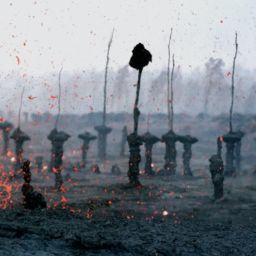
As soon as this new blockade came into effect, the attacks continued; last night, strikes occurred in nearly every country in the Middle East where there is a US military presence. New weapons are already being tested by both the Iranians and the Americans. Drone boats have been used to strike Iranian vessels, and the focus has increasingly shifted towards the islands.
Iranian Foreign Ministry spokesman Bahaei stated that Tehran currently has no plans to negotiate and remains focused solely on defense, unwilling to honor any agreement if the Americans violate all their obligations.
On the economic front, oil prices have risen and market indices have fallen, though not as sharply as they did initially. The world is becoming desensitized to war and such conflicts; in a way, they have become the new normal. We know that Donald Trump has threatened to launch much harsher attacks next week—as is his custom—targeting power plants and bridges once again, thereby punishing civilians for aspects of Iran’s leadership he dislikes. While the specific grievance remains unclear this time, it is evident that civilians are the ones bearing the punishment, and support for the US and the concept of democratization has plummeted since this conflict with Iran began.
The Iranians have declared that the Strait of Hormuz will remain closed on their end, which will create problems for everyone relying on oil exports from that region.
As for the signed truce—or more accurately, the memorandum, since it wasn’t a true truce—it was essentially a performative act; it seems to me its sole purpose was to shift the paradigm and distance Israel from US actions. We can see that things are not going well for the Iranians, the Gulf states, or—generally speaking—almost anyone else due to this war. Yet, this move will save Israel, because once the war ends, the only states officially benefiting from this series of truce talks will be the US and the Gulf states—clearly positioned against Iran.
So, what can we actually gather from this? That, once again, the Israelis are, in a sense, getting off scot-free in these discussions. They were aided by the Americans, and the Israel-Lebanon conflict was separated, to a certain extent, from the US-Iran conflict. The Americans achieved this—at least at the level of rhetoric and diplomacy—through that memorandum of understanding.
Regarding the Israel-Lebanon situation, meetings have taken place again; this marks the sixth round of negotiations. If you recall, nearly three years and a month have passed since the initial truce was concluded via a ceasefire agreement between Israel and Lebanon—following the spring 2023 campaign, which resulted in 4,000 Lebanese deaths and the displacement of over a million Lebanese people due to Israel’s actions.
Negotiations have taken place almost every month since then. We are told each time that a truce has been reached, yet the conflict drags on. The Israeli Defense Minister publicly boasted that southern Lebanon had become “Gaza.” That was his exact quote. He stated that Rafah had become the model: Rafah was destroyed, people have nowhere left to return to, and the same fate awaits Lebanon.
He stated that Israel has systematically destroyed 24 villages along the border, reducing them to ruins using bulldozers and explosives. He further notes that this amounts to between 15,000 and 20,000 homes destroyed by Israel in Lebanon—representing approximately 90% of the housing in these villages—and that 200,000 former residents have been displaced for an extended period this year. This information comes directly from Defense Minister Katz. While the figure is not as high as the one million displaced three years ago, it remains a significant—indeed, an extremely large—number.
Problems are evident within Israel as well. There is hardly any talk of elections anymore; instead, attention is focused on expanding military campaigns in Lebanon, while global focus is diverted by events unfolding between the US and Iran. However, this situation does not sit well with all Israelis, not everyone agreeing with Netanyahu’s actions. Netanyahu has become a widely reviled figure globally—a sentiment reflected in the fact that many Israelis are choosing to relocate to Argentina.
Argentina is preparing to lift restrictions on foreign ownership of rural land. This move is championed by Javier Milei, who argues that it will attract investment, create jobs, and accelerate economic growth.
You are already familiar with the Abraham Accords. Javier Milei and Netanyahu are very close. There have even been investigative reports suggesting they are cousins ​​sharing the same grandfather, though neither has ever confirmed this information. Direct flights between Buenos Aires and Tel Aviv were launched last year; the two have met several times and refer to each other as very good friends.
However, the issue is that Israelis have repeatedly been caught by civilians setting fire to forests in Patagonia and clearing land to prepare for future settlements intended for Israelis wishing to leave their country due to the chaos.
Argentina is home to the largest Jewish community in Latin America—approximately 300,000 people—and in recent years, a large number of so-called Israeli tourists have arrived in Patagonia, coinciding precisely with the worst wildfires in Argentina’s history. The idea that Patagonia could serve as an alternative to the State of Israel has circulated for a long time. I do not believe it is worth destroying so much vegetation for a plan that does not even seem particularly plausible. Argentina is a vast country, and the territory required is not extensive. The real question is how many Israelis could actually move to Argentina and how many truly wish to leave Israel. A very large exodus would not suit Netanyahu, as the Palestinian population would then become significantly larger, and settlements built on Palestinian territories could no longer be fully populated—complicating Israel’s plans for territorial expansion.
However, returning to the situation regarding Iran, we observe a moment of extreme tension for the entire region. Geopolitical maneuvering is currently underway for the Gulf states, which must choose their own survival strategies.
Trump stated yesterday that he wants to receive payment from the Gulf states for the protection the Americans provide them. This remark could also be interpreted as a joke, given that—were it not for the Americans instigating senseless wars and maintaining military bases in the region—the Gulf states likely wouldn’t even need such protection.
Nevertheless, key regional leaders did not treat this statement with irony. Also yesterday, the US State Department approved a potential sale of military equipment, as everyone attempts to find new solutions amidst this unfavorable economic climate.
The most significant initiatives come from the rival nations of the United Arab Emirates and Saudi Arabia—two states vying for regional leadership.
In Dubai, DP World—the logistics giant that owns over 60 ports worldwide and manages the Jebel Ali port in the Persian Gulf (located about 35 kilometers west of Dubai; I am sure most of you have heard of Jebel Ali)—plans to build a new port in Fujairah, on the UAE’s east coast. This could reduce reliance on the Strait of Hormuz, allowing for the distribution of oil and other products even if the strait were to be blocked.
Consider that, prior to the war, approximately 40,000 shipping containers passed through Jebel Ali port daily. That figure has now dropped to just around 1,000 containers a day—an extremely low number relative to the United Arab Emirates’ needs. This is why there is a plan to build a large-scale port in Fujairah as well.
Fujairah is significant not only because it lies beyond the Strait of Hormuz but also because of the Habshan–Fujairah oil pipeline, which connects Abu Dhabi’s oil fields directly to the port. While the project would require investments amounting to hundreds of millions of dollars, it could be completed in approximately 18 months.
It has not yet been fully confirmed whether the project will go ahead, and I believe the authorities are still weighing whether the investment is worthwhile. However, no matter how modernized the Port of Fujairah becomes, without a serious and lasting security agreement with Iran, it cannot guarantee the safety of maritime traffic. Iran is capable of striking the Fujairah area, as it lies within its operational range.
The United Arab Emirates could not guarantee the safe passage of vessels using this route. In fact, attacks on port facilities in Fujairah attributed to Iran have been reported in recent months. Therefore, it is not necessarily a foolproof solution; however, it will be interesting to see if the project is approved and, above all, where the funding will come from. I do not believe this will be a completely independent project. This will also give us a better understanding of the geopolitical direction in which the United Arab Emirates is heading.
In Saudi Arabia, we are seeing another very interesting initiative: a project for an expanded military alliance with Turkey. You may recall that a military alliance between Pakistan and Saudi Arabia was signed a few months ago. This is a significant alliance because Pakistan possesses nuclear weapons but lacks financial resources comparable to Saudi Arabia’s. Saudi Arabia has vast financial resources but lacks nuclear weapons and an independent industry for producing state-of-the-art weaponry and military technology. Turkey, however, does possess these technologies.
A closed-door meeting took place in Ankara this week between Turkish President Recep Tayyip Erdoğan, Pakistan’s army chief Marshal Asim Munir, and representatives from Saudi Arabia. Discussions reportedly focused on expanding the defense pact between Saudi Arabia and Pakistan.
Such a move would benefit all parties involved and prove highly significant in the context of Central Asia, a region where all three nations wield considerable influence. We are looking at a major geopolitical project here. It remains to be seen whether such an alliance will actually materialize. For now, there is no official information from the participants, and these details stem from journalistic investigations. Nevertheless, it is a fascinating development, as it could pave the way for trilateral investments across Central Asia—a region traditionally within Iran’s sphere of influence.
It remains to be seen—once the conflict involving Iran concludes—whether Iran will continue to be treated as a key geopolitical player in the international system or if Turkey, Saudi Arabia, and Pakistan will assume that role.
The final point for today concerns the visit of Iraqi Prime Minister Al-Zaidi to Donald Trump. Iraq, too, faces challenges. Iraqis continue to be affected by the conflict with Iran—particularly in the Kurdish separatist region in the north, home to the U.S. base at Erbil—as well as by difficulties regarding exports through the Strait of Hormuz.
Although the U.S. has announced a complete withdrawal from Iraq this autumn, in reality, it will retain immense influence. When Iraq sells its oil—which generates roughly 80–85% of state revenue—the proceeds are first deposited into a U.S. bank account. It is only subsequently that the U.S. government decides whether Iraqi authorities may access these funds, as dollar transfers and all major transactions are subject to U.S. Treasury approval and oversight.
The U.S. has employed this mechanism before. For instance, in 2020, after the Iraqi Parliament voted to expel U.S. troops from the country, the United States threatened to block Iraq’s access to these accounts, prompting Iraqi authorities to quickly back down.
We now see the Americans withdrawing in a manner that suits them, as Al-Zaidi is a Trump associate who has adopted a clearly pro-American stance. In a way, he follows the Trump model: a businessman heavily focused on real estate, banking, and logistics, who has put forward numerous profitable investment proposals for American companies.
We know for certain that the Americans will remain influential in Iraq, even though their military presence will be significantly reduced and they will not retain the full military infrastructure they previously maintained.
One particularly interesting initial project involves the US, Iraq, and Syria. In Syria, there is another Trump associate, Mr. Al-Sharaa, who rose to power in a way that is difficult to explain according to the official narrative—especially considering that the Americans should have been fighting him rather than supporting him, given his past membership in Al-Qaeda and ISIS.
The three states aim to refurbish a pipeline spanning approximately 800 kilometers, connecting the Kirkuk oil hub in northern Iraq to the Syrian port of Banias on the Mediterranean Sea. At one time, this pipeline had the capacity to transport up to 370,000 barrels of crude oil per day, but it was destroyed during the 2003 US invasion of Iraq.
It appears that an agreement on this project will be signed by the three states in the coming days. Its success remains to be seen, however, as a complete overhaul is required—including the construction of new storage tanks and pumping stations, as well as the modernization of electrical systems and the entire infrastructure. Reconstruction is estimated to take approximately three years and cost at least five billion dollars.
This represents a massive investment for Iraq and Syria; it remains to be seen to what extent the Americans will contribute to the costs or if, once again, other nations will be expected to shoulder the bulk of the investment.
It is a highly interesting project, particularly if the United States does indeed fully withdraw its military presence from Iraq. In such a scenario, future Iraqi leaders might attempt to reverse the decisions that currently give the US control over Iraq’s financial assets.
What unfolded in Iraq was a tragedy followed by chaos that persisted for decades. While the situation there has yet to stabilize, it could mark a positive step forward if Iraq were one day to have a truly independent leader.
By Daria Gusa

Related Posts