The Ankara Ledger: Who Is Actually Paying for NATO’s 5%?
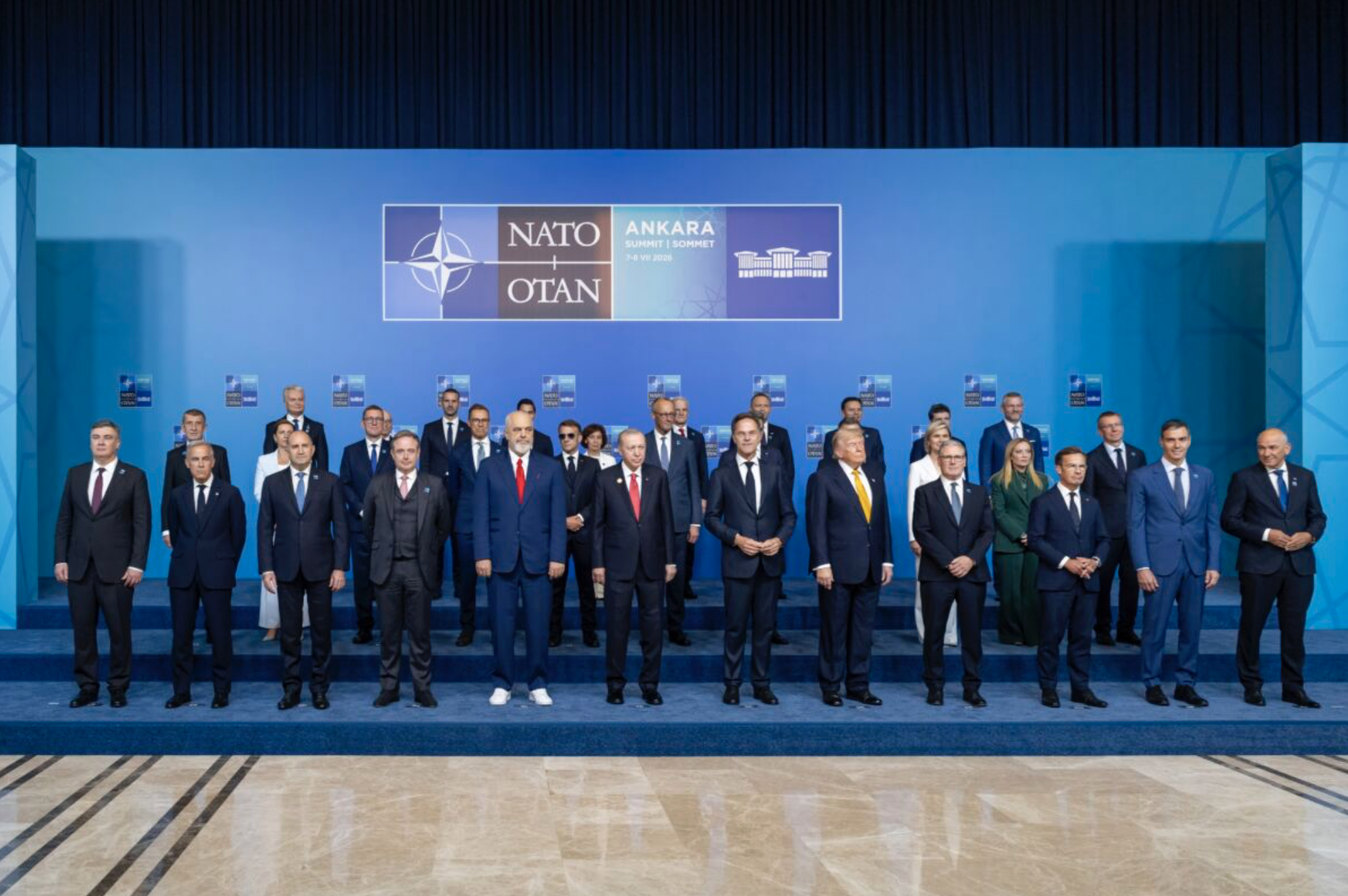
The Ankara Summit was never designed to produce a breakthrough. Its purpose, as Secretary General Mark Rutte framed it on the eve of the gathering, was delivery: leaders of all 32 allies arriving in Turkey on July 7–8 to present “clear, concrete and credible plans” for reaching the target agreed a year earlier at The Hague: 5 percent of GDP on defense and security by 2035, split into 3.5 percent for core military capability and 1.5 percent for defense-related spending, from cyber to the roads and bridges that let tanks move east.
A summit about accounting sounds dull. It was anything but, because the ledger, once opened, revealed just how unevenly the alliance’s burden is being carried, how expensive the promise really is, and how little time NATO’s own officials believe remains to keep it.
Fairness requires starting with what has genuinely changed. In 2014, when the Wales pledge set the old 2 percent benchmark, exactly three allies met it. NATO’s figures published in March show that in 2025, all 32 did and all now also clear the companion target of spending at least a fifth of their defense budgets on equipment and modernization, up from eight countries a decade ago.
European allies and Canada have added some $1.2 trillion in defense spending over ten years, a 20 percent increase in the most recent count, and Ankara was accompanied by a Defence Industry Forum where tens of billions in new contracts were announced, alongside multinational purchases of A330 tanker aircraft, Triton surveillance drones and GlobalEye early-warning planes – the enabling capabilities Europe has historically rented from America.
The star pupil sits on the alliance’s most exposed border. Estonia’s prime minister, Kristen Michal, told the summit his country already invests almost 7 percent of GDP (5.4 percent on core defense plus 1.5 percent on related projects), meaning Tallinn will hit both 2035 targets nine years early. Poland, Albania and Luxembourg now devote more than half their defense budgets to equipment alone. For the frontline, the threat is not an actuarial projection; it is the neighbor.

Then there is the other alliance. Spain used the summit to renew its formal objection to the 5 percent target itself, the only ally in open dissent. Czechia’s spending may actually slip below 2 percent this year, moving backward from the floor everyone else just finished reaching. And three of NATO’s heavyweights – France, Italy and the United Kingdom – face what analysts politely call fiscal obstacles: debt-burdened treasuries for whom each additional half-percent of GDP means visible cuts elsewhere. Britain is the cautionary tale of the trade-offs: its rearmament, billed as the largest since the Cold War, is being financed partly from the foreign-aid budget, and its defense secretary resigned weeks ago demanding even more.
The hardware ledger has its own embarrassments. Since The Hague, two of Europe’s flagship programs have collapsed, the Franco-German-Spanish FCAS sixth-generation fighter and Germany’s F-126 frigate, setbacks that cut directly against the summit’s story of a continent building its own capability. Europe, it turns out, can raise money faster than it can hold a consortium together.
And the true bill is rarely spoken aloud. Independent analysts estimate that bringing the whole alliance to 5 percent implies on the order of $1.9 trillion in additional annual spending. The Hague set a number; Ankara began the far harder argument over who pays it, whose factories fill the orders, American or European, and what gets sacrificed at home.
The most sobering line in the post-summit assessments concerns time. On paper, allies have nine years to reach the targets. Yet official sources across the alliance have suggested Russia could be capable of militarily challenging NATO well before 2035, some assessments say before the decade ends. The new capability targets adopted alongside the money, including a fivefold increase in air defense, the lesson written in the skies over Ukraine, Abha and Manama this year, are calibrated to that nearer horizon. The uncomfortable arithmetic: the alliance is funding a 2035 army against a potential 2029 problem.
Ankara also exposed a deeper unresolved question, which one analysis distilled perfectly: NATO has agreed how much to spend without agreeing which war comes first. The alliance’s strategy still names Russia the “most significant and direct threat,” but Washington increasingly treats it as manageable while looking to China; Turkey, the summit’s host, has its own southern priorities; the Iran war split allies over Rutte’s supportive stance. An alliance can share a spending floor and still fight over the threat map and the money’s impact will be uneven precisely along those fault lines.
Ukraine, at least, produced convergence. Contributions to Kyiv’s defense, including its defense industry, now count toward the 5 percent, and the PURL mechanism, under which European allies and Canada buy American weapons for Ukraine with NATO coordinating delivery, has grown to some $5.5 billion in commitments by the Atlantic Council’s count: aid deliberately institutionalized to survive any political weather in Washington.

For a frontline state like Romania, the Ankara ledger is not an abstraction. The country hosts the Aegis Ashore missile-defense site at Deveselu and the vast expansion of the Mihail Kogălniceanu air base near the Black Sea coast, infrastructure that makes it a beneficiary, a contributor and a target of the new NATO map all at once. The 1.5 percent “related spending” tier is, for the eastern flank, not creative accounting but military mobility made concrete: the highways, railways and bridges that determine whether reinforcement arrives in days or weeks. Bucharest’s interest in the summit’s outcome is therefore brutally simple, that the laggards’ politics do not outpace the frontline’s clock.
The summit closed with a short communiqué reaffirming Article 5’s “ironclad” guarantee, and, notably, no commitment to hold a summit next year, a hint that the era of annual choreography may pause while the alliance digests its own promises. That may be fitting. The Hague was the pledge; Ankara was the first audit; what follows is a decade of budget votes in 32 parliaments, each one a small referendum on whether Europe’s rearmament is real.
The honest reading of the ledger is neither triumph nor failure. An alliance that moved from three members at 2 percent to thirty-two in a decade has proven it can change under pressure. But the gap between Tallinn’s 7 percent and Madrid’s dissent, between the contracts signed and the flagships cancelled, between the 2035 deadline and the pre-2030 warnings, is now the central strategic variable in Europe. Deterrence, in the end, is a number Russia believes. Ankara showed the number rising and the argument over it far from over.
By I. Constantin
Sources: NATO Secretary General’s summit preview and Ankara Summit Declaration; Congressional Research Service, “NATO: Issues for the July 2026 Ankara Summit”; International Centre for Defence and Security (ICDS), “Defence Spending: Who Is Doing What?” (July 2026); Atlantic Council, “Eleven takeaways from the NATO Summit in Ankara”; Al Jazeera; Forbes; The Ops Con.