The Pilgrim Who Could Be Prime Minister: Călin Georgescu and Romania’s Political Earthquake
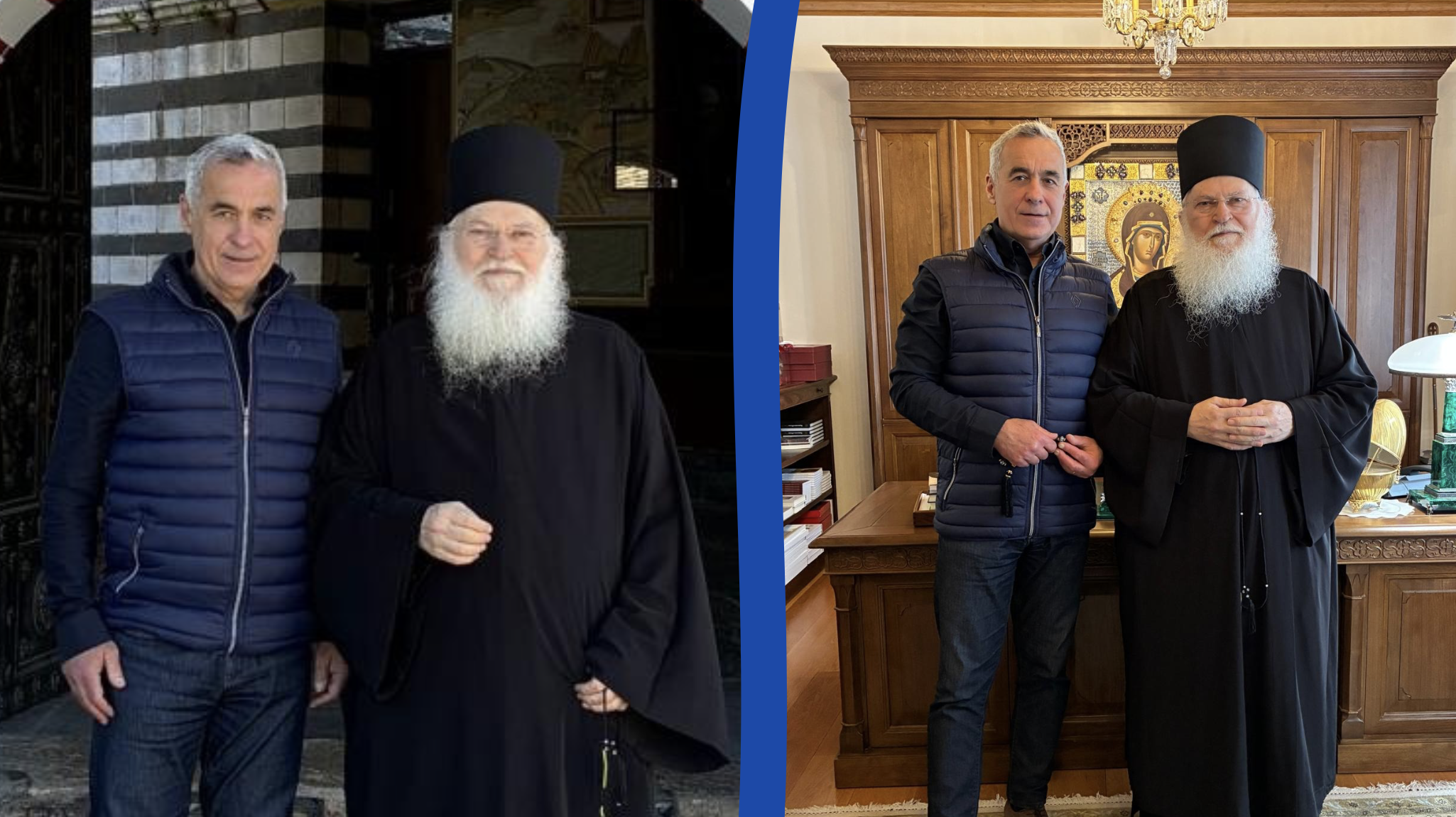
On the very day that Romania’s Parliament prepares to vote on a motion of censure that could topple the government of Prime Minister Ilie Bolojan, Călin Georgescu is not in Bucharest scheming in backrooms or granting interviews to television cameras. He is on the Holy Mountain.
Mount Athos, the monastic peninsula that juts into the Aegean Sea from the Greek region of Chalkidiki, is, according to Orthodox tradition, the garden of the Virgin Mary herself, a strip of land where time folds inward and the noise of the world is replaced by the sound of Byzantine chant. Only men may enter, and even they must carry a special permit, the diamonitirion, issued by the Holy Community’s pilgrims’ bureau. The peninsula houses twenty monasteries, each a living fragment of a civilization that the rest of Europe has long since abandoned. Russian monks pray at St. Panteleimon. Serbian brothers keep vigil at Hilandar. Romanians have deep roots at Prodromu, at Lacu, at the cells of Colciu. This is not Greek territory so much as it is Orthodox territory, a spiritual republic with its own internal logic and its own hierarchy of influence.
And it is in this world that Călin Georgescu has chosen to spend three days of fasting and prayer, beginning today.
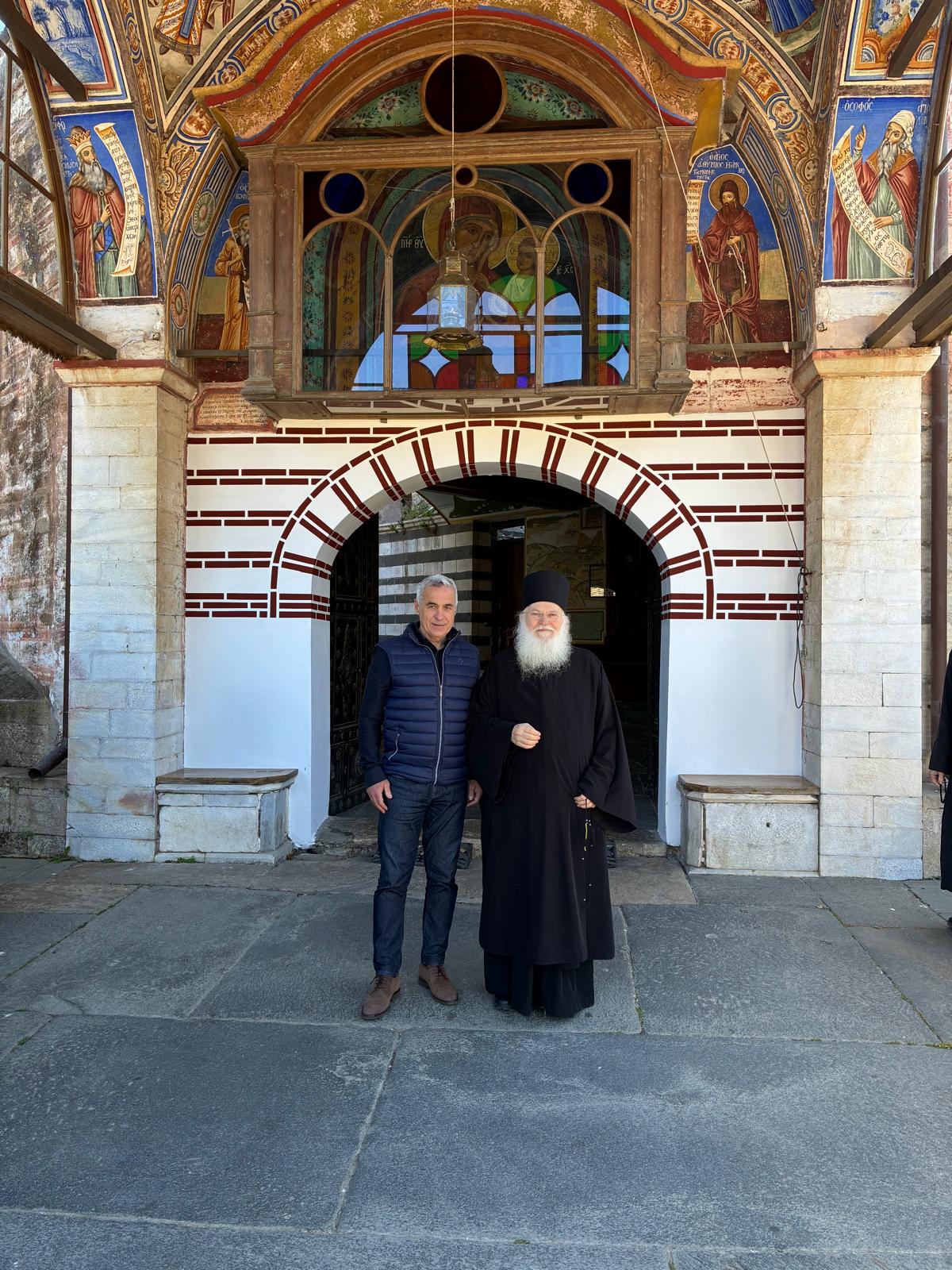 The images circulating on Romanian social media show Georgescu alongside Father Abbot Ephrem, the gheronda of Vatopedi Monastery, arguably the most significant monastic figure on Mount Athos today.
Vatopedi, the second-ranking monastery on the peninsula after the Great Lavra, is a place of staggering spiritual prestige. More than seventy saints are said to have lived or passed through Vatopedi over the centuries, among them Saint Gregory Palamas, who began his spiritual life within its walls. The monastery counts among its benefactors some of the greatest Romanian princes: Stefan cel Mare, who built its defense tower and harbor in 1496; Neagoe Basarab; Serban Cantacuzino; Vasile Lupu; and Constantin Brancoveanu. Romania’s relationship with Vatopedi is not peripheral. It is centuries-deep.
Father Ephrem is not merely an abbot. Among the igumeni of Athos, he functions as an informal dean, a spiritual anchor of the broader Athonite community. He is described as one of the leading names of contemporary Orthodoxy, a figure whose visits to Romanian monasteries draw hierarchs, bishops, and thousands of faithful. When Georgescu poses beside him, the symbolic weight is considerable. In the visual grammar of Romanian Orthodox culture, this is an endorsement that no campaign poster could replicate.
Georgescu’s three-day program of fasting, prayer, and meetings with abbots from across the monastic republic carries a message calibrated for a specific audience: millions of Romanians for whom Orthodoxy is not a cultural accessory but a civilizational identity. Mount Athos, in this reading, is not a retreat. It is a staging ground.
To understand why this pilgrimage resonates so powerfully, one must understand what preceded it. On February 26, 2025, Călin Georgescu was pulled from traffic by prosecutors and taken to the Prosecutor General’s office in Bucharest, where he was questioned for more than five hours. Hundreds of supporters gathered outside the building, chanting “Georgescu President!” alongside AUR leader George Simion and members of Parliament.
He was placed under judicial control and charged with six criminal offenses, including instigation to actions against the constitutional order, initiating a fascist organization, and false declarations regarding the financing of his electoral campaign. The charges were serious. Prosecutors alleged links to a legionary network, recorded phone conversations with far-right sympathizers, and a coordinated plan to capture state power outside electoral channels.
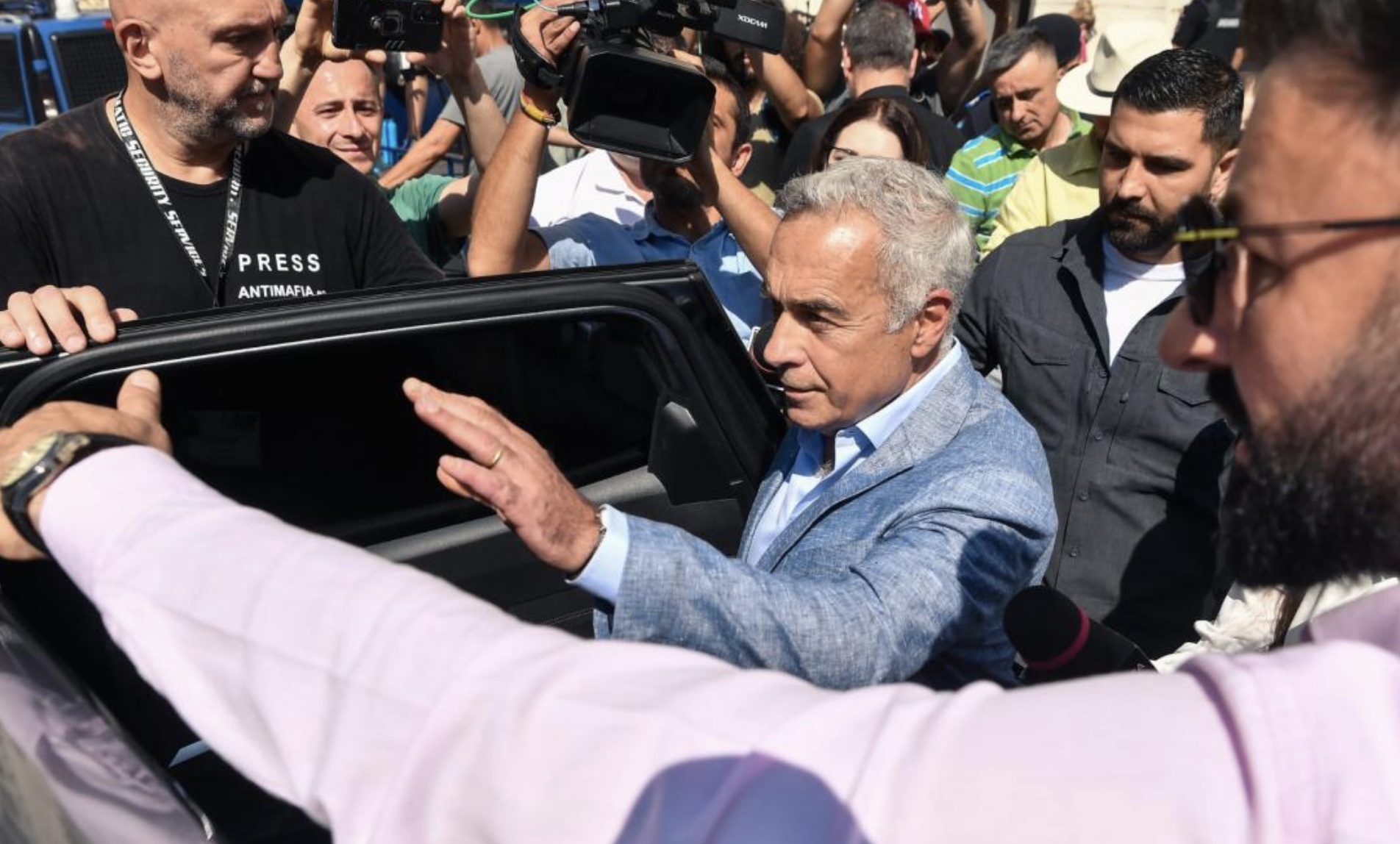
For fourteen months, Georgescu could not leave the country. He was required to report periodically to police. He could not post content on social media. His world shrank to the borders of Romania.
On April 1, 2026, the Bucharest Tribunal definitively revoked the judicial control measure. Georgescu was freed from all obligations and restrictions imposed under the measure. He could now leave the country without judicial authorization and no longer needed to present himself to police.
The important fact here is this: when the first round of Romania’s presidential election was held in November 2024, Georgescu finished first. The result shocked the European establishment. It shocked Washington. It shocked the Romanian political class, which had spent years assuring itself that such a figure could never be competitive.
What followed was a crisis without clean resolution. The Constitutional Court annulled the election, citing foreign interference concerns tied to a Russian-linked influence campaign that had amplified Georgescu’s TikTok reach. The annulment itself sparked fierce debate: was it a legitimate safeguard against manipulation, or was it the Romanian state using the machinery of justice to erase an inconvenient result? That argument has not been settled. It may never be.
What is beyond dispute is that Georgescu commands a constituency of genuinely massive proportions. Polling conducted through late 2025 and early 2026 consistently shows him as one of the most recognizable and followed political figures in the country. His supporters are not a fringe. They include small-business owners, priests, farmers, and a generation of young Romanians who experienced the 2024 annulment as a democratic wound that has not healed.
Even monks from Athos spoke out in his favor before the 2024 elections, calling him “a Christian and patriotic option” and urging Romanians to vote for the defense of Christian values. That the Holy Mountain already regarded him favorably makes his current pilgrimage feel less like a new relationship and more like a renewal of one already established.
Fast forward to April 2026: Romania’s government is in freefall. On April 29, 2026, the motion of censure titled “STOP Bolojan’s Plan to Destroy the Economy, Impoverish the Population, and Fraudulently Sell State Assets” was presented in the joint session of the Senate and Chamber of Deputies, supported by PSD, AUR, and PACE-Intai Romania.
The motion was signed by more than 250 parliamentary members from PSD, AUR, and allied formations, and the vote is scheduled for Tuesday, May 5th. The motion accuses the Bolojan government of planning to liquidate strategic state companies including CEC Bank, Hidroelectrica, Romgaz, Bucharest Airports, the Port of Constanta, and others, allegedly to satisfy PNRR requirements in a manner that transfers national wealth to private interests.
The political arithmetic is tight but sufficient. PSD and AUR together hold 219 parliamentary seats. With PACE and independent signatories, the motion has cleared the 233-vote threshold needed to pass.
The PACE parliamentary group has announced it will vote for the censure motion on the explicit condition that Călin Georgescu be proposed as prime minister. This position was also acknowledged by George Simion of AUR, who confirmed that he had kept Georgescu informed about AUR’s steps toward dismissing the Bolojan government.
Political analysts have outlined the scenario: if the Bolojan government falls on May 5th, President Nicusor Dan will hold consultations with the parties, at which point Georgescu’s name could be advanced as a prime ministerial candidate from the sovereign bloc.
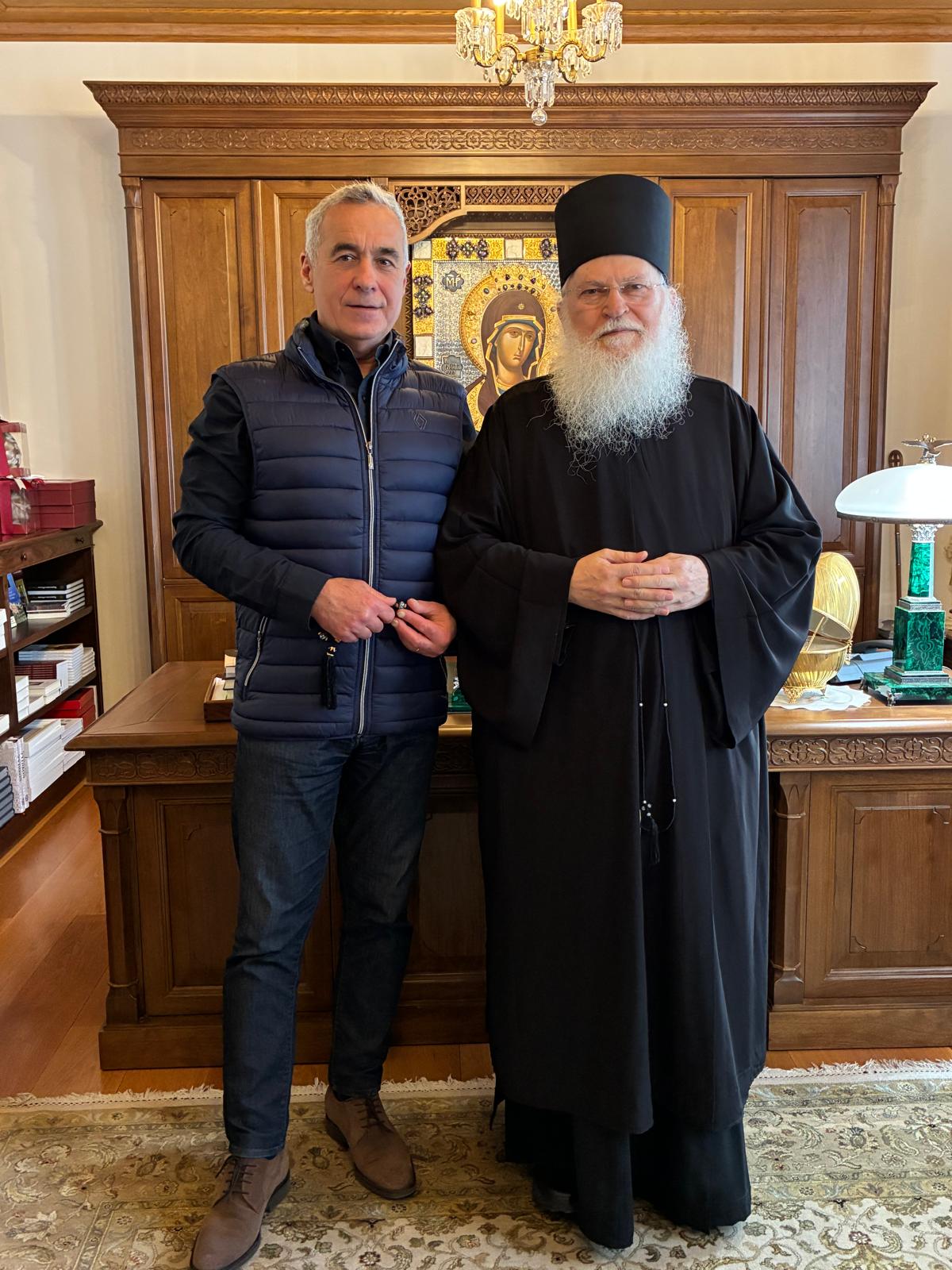 Against this backdrop, the timing of the Athos visit acquires an additional layer of meaning. Mount Athos has historically been a place where legitimacy is conferred, not merely sought. Byzantine emperors sent embassies there. Romanian princes funded its monasteries as an act of spiritual statesmanship. In the Orthodox imagination, a man who walks those paths in prayer, who breaks bread with the gheronda of Vatopedi, who fasts for three days in the company of monks from Serbia, Russia, Greece, Bulgaria, and Romania, is doing something that no press conference can replicate. He is inscribing himself into a tradition larger than any political party.
Vatopedi monastery today houses approximately 80 monks from multiple countries, including 12 Romanian monks, with Father Abbot Ephrem leading a community that has practiced the communal monastic life for decades. This is not a Romanian institution. It is a pan-Orthodox one. For Georgescu to be received there, to be photographed beside its abbot, is to claim a kind of trans-national Orthodox legitimacy that transcends the jurisdiction of Romanian prosecutors.
Romania is, by any measure, a country under strain. Its fiscal deficit has been among the largest in the European Union. Its political class has failed repeatedly to produce stable government. The 2024 presidential election annulment left a wound in democratic legitimacy that subsequent governments have not been able to close. The Bolojan government, which had promised a kind of technocratic seriousness, is now being pulled down by the very parties that helped install it.
Into this space, Călin Georgescu returns from Mount Athos. He returns having prayed and fasted. He returns having met the spiritual leaders of the Orthodox world. He returns, for his followers, as a man cleansed of the institutional grime that spent fourteen months trying to crush him.
Whether Romania is ready to accept what he represents is the question the country must now answer. The monasteries of Athos will continue their vigil regardless. The candles will burn through the night, the chant will rise before dawn, and the world outside will proceed with its urgencies. But for a few days, Romania’s most polarizing figure has stepped outside that world entirely, into one governed by different laws.
He will return. And when he does, Parliament will be waiting.
By I. Constantin