The Quiet Architects of Peace: How Pakistan and Oman Can Put a Stop to The War in Iran

When JD Vance stood at the alpine resort of Bürgenstock in Switzerland on June 21, 2026, ready to put American weight behind a framework deal ending the U.S.-Iran war, he began his remarks by pointing to Field Marshal Asim Munir, Pakistan’s military chief.
“Since Field Marshal Asim Munir welcomed us with the Prime Minister in Islamabad in April,” Vance said, “I have joked that I have two very, very important people in my life: an Indian and a Pakistani.”
That the Vice President of the United States was making insider jokes about a Pakistani general at a Middle East peace signing was, in itself, a signal of how dramatically the architecture of global diplomacy had shifted since February 28, 2026, the day American and Israeli jets struck Iran and set the world on fire.
To understand how the fire was extinguished, one must understand the two countries that made it possible: Oman, which held the line through the pre-war negotiations and kept a back channel alive even when bombs were falling; and Pakistan, which stepped in when every other actor was either too compromised, too regional, or too scared to try.
 In this photo released by the Iranian Foreign Ministry, Iranian Foreign Minister Abbas Araghchi, right, shakes hands with Oman’s Sultan Haitham bin Tariq during their meeting, in Muscat, Oman, Sunday, April 26, 2026. (Iranian Foreign Ministry via AP)
Oman is not a typical Gulf state. It has no significant oil reserves compared to its neighbours, no outsized military, no ideological project to export. What it has, and has cultivated with extraordinary discipline since Sultan Qaboos bin Said came to power in 1970, is a foreign policy philosophy built on a single, radical premise: be friends with everyone, and let that friendship be useful.
The results of this philosophy have been visible for decades. Oman hosted the back-channel talks between the U.S. and Iran that eventually led to the 2015 JCPOA. It maintained relations with Israel at a time when that was diplomatically costly in the Arab world. It kept diplomatic lines open with the Houthi movement in Yemen while simultaneously hosting American military assets. It has never been a member of a political bloc that required it to take sides in the Gulf’s many fractures.
When the Trump administration began its 60-day diplomatic pressure campaign on Iran in early 2025, Oman was the natural first phone call.
The Omani mediation began formally on April 12, 2025, when Witkoff and Iran’s Foreign Minister Abbas Araghchi held the first round of high-level indirect talks in Muscat. The discussions were described as constructive by both sides, cautiously so, the way diplomats speak when they are relieved the other party showed up at all. A second round followed in Rome on April 19, a third in Muscat, and expert-level technical meetings extended the process through the summer.
By January 2026, the process had deteriorated. Trump’s deadlines accumulated and he set Iran deadlines of March 21, then March 23, then April 7. On February 6, 2026, the United States and Iran held indirect talks in Muscat under Omani mediation, with the Iranian delegation led by Araghchi and the U.S. side represented by Witkoff, Kushner, and CENTCOM commander Admiral Brad Cooper. Despite some initial reports of direct engagement, the entire session was mediated by Omani Foreign Minister Badr Albusaidi – Araghchi and Witkoff never met face to face.
Following the February talks, Albusaidi said he was “confident” that a peace deal was “within our reach” and described “substantial” progress, including that Iran had agreed to “never, ever have a nuclear material that will create a bomb,” which he called “completely new.” Trump, characteristically, said he was “not thrilled” with the talks and the bombs fell the next day.
Here is the detail that most coverage of the Iran war has overlooked: Oman never stopped mediating. Even after the U.S. and Israeli strikes began on February 28, even as the Strait of Hormuz closed, even as Iranian missiles reached Kuwait and Bahrain and Saudi Arabia, Omani Foreign Minister Albusaidi continued shuttling between Washington and Tehran.
In a March 2026 opinion piece for The Economist — an unusual public intervention for a sitting foreign minister — Albusaidi argued that the United States had “lost control of its own foreign policy” and accused Israel of persuading the Trump administration to engage in what he termed a “grave miscalculation” and a “catastrophe.” That an Omani foreign minister would write those words publicly, during an active U.S. military operation, signals both the depth of Muscat’s frustration and the unusual latitude Oman has always claimed for itself in the diplomatic space.
The Omani talks continued in Geneva, cycling through multiple rounds. After the third round of indirect talks in Geneva, Albusaidi described negotiations as having achieved “unprecedented” progress that could form the basis of a final agreement, noting that he had met Vance to share details of ongoing talks and that he looked forward to “further and decisive progress in the coming days.”
After a subsequent Geneva round, Albusaidi confirmed that significant progress had been achieved and announced that technical discussions would resume in Vienna the following week. The Omani model — patient, incremental, never triumphalist — was doing what it always does: narrowing the gap millimetre by millimetre.
What Oman could not do, however, was provide the political weight to force a ceasefire when Trump was threatening to bomb Iran “back to the Stone Ages.” For that, a different kind of mediator was needed.
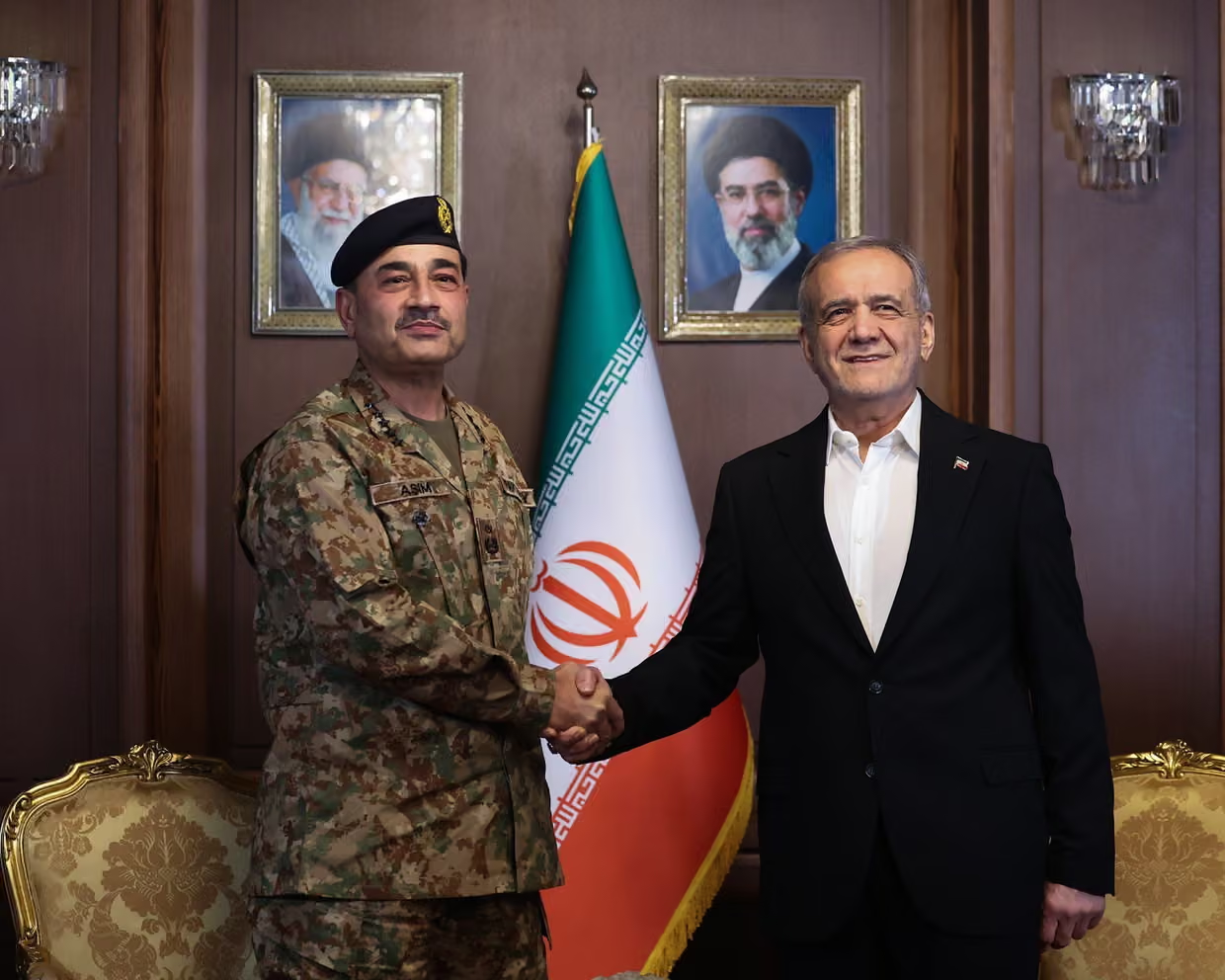 Asim Munir meets the Iranian president, Masoud Pezeshkian, in Tehran. The Pakistani military chief has emerged as a diplomatic broker between the US and Iran. Photograph: Anadolu/Getty
On the surface, Pakistan is an improbable choice to mediate one of the most complex diplomatic crises in recent memory. It is the world’s fifth most populous country, but not a major economy. It holds no permanent seat on the UN Security Council. It is in its 25th arrangement with the IMF since the 1950s. It shares a nearly 1,000-kilometre border with Iran, a defence pact with Saudi Arabia, a complicated relationship with the United States, and an active conflict with the Afghan Taliban on its western frontier.
And yet: as one analyst put it, “Pakistan entered this regional crisis as a communication enabler between the US and Iran at a time when the Trump administration didn’t trust any possible mediator. It was this vacuum that Pakistan filled while also being acceptable to the Iranian side and coordinating the mediation with Egypt, Turkey and Saudi Arabia, thus bringing all the big regional players on board.”
That last point is critical. Oman could hold the nuclear conversation. What it could not do was coordinate a broad regional consensus involving Saudi Arabia, Turkey, Egypt, and Qatar simultaneously, all of whom had either been struck by Iranian missiles, had their own axes to grind, or both. Pakistan, sitting outside the Gulf’s fault lines while maintaining relations with everyone, could.
The groundwork was laid in September 2025, when Prime Minister Shehbaz Sharif and Field Marshal Asim Munir visited the White House and met Trump, Vance, and Secretary of State Marco Rubio, a relationship that would prove decisive six months later.
The most dramatic moment of Pakistan’s mediation came on April 7, 2026. Trump had set a deadline: bomb Iran’s “civilisation” if no deal was reached. Just under 90 minutes before the deadline, Trump posted on Truth Social that he had agreed to a two-week ceasefire: “based on conversations with Prime Minister Shehbaz Sharif and Field Marshal Asim Munir of Pakistan,” adding that they had “requested that I hold off the destructive force being sent tonight to Iran.”
Iranian Foreign Minister Araghchi confirmed the ceasefire immediately, and was notably effusive: “On behalf of the Islamic Republic of Iran, I express gratitude and appreciation for his dear brothers PM Sharif and Field Marshal Munir for their tireless efforts to end the war in the region,” he said, adding that Iran had accepted the ceasefire “in response to the brotherly request of PM Sharif.”
That language, “brotherly request, signals the degree of personal trust that Pakistani officials had built with Tehran, a trust that the United States, for obvious reasons, could not replicate directly.
 Pakistan’s PM Shehbaz Sharif speaks with US Vice President JD Vance in Islamabad on April 11
The Islamabad Talks of April 11–12, 2026 represented the first instance of direct high-level, in-person engagement between the United States and Iran since the 1979 Islamic Revolution. The U.S. delegation of 300, led by Vice President Vance alongside Witkoff and Kushner, met the Iranian team of 70, led by parliamentary speaker Ghalibaf and Foreign Minister Araghchi, at the Serena Hotel in Islamabad, a city placed under effective lockdown for the occasion, with over 10,000 security personnel deployed across the capital.
The talks lasted 21 hours across three rounds, the first indirect, the second and third direct. They ended without a deal, stalling on the nuclear program and the Strait of Hormuz. But they did not end in rupture. Pakistani officials immediately reframed the outcome as a beginning, describing the ongoing process as the “Islamabad Process”, a deliberate effort to give the engagement an institutional identity that would survive a single failed round.
According to a former Pakistani diplomat, the arc of Islamabad’s mediation reflected something more fundamental than tactical adjustment: “It’s not a question of what changed between April and June. It’s rather an example of a never-give-up approach in diplomacy where an honest broker respected by both sides can eventually help overcome an overwhelming trust deficit.”
The weeks between April and June 2026 tested Pakistan’s diplomatic stamina severely. Face-to-face negotiations did not resume after Islamabad. Trump said the two sides could speak by phone if needed, a sign that Washington’s attention was fragmenting. Iran oscillated between public defiance and private signals of continued interest.
Through all of it, Pakistani officials kept shuttling. Field Marshal Munir travelled to Tehran carrying what officials described as a new message from Washington. Iran’s ambassador in Islamabad confirmed that Tehran would “do talks in Pakistan and nowhere else, because we trust Pakistan.”
Sharif travelled to Saudi Arabia, Qatar, and Turkey, briefing their leaders on recent developments and building what he described as a “consensus in support of a sustained process of dialogue and diplomacy.” The goal was not just to keep Washington and Tehran talking, it was to ensure that the regional architecture around the talks remained stable enough to absorb the inevitable crises.
Those crises came. Israeli strikes on Lebanon repeatedly threatened to collapse the process. Iran threatened to walk away multiple times. Sharif told the Pakistani National Assembly that there were many moments when “it felt like the negotiations would come to a halt”, and that each time, it was Field Marshal Munir who kept the deliberations alive, “awake all day and night,” sacrificing, in Sharif’s words, “day and night to extinguish the flames of war.”
On June 23, Iranian President Pezeshkian flew to Islamabad for a daylong visit, his first trip outside Tehran since the war began in February. The symbolism was unmistakable. Iran was not merely tolerating Pakistan’s mediation. It was endorsing it publicly, at the highest level.
The most analytically interesting aspect of the U.S.-Iran peace process is how they divided the labour with remarkable precision, often without explicit coordination. Oman owned the nuclear file. Its relationship with Iran on nuclear issues, stretching back to the pre-JCPOA negotiations, gave Muscat the technical credibility and the personal relationships to manage the most sensitive conversations about enrichment, stockpiles, and verification. Albusaidi’s repeated involvement in Geneva talks, the venue associated with nuclear diplomacy since 2015, was not coincidental. The Omani foreign minister anchored the Geneva track explicitly, describing talks held “under Omani auspices” and noting they had made “good progress in identifying shared objectives and related technical issues.”
Pakistan owned the ceasefire and the political architecture. Islamabad’s value was not technical expertise on nuclear physics; it was political weight with both Trump (through personal relationships with Sharif and Munir) and Iran (through geographic proximity, Islamic solidarity, and a history of non-alignment in Gulf conflicts). Pakistan could make the phone call that stopped the bombers. Oman could not.
Qatar bridged the final gap. As the deal approached signature, Qatar, which maintains formal relations with both Iran and the United States and hosts the largest American military base in the Middle East, emerged as the third leg of the mediator triangle. At Bürgenstock, Vance stood alongside both Sharif and Qatari Prime Minister Sheikh Mohammed bin Abdulrahman Al Thani, acknowledging a division of labour that had been operating for months behind closed doors.

Pakistan’s mediation came at a price. The country simultaneously held a mutual defence pact with Saudi Arabia – the Strategic Mutual Defence Agreement signed in September 2025, which commits both countries to treat an act of aggression against one as an act against both. On the very day Sharif was hosting Vance in Islamabad for the historic April talks, Saudi Arabia announced the arrival of Pakistani military aircraft at King Abdulaziz airbase in its Eastern Province under the SMDA.
This meant Pakistan was, technically, deploying forces in support of a Saudi Arabia that had been attacked by Iran, while simultaneously brokering peace with Iran. A former Pakistani three-star general warned privately that Pakistan’s window for holding both roles was narrow: “The moment the theatre shifts to offensive operations, or the perception of offensive coordination emerges, the dual role collapses. Iran’s perception, not Pakistan’s intent, will determine whether trust survives.”
That the dual role did not collapse is a testament to the depth of Iran’s trust in Islamabad, and, arguably, to Tehran’s pragmatic understanding that it needed Pakistan more than it needed to punish it.
Oman’s position also required careful management. While UAE, Bahrain, Saudi Arabia, Kuwait and Qatar all sustained Iranian missile strikes during the war, Oman experienced relatively fewer attacks — a pattern consistent with Iran’s historical reluctance to jeopardise its most reliable regional communication channel. Tehran understood, even under fire, that damaging Oman’s neutrality would close the one diplomatic window it had not yet exhausted.
For Oman, the payoff is continuation of its core foreign policy identity: the small state that punches above its weight through diplomatic capital rather than military or economic power. Albusaidi has emerged from the process as arguably the most capable active foreign minister in the Arab world.
For Pakistan, the picture is more complex. The country is the world’s fifth most populous but lacks the leverage of a critical export like oil or microchips. The diplomatic goodwill generated by the mediation is real, but it does not automatically translate into investment or structural economic relief. Pakistan remains in its 25th IMF programme. The Iran-Pakistan gas pipeline, long delayed by sanctions, may now find renewed momentum, but only if sanctions relief sustains and Washington allows it.
What Pakistan has gained unambiguously is something harder to quantify and easier to lose: strategic relevance. For a country that has spent two decades being alternately coddled and punished by Washington in the context of Afghanistan, the role of indispensable mediator in a Middle East peace process represents a fundamental reorientation of how the world sees Islamabad.
The U.S.-Iran framework deal, whatever its ultimate fate, was produced by a diplomatic architecture that would have seemed implausible five years ago. A Gulf microstate with a population of five million. A South Asian nuclear power simultaneously at war with its own insurgents and mediating between the world’s most powerful military and one of its most defiant theocracies. A Qatari emirate hosting the largest American airbase in the region while simultaneously maintaining functional relations with Tehran.
None of these actors should, by conventional logic, have been able to produce what Washington and its traditional European allies could not. And yet they did, precisely because they were not Washington, and not Europe. They were trusted, or at least not distrusted, by both sides. They had skin in the game, economic, geographic, existential, that gave their mediation urgency rather than mere ambition.
As one former Pakistani diplomat put it: “It’s not a question of what changed between April and June. It’s rather an example of a never-give-up approach in diplomacy where an honest broker respected by both sides can eventually help overcome an overwhelming trust deficit.”
In the end, what stopped a war was not a superpower, not a multilateral institution, not a grand diplomatic coalition. It was a Pakistani general awake around the clock in Islamabad, and an Omani foreign minister carrying messages in Geneva, two quiet architects working on a building the world was not sure could stand.
Sources: Al Jazeera, Foreign Policy, Oman Ministry of Foreign Affairs, Anadolu Agency, Al Jazeera Centre for Studies. All statements from government officials sourced from their public communications or as reported by named international news agencies.
By I Constantin