“We Were Lied To”: Robert F. Kennedy Jr.’s Case Against NATO Expansion and the War in Ukraine
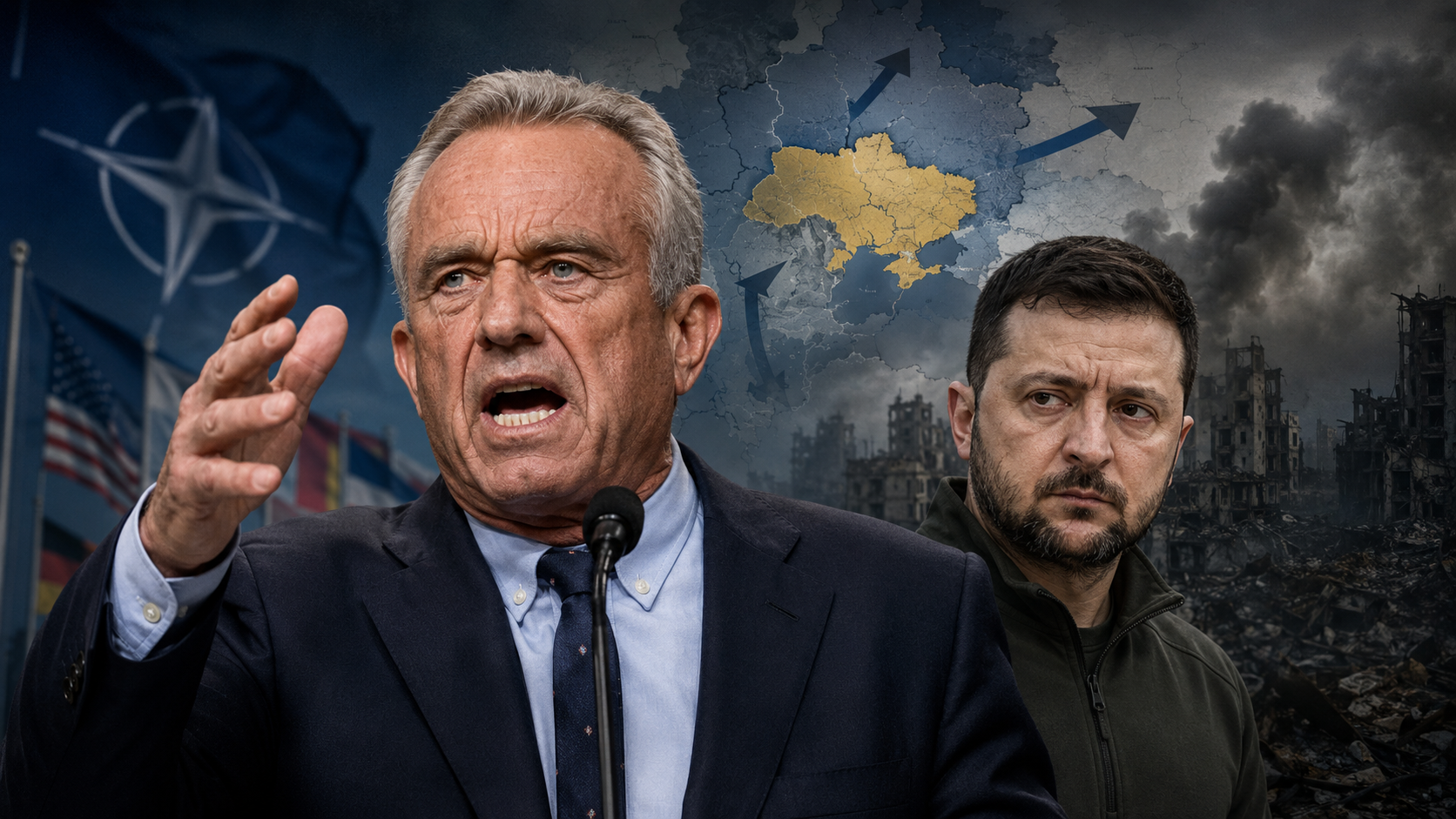
A speech from Kennedy’s presidential campaign, now recirculating widely, lays out the most complete version of the argument that Washington provoked the war it claims merely to be resisting. It deserves to be read in full, and argued with honestly.
Editor’s note: The remarks below were delivered by Robert F. Kennedy Jr. during his campaign for the American presidency, before his appointment to the U.S. cabinet. The excerpts are translated from a transcript of his speech; they are rendered faithfully. We publish them because the argument they contain is one the Western public has largely been spared, and a serious readership deserves to weigh it, together with the substantial objections to it, for itself.
There are speeches that matter because of who delivers them, and speeches that matter because of what they force into the open. Robert F. Kennedy Jr.’s extended account of the war in Ukraine is both. Here is a Kennedy – nephew of the president who stared down the Cuban missile crisis – telling Americans, and by extension all of us, that the story they have been told about this war is, in his words, a comic book.
“Let me tell you what happened in Ukraine, from the standpoint of the war. Because we were lied to. We were told that Putin is trying to conquer Europe, that this is his first step toward rebuilding the Soviet Union, the Soviet Empire. All of this is comic books. These are lies. About Saddam Hussein we were told the same thing. That there were weapons of mass destruction there, that he had to be overthrown. There were no weapons of mass destruction.”
The heart of Kennedy’s indictment is chronological, and it begins in the early 1990s. As the walls came down, he recounts, Mikhail Gorbachev offered the West something extraordinary: the withdrawal of 450,000 Soviet troops from East Germany and consent to a reunified Germany inside NATO. “But I ask you one thing,” Kennedy paraphrases Gorbachev as saying “never move NATO to the east. Never expand it.” And Western officials, he says, agreed: NATO would not move “even one step.”
Then came 1997. “All these neoconservatives appeared and proposed: let’s push NATO eastward, straight to Russia’s borders.” Kennedy invokes the dissenters of that moment, above all George Kennan, the architect of Cold War containment, who called expansion a fateful error, and cites reports that Defense Secretary Bill Perry considered resigning over the plan.
“Between that moment and today, we have pushed NATO into 14 countries,” Kennedy says, and he offers a motive that is less ideological than commercial: “When a country joins NATO, it signs a contract according to which it must buy armaments to NATO standards. That means buying from the American military-industrial complex. That means money.” To this he adds Washington’s unilateral withdrawal from arms-control treaties and the placement of missile systems capable of carrying nuclear warheads,
Kennedy’s account of Ukraine itself turns on the year 2014.
We overthrew the government of Ukraine in 2014. We spent five billion dollars, the CIA was involved. We brought down the democratically elected president of Ukraine, who wanted to keep Ukraine in a neutral status, away from NATO.
He points to the leaked telephone call in which Victoria Nuland, the State Department’s leading hawk, appeared to be casting the roles of a future Ukrainian government “a month before” the change of power.
What followed, in his telling, was a new government in Kyiv that pressured the Russian language, a civil war in the Donbas that killed thousands, and the Minsk agreements – autonomy for the eastern regions, guarantees on language, and Ukraine outside NATO – which were discussed endlessly and never implemented.
Into this stalemate, in 2019, stepped Volodymyr Zelensky: “this young comedy actor,” whose television series was, Kennedy notes with evident relish for the irony, about a comedian who becomes president of Ukraine. “His main idea was that he would sign the Minsk agreements, that he would make peace with Russia. And 70 percent voted for him, because everyone wanted peace in Ukraine. Everyone. He comes to power – and backs away.”

Kennedy then does what few American politicians have dared: he asks his audience to stand in Vladimir Putin’s shoes, using his own family as the bridge. “Remember my uncle, President Kennedy. He said the same thing when the Soviets tried to install missiles in Cuba.” Just as JFK could not tolerate Soviet launchers ninety miles from Florida, Kennedy argues, Putin could not tolerate the prospect of NATO’s fleet in Sevastopol, home to Russia’s Black Sea navy “for 347 years.”
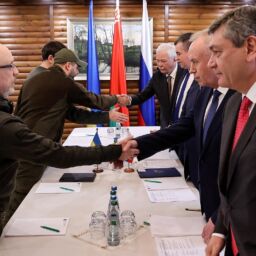
Perhaps the most explosive passage concerns the weeks immediately after the invasion. Negotiations mediated by Turkey and by Israel’s Naftali Bennett, Kennedy says, had produced the outlines of a settlement – “no NATO, let’s negotiate everything” – and Putin had even pulled his troops back from Kyiv. Then, he claims, “President Biden sends Boris Johnson, and this Boris comes to Zelensky and tells him: stop, don’t sign anything.” How do we know? “All the participants in those negotiations are already speaking openly about it. Even Naftali Bennett talks about it on YouTube.”
The war’s true purpose, Kennedy concludes, was stated by Washington itself: Defense Secretary Lloyd Austin’s declared aim to “weaken Russia,” and the president’s own talk of regime change in Moscow. “This strategy is not at all for the benefit of the ordinary people of Ukraine, because they are the ones taking the blows. It is a geopolitical theme of the USA, but Ukrainians suffer.” And the result, he argues, is strategic failure across the board: a growing Russian economy, a booming BRICS, a Putin more popular than ever, and – “a total disaster for us” – Russia driven into alliance with China. “It is a bad war. A war of choice. I am not justifying Putin. I am not justifying him. But we must understand our role in provoking this war.”
We are not publishing Kennedy’s speech because we co-sign every sentence of it. We publish it because the questions it raises are legitimate, and because the Western public square has too often preferred to anathematize them rather than answer them.
Whether NATO’s eastward march was wisdom or hubris; whether the diplomatic exits of 2021 and April 2022 were genuinely explored or briskly closed; whether a war fought “to weaken Russia” is being fought in Ukraine’s interest or over Ukraine’s body – these are questions citizens of a democracy have every right to ask out loud. A press that treats such questions as thoughtcrime does not protect democracy, but, rather, hollows it out. On that, Kennedy is right, and his uncle, who chose negotiation over annihilation in 1962, would have understood him.
By TDA
Sources: transcript of Robert F. Kennedy Jr.’s campaign remarks; public statements by Victoria Nuland, Lloyd Austin, Naftali Bennett; reporting on the 2022 Istanbul negotiations; OSCE and UN casualty documentation for the Donbas conflict.