Thirty-Five Minutes in Manila: What the Rubio–Lavrov Meeting Reveals About a Frozen Peace
The top American and Russian diplomats sat down for the first time in months and spent half an hour confirming that the old peace plan is dead, no new one exists, and both capitals are preparing for a longer war while insisting they want it over. An anatomy of diplomacy at a standstill.
The most honest sentence spoken in Manila on Thursday came from Marco Rubio, in answer to a question about breakthroughs: “You think we settled the war in Ukraine in our 30 minutes here in Asia? That’s not the way it works.”
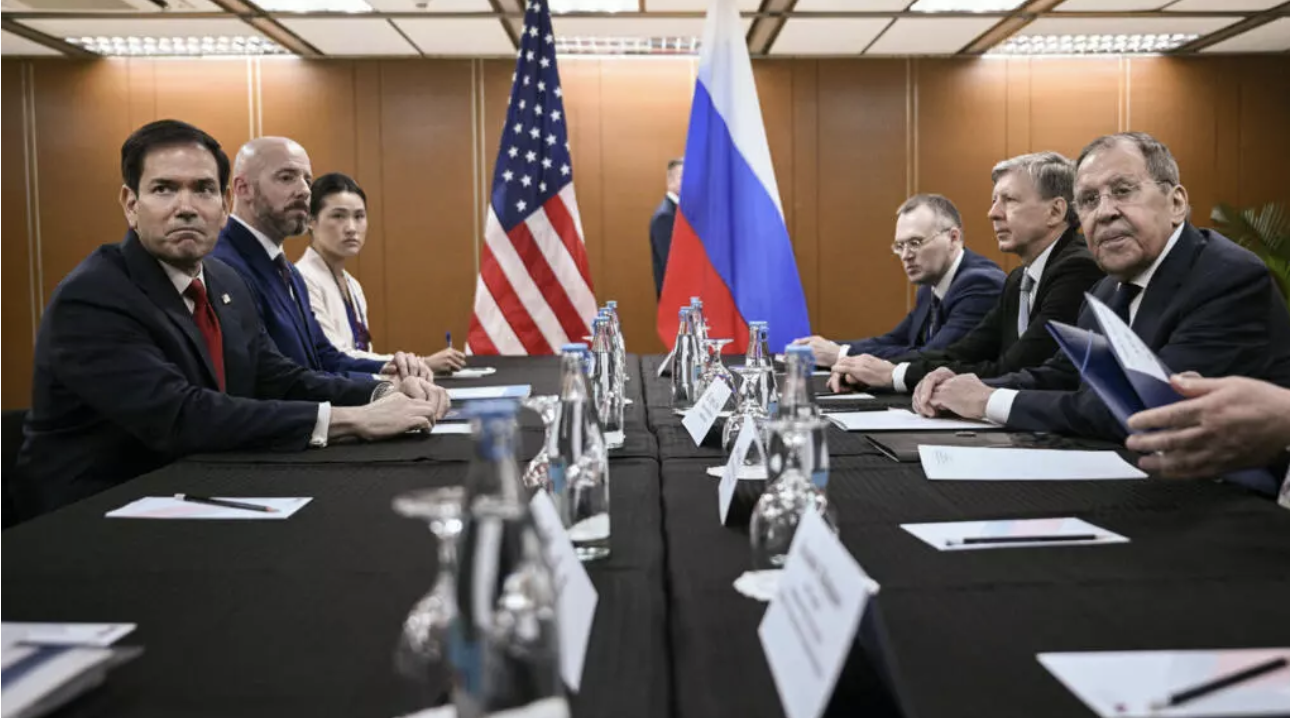
It was a rare moment of plain speech in a diplomatic encounter otherwise built from familiar formulas. The US secretary of state and Russian foreign minister Sergey Lavrov met for roughly 35 minutes on the sidelines of the ASEAN foreign ministers’ meeting in the Philippine capital, their delegations facing each other across a black-draped table, flags behind them, in the choreography of talks that both sides needed to be seen having. Rubio called the conversation “good” and “frank.” Moscow said Lavrov “reaffirmed Russia’s readiness” for a political settlement. The Kremlin’s spokesman, asked afterward whether anything had changed, answered that Moscow was not overly optimistic.
Beneath the boilerplate, however, the Manila meeting was genuinely revealing, less for what was agreed, which was nothing, than for what each side confirmed about where this war’s diplomacy actually stands after more than four years.
The most consequential substance concerned the past, not the future. Ever since Donald Trump and Vladimir Putin met in Anchorage in August 2025, the Kremlin has insisted the two presidents reached a key understanding there on ending the war, a claim Washington has repeatedly denied, and one Lavrov raised again in Manila, telling Rubio that Moscow remains committed to the proposals from Alaska.
Rubio’s response in Manila amounted to a public death certificate for that framework. The previous proposal, he told reporters, “was not acceptable to Ukraine at the time” – and is probably less acceptable to Kyiv now. Any eventual settlement, he said, would require “new ideas and some new concepts,” which Washington was prepared to contribute “if the opportunity presents itself and the conditions are right.”
Read carefully, this is the diplomatic equivalent of returning to a blank page. The one document both presidents ever hovered over is now disowned by Washington as unsellable to Kyiv; Moscow, meanwhile, clings to it precisely because it enshrined demands, chief among them full control of occupied eastern Ukraine, that Kyiv has categorically rejected. The two sides did not merely fail to advance in Manila. They confirmed they no longer share even a starting point.

The Russian foreign ministry’s readout listed Moscow’s positions with the consistency of a form letter: weapons supplies to what it calls “the Kyiv regime” must stop; European countries are pursuing a “destabilising policy” aimed at inflicting “strategic defeat” on Russia. Asked whether Lavrov had pressed Washington to halt the arms pipeline, Rubio confirmed there had been no change in US policy, America continues to sell weapons routed through NATO mechanisms while pursuing diplomacy in parallel.
That formulation deserves attention, because it describes the system built precisely to survive moments like this one. Since Trump’s return to office slowed direct US aid, supplies to Ukraine have been institutionalized through European purchases of American weapons, the PURL mechanism now counting billions in commitments, meaning the pipeline Lavrov demands be shut is no longer a policy lever Washington can simply pull. Moscow is negotiating with an administration that has partially outsourced the very concession being demanded of it.
Rubio, for his part, framed American motives in Trump’s characteristic register: the president considers it “a senseless war,” even “a stupid war,” and wants it ended so that “people stop dying” – Ukrainians rebuilding, young Russians no longer being killed. He attached a number to the second half of that sentence: Russia, he said, is losing upwards of 5,000 to 6,000 soldiers a week, while Ukraine has paid “a tremendous price” in civilian deaths and intensified strikes on its capital.
Those numbers point to the deeper reason Manila produced nothing: neither side’s position at the table reflects a battlefield verdict, because the battlefield has not delivered one. Russian units grind forward at a glacial pace and staggering cost, the fight for Kostyantynivka has reduced the Donbas city to rubble without resolving it. Ukraine, unable to expel the invader, has instead taken the war to Russia’s economy: a long-range drone campaign against refineries, oil depots and cargo ships that has produced genuine fuel shortages inside Russia, a campaign Trump himself has publicly endorsed as something that could help end the conflict. Russia answers with mass missile barrages; one in late June killed at least 30 people in Kyiv.
This is a war in which each side retains a theory of eventual leverage, Moscow through attrition, Kyiv through economic strangulation and Western weaponry – and as long as both theories remain plausible, neither has a compelling reason to accept the other’s terms. Rubio said as much, stripped of jargon: both sides have incentives to stop, but the challenge has always been “an end that both sides can accept.”
Met today with Russian Foreign Minister Sergey Lavrov on the sidelines of the ASEAN Ministerial.
We discussed the U.S.-Russia relationship and the need to end the Russia-Ukraine war. pic.twitter.com/8AN3EOTCUE
— Secretary Marco Rubio (@SecRubio) July 23, 2026
Two details on the margins complete the picture. First, the diplomacy is quietly multiplying channels even as the main track stalls: President Zelenskyy announced the same day that he had held “a good, important conversation” with US envoys Steve Witkoff and Jared Kushner on reinvigorating negotiations, a reminder that the Trump administration’s Ukraine diplomacy runs as much through personal emissaries as through the State Department, and that Kyiv, as Rubio noted, meets American officials far more often than Moscow does.
Second, the political ground in Kyiv is shifting: Zelenskyy has just replaced his military chief following street protests, and the new commander’s first pledge was to escalate retaliation against Russia, hardly the posture of a government preparing concessions. Meanwhile Washington’s strategic attention has migrated to the Iran war, relegating Ukraine, in Rubio’s own Wednesday formulation, to an obstacle that “has in many ways impeded” broader US-Russia cooperation – a framing Kyiv’s partisans will find ominous, since it treats the war less as a cause to be won than as a nuisance to be cleared.
What, then, was Manila for? The honest answer: maintenance. In a conflict where the principals no longer share a framework, where the battlefield refuses to arbitrate, and where the mediator’s attention is split between two wars, meetings like Thursday’s serve to keep the channel warm, test for movement, and demonstrate to domestic and international audiences that diplomacy has not been formally abandoned. Lavrov captured the modesty of it beforehand: the meeting would “be useful in any case,” he said: “it’s good to ask questions and get answers.”
Questions were asked; answers were given; nothing moved. The war’s diplomacy is not dead and Rubio was at pains to say Washington stands ready with proposals when conditions ripen. But conditions are made ripe by events, not communiqués, and the events that matter are occurring elsewhere: in the rubble of Kostyantynivka, in the fuel queues of Russian cities, in the drone factories of both countries, and in the political calendars of Washington, Moscow and Kyiv.
Until one of those clocks strikes, the table in Manila, filled with flags and folders fluttered around for the media for just thirty-five minutes…is what “peace” looks like.
Sources: Al Jazeera (AFP/AP reporting); RFE/RL reporting from Manila; statements by the Russian Ministry of Foreign Affairs and US Secretary of State Marco Rubio (July 23, 2026); Kremlin spokesman Dmitry Peskov; President Volodymyr Zelenskyy on X.
By I. Constantin