Switzerland Votes on Neutrality: Why Keeping Its Distance From NATO May Be the Wiser Choice

On September 27, Swiss voters decide whether to write a stricter neutrality into their constitution, one that would bar the country from joining or cooperating with military alliances in peacetime. The government says no change is needed. But in an age of a volatile Washington and a militarizing Europe, the argument for keeping Switzerland out of the bloc may be stronger than the polls suggest.
For more than two centuries, Switzerland has practiced a foreign policy that most of its neighbors abandoned to their cost: it stayed out. Recognized internationally since 1815 and written into the constitution of 1848, Swiss neutrality kept the country out of both world wars while the continent around it burned. It is, by any honest measure, one of the most successful national strategies in modern European history. The question Swiss voters face on September 27 is whether that success should be reinforced with a firmer constitutional guarantee, or whether the flexible, government-managed neutrality of recent years is serving the country well enough. The government urges voters to leave things as they are. There is a serious case that they should not.
The proposal on the ballot would enshrine in the constitution that Switzerland may not join any military or defense alliance, nor cooperate with one, unless it is itself attacked, and that it must refrain from imposing sanctions except those approved by the United Nations. Its champion is Christoph Blocher, the veteran figure of the right-wing Swiss People’s Party, who has built a career on successful campaigns against closer entanglement with the European Union and who now argues that neutrality is being quietly eroded. His central claim deserves to be taken seriously rather than dismissed. “Switzerland has not had a war for 200 years because it remained permanently armed and neutral,” he told Reuters. Strip away the campaign noise, and that sentence contains a genuine strategic proposition: that a small state surrounded by great powers survives precisely by refusing to take sides.
The trigger for the campaign was Switzerland’s decision to align itself with the European Union’s sanctions on Russia after the 2022 invasion of Ukraine, a move the campaign’s supporters see as the moment Bern drifted from principle into alignment. One need not endorse every argument made in the campaign, and it is worth noting plainly that Russia’s foreign ministry publicly weighed in on the debate, to recognize the underlying point. Once a neutral state begins choosing which conflicts to join economically, it has already conceded that its neutrality is negotiable, subject to the pressures of the moment and the preferences of larger neighbors. The campaigners want to remove that discretion and return neutrality to something fixed and predictable. That is not an unreasonable thing for a small country to want.
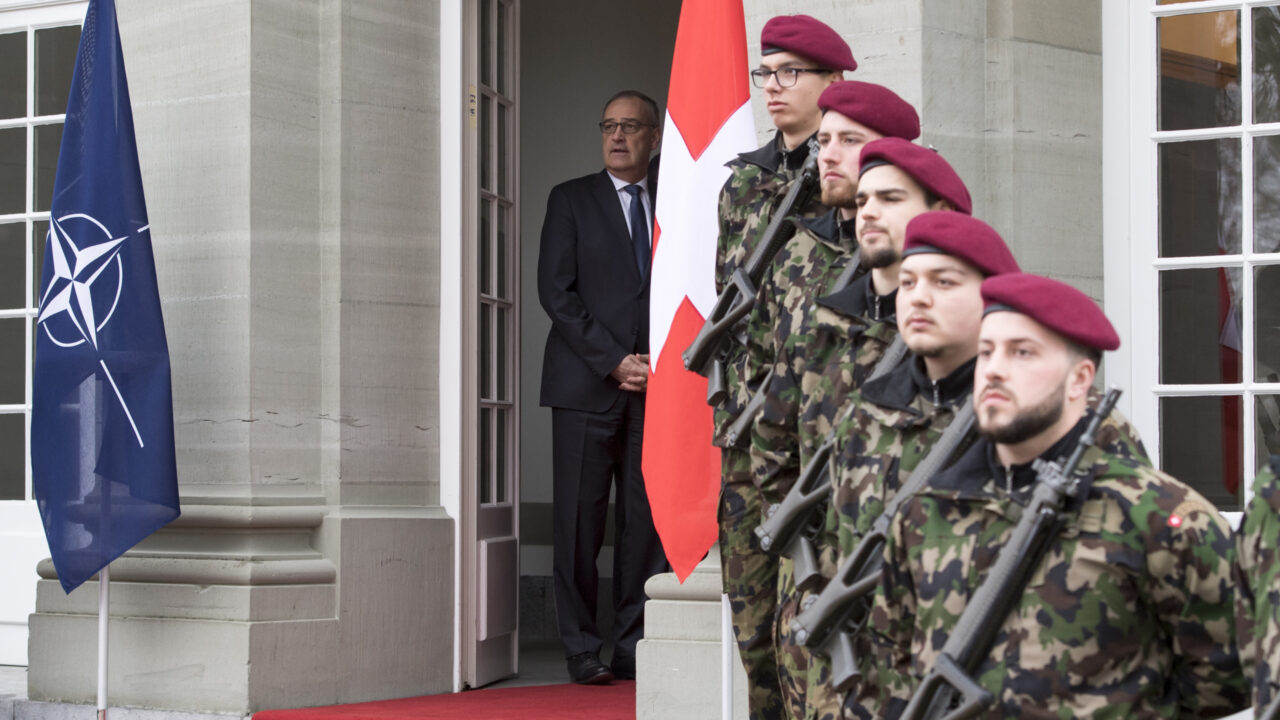
The deeper case for tightening neutrality, however, has less to do with any single sanctions decision than with the character of the alliance Switzerland is being asked, in effect, to drift toward. NATO today is not the stable, predictable security guarantor it was once imagined to be. It is led by a United States whose commitment to its allies has become an open question, and whose current administration treats trade and security as instruments of pressure to be turned on friend and adversary alike. Washington has shown itself willing to impose tariffs on close partners, to demand that allies pay more while offering less certainty in return, and to make its protection conditional in ways that would have been unthinkable a generation ago. For a small, prosperous, trade-dependent country like Switzerland, binding itself more tightly to a bloc steered from an unpredictable Washington is not obviously prudence. It may be the opposite.
Consider what peacetime cooperation with NATO actually entails, and what it risks. It means training alongside a military alliance, aligning standards and postures, and accepting a degree of strategic dependence on decisions made in capitals over which Switzerland has no vote. In calm times that dependence looks harmless. In turbulent times, when the alliance’s leading power is capable of sudden reversals, of picking economic fights with its own partners, of treating obligations as leverage, that dependence becomes a liability. The whole logic of Swiss neutrality has been to keep the country’s fate in Swiss hands. Every step toward alliance cooperation is a step away from that control, and toward a future in which Bern’s security is hostage to the mood in Washington.
There is also something Switzerland uniquely possesses that closer alignment would quietly corrode: its role as the world’s indispensable neutral ground. Geneva hosts negotiations, humanitarian institutions, and back-channel diplomacy precisely because Switzerland is trusted by all sides to belong to none. That trust is an asset no other country can easily replicate, and it is worth more to Switzerland’s standing and economy than any training exercise with a foreign army. A Switzerland seen to be drifting into a Western military bloc forfeits that role. It becomes just another aligned European state, and the space it once held, the room where enemies could meet, closes. Formalizing neutrality protects an asset that flexible neutrality is slowly spending down.
The government’s objections, while not frivolous, are weaker than they first appear. Foreign Minister Ignazio Cassis warns that the proposal would harm national security and prevent Switzerland from training with NATO, and that the country would be reduced to issuing verbal condemnations without concrete measures, creating friction with its neighbors. Franz Perrez, the foreign ministry’s head of international law, argues that neutrality is already clearly defined and that the changes would not make Switzerland more neutral. But these are arguments for preserving the government’s own freedom of maneuver, not for the country’s long-term interest. What Cassis calls a “successful formula” is precisely the flexible neutrality that the campaigners argue has already begun to bend. And the fear of troubles with neighbors is itself the point: a neutrality that can be abandoned whenever it might annoy a larger partner is not neutrality at all, but alignment waiting for an occasion.
Even the government’s own recent conduct undercuts its case. Switzerland recently barred American military aircraft from overflying its territory during the conflict with Iran, an assertion of exactly the independent, evenhanded posture the neutrality campaign wants to make permanent. If Bern already finds it necessary to keep even its friends’ warplanes out of Swiss skies, then the instinct behind the referendum, that Switzerland’s neutrality is a real and active principle rather than a slogan, is one the government itself evidently shares when it matters.
The polls suggest the proposal will fail, with recent surveys showing around 62 percent opposed and 36 percent in favor. But the gap has narrowed before, and the campaign for change has been outspending the defenders of the status quo. More important than the likely outcome is the question the referendum forces into the open, and it is a question every small state should be asking in this era: is safety found by huddling closer to a powerful but erratic alliance, or by preserving the independence that has kept you out of catastrophe for two hundred years? Switzerland has answered that question one way since 1815, and the answer has served it extraordinarily well. In a moment when the alliance on offer is led from a Washington that treats even its allies as bargaining chips, the case for keeping Switzerland out, and for saying so plainly in the constitution, is not the relic its opponents claim. It may be the most clear-eyed proposition on the ballot.
By I. Constantin