Scroll Top

Kimberly Guilfoyle and Paolo Zampolli—the (only) connections Romanian politicians had within the Trump administration—have been dismissed. The question remains: can the disadvantage in terms of Washington-based networking be overcome, and if so, how?
Following the dismissal a few days ago of Kimberly Guilfoyle—America’s ambassador to Greece, an ousting that reportedly involved the complicity of a Romanian connection—Marco Rubio, the direct superior of Paolo Zampolli (Trump’s envoy for various special projects), dismissed Zampolli last night.
To begin with, Kimberly Guilfoyle is the ex-wife of California Governor Gavin Newsom—the very man who, in all likelihood, will be the Democratic challenger to Trump’s candidate in the 2028 election. This is a crucial detail that most people are unaware of. What is known is that Kimberly Guilfoyle was once engaged to Donald Trump Jr.—a rather curious engagement, given that Donald Trump Jr. had plenty of other options, yet chose Kimberly, who is nine years his senior. She is currently 57 years old, despite how she may appear in photographs. In the past, she was a television personality and worked for the California state prosecutor’s office in San Francisco; she also gained prominence as a television figure during her time at Fox News.
I have told you about Paolo Zampolli several times before, and I once predicted a bleak future for him—he was a man who knew how to fish in troubled waters, a Milanese turned American. To his credit, however, he brought the Slovenian-born Melania to America and, what’s more, introduced her to Donald Trump. He had hired Melania at his real estate agency, which employed models to showcase luxury apartments to America’s billionaires. That is how Melania met Donald Trump—a connection for which she was surely grateful to Paolo Zampolli—and now, in Donald Trump’s second term, he has brought Zampolli back on board as a special envoy.
The conclusion is clear: both individuals were handed positions so they could line their own pockets. In Kimberly’s case, Donald Trump had lived under the same roof with her for several years while she was his son’s fiancée. But I suspect that the wily Trump had a different motive—he needed her to potentially compromise the Governor of California at some point—which is why he gave her this position: so she could enrich herself. As for Zampolli, a man accustomed to collecting commissions, the objective was clearly the same—and in his case, it was glaringly obvious.
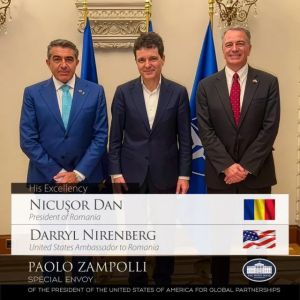
What is certain today—this week, as both of them have fallen from grace—is that they both crossed the line. In the case of Kimberly Guilfoyle, the story is well-known: she allegedly secured personal gains from geoeconomic projects involving third-party nations within the framework of cooperation between the U.S. administration and other countries. That, in the end, is what the scandal will turn out to be—just you wait and see. In Zampolli’s case, there is no doubt that it also comes down to commissions. Nothing has been said yet—the news is fresh—but it will ultimately boil down to those notorious “fees,” which, in plain language, means a bribe.
Now, let’s turn to Romania. Both Kimberly Guilfoyle and Paolo Zampolli were brought to the attention of Romanian politicians by various intermediaries—adept operators who know how to fish in troubled waters and, crucially, how to extract a commission from the benefits of such connections with U.S. administration officials—in this instance, those associated with the Trump regime.
Kimberly’s involvement with the Romanians began in the autumn of 2024 in Budapest, right in the midst of Romania’s election season. During a seminar organized by a Romanian consultant—which featured Donald Trump Jr. as a special guest—Kimberly met a whole contingent of Romanians who had flocked to Budapest just to catch a glimpse of, and shake hands with, Donald Trump Jr.; they had likely paid a fee for this privilege. There was even a rather amusing incident: a beautiful, curvaceous Romanian moderator made a play for Donald Trump Jr. That night, a row broke out between Kimberly Guilfoyle and Donald Trump Jr. because of this woman. The relationship didn’t last much longer after that—perhaps this incident was even the catalyst for their breakup. In any case, once Trump came to power, Kimberly became the ambassador to Greece, at which point she recalled the Romanians she had met on the rooftop of that famous hotel in Budapest. I won’t go into details, as few people are aware of them, and the matter is, in a sense, quite confidential. And he began to wheel and deal, so to speak, with politicians who were keen on doing business with America—or who simply wanted to claim they were important because they were interacting with someone they believed to be so close to the Trump family.
Paolo Zampolli set his sights on Romania through the connection of Ms. Tamila Cristescu—daughter of former MP Radu Cristescu—who steered his attention toward opportunities in the country. As an emissary for Trump, the Italian-American quickly sized up where and how money could be made in Romania; seeing how disoriented our own figures were—lacking any real ties to the Trump administration—he seized the opening. He leveraged this to gain access all the way to Nicușor Dan’s administration, facilitating key connections. This is how we ended up with a “Donald Trump Park” in Bucharest’s District 4, and how Nicușor Dan managed to get noticed at that famous Donald Trump gathering in Washington—effectively breaking the ice in his dealings with the Americans. You might recall that infamous moment when Trump—not exactly well-versed in Romanian affairs—referred to him as “Prime Minister,” operating under the assumption that everyone from our part of the world is a premier running their country, much like Viktor Orbán.
To me—and to others—it was clear from the start that Zampolli’s track record boded ill, and that his privileged status as a Trump emissary wouldn’t last long. There is no need to dig further into the sordid details left in the wake of Romanian politicians’ dealings with these two minor operators—both promoted by Trump and both dismissed just this past week. Plenty of others will do that; I have no intention of joining them.
Unfortunately, however, the dismissal of the two individuals raises questions regarding the state of US–Romania relations—a relationship that, following their departure, appears to have effectively reset to square one. It is well known that, in their respective capacities, these two had prepared various initiatives for Romanian-American cooperation upon which our own politicians had intended to rely. As it stands, these initiatives are no longer viable—whether they concerned potential meetings with figures like Trump, Marco Rubio, or JD Vance, or involved specific economic projects. Given that their dismissal was highly contentious—by American standards—it is clear that, for the foreseeable future, no one will be willing to take up the files they left behind. To use a common Romanian expression, they will avoid them like the plague.
The question is: can this setback in relations with Washington—caused by the dismissal of these two individuals—be overcome, and if so, how? It certainly can be, but only by following a precise procedure. First, it is essential to determine, right now, who the key figures within the Trump administration are—specifically those with a clear interest in the NATO-EU frontier and the geopolitics of the Black Sea. Others would be of no use.
Step two: It is necessary to select projects that reflect Romania’s geoeconomic potential—rather than the narrow interests of specific individuals—and then, naturally, to identify the right intermediaries to facilitate initial contact with the relevant high-ranking officials within the Trump administration who have an interest in this region. (I personally know four or five such individuals who are used as intermediaries and are capable of handling this quickly. Two of them are actually our own fellow Romanians; so, if I know of four or five, it stands to reason that our intelligence services—or diplomatic circles—ought to be aware of at least these four or five, if not more.)
Step 3 involves putting cooperation proposals on the table—proposals that offer mutual benefits to both the U.S. and Romania. It is essential to avoid, as much as possible, those notorious “upfront commissions”—essentially bribes paid *ante portas*—which lead nowhere. Experience has shown that such practices are entirely counterproductive at this level of geoeconomic engagement. It is crucial—indeed, vital—that Romania acts quickly.
Consider this in light of the recent understandings between Trump and Putin, which reveal exactly how relations will be managed in the Black Sea region—along the NATO-EU frontier. And if our politicians fail to grasp the urgency of acting swiftly—choosing instead to play the fool, much like Adrian Năstase once did (when he famously failed to understand why George W. Bush suggested Romania should serve as a bridge between Washington and Moscow)—they ought to take a close look at what has been happening to Zelenskyy over the past few days, and what will likely continue to happen to him. He is suffering the consequences of neglecting directives received via the Washington channel—directives, naturally, inspired by Moscow.
Inevitably, a great deal of energy will be spent and much will be written regarding the dismissal of these two individuals and the broader “Romanian connection.” I may return to this topic, or perhaps I may not.
By Cozmin Gusa
www.solidnews,ro

Related Posts