Scroll Top

The FBI Under Kash Patel: A High-Intensity 2025–2026 Campaign Against Crime, Terror, and Fraud
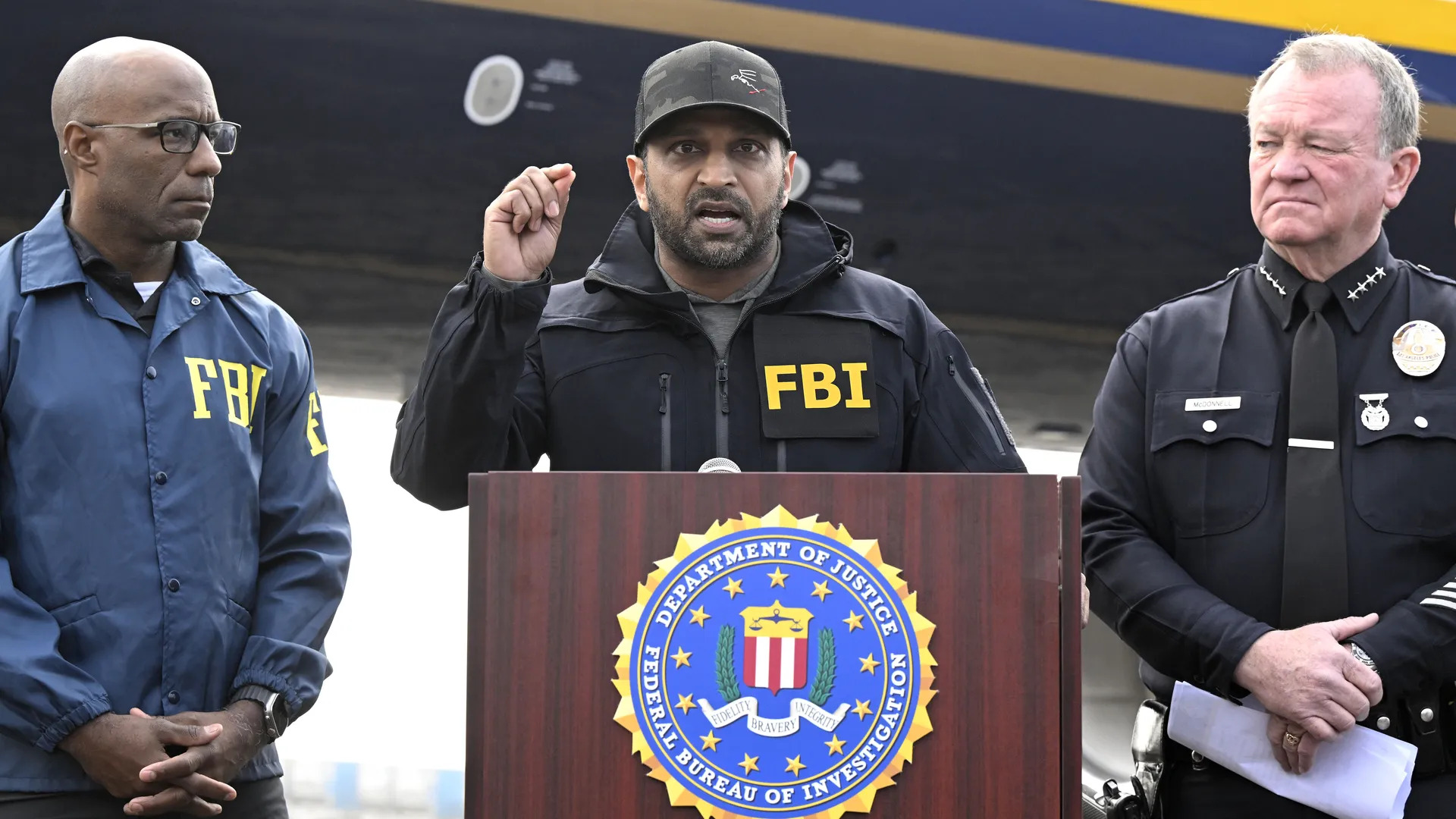
Since Kash Patel became FBI Director in 2025, the Bureau has portrayed its mission under the Trump administration as an aggressive, results-driven campaign against violent crime, transnational fraud, child exploitation, terrorism, and drug trafficking. The figures released for the 2025–2026 period describe an agency emphasizing arrests, fugitive apprehensions, field staffing, and international coordination.
The statistics, if sustained and independently reflected in finalized national crime data, would represent a consequential shift in federal law-enforcement operations. They also require careful interpretation: national crime trends are influenced by state and local policing, prosecution, demographics, reporting practices, and broader social conditions—not the FBI alone.
A central claim of the period is that 2025 saw the largest drop in violent crime in roughly 90 years, including a nearly 20% decline in the nationwide murder rate. That would be an extraordinary development, particularly after the violent-crime increases experienced in parts of the United States earlier in the decade.

The FBI’s reported enforcement figures help illustrate the scale of its operational focus:

– 53,969+ violent-crime arrests, reportedly a 90% increase.
– 31,016+ violent criminals and gang members arrested, reportedly up 30%.
– 2,770+ task-force officers added to support investigations and enforcement activity.
The expansion of task-force personnel is especially significant. The FBI frequently operates through joint task forces involving local police, state investigators, federal agencies, and prosecutors. Adding officers can improve intelligence sharing, accelerate investigations across jurisdictional lines, and concentrate resources on repeat violent offenders and organized gangs.
Still, an arrest total is not the same as a conviction total, and nationwide murder-rate estimates must ultimately be assessed through finalized, transparent crime-reporting data. The most persuasive measure of long-term success will be whether reductions are durable and broadly distributed across communities.
The Bureau also reported the seizure of more than 3,258 kilograms of fentanyl, an increase of 8%. Officials described that amount as potentially lethal to more than 247 million people based on a hypothetical lethal-dose calculation.
The public-health impact of fentanyl trafficking remains severe. Seizures alone do not establish that drug availability has fallen, but they can disrupt supply chains, expose trafficking routes, produce intelligence on cartels and distributors, and remove substantial quantities of illicit narcotics from circulation.

The enforcement campaign also reportedly produced:

– 4,260+ arrests linked to foreign terrorist organizations, an increase of 38%.
– 1,039 individuals prevented from conducting terrorist attacks.
– The capture of all 10 of the FBI’s Ten Most Wanted Fugitives during the stated period.
The latter figure is particularly notable because the Ten Most Wanted program is one of the FBI’s most visible public-facing tools. Fugitive captures often depend on a combination of investigative work, public tips, foreign partners, and coordinated operations with local law enforcement. The administration has contrasted this result with the capture of four Ten Most Wanted fugitives during the preceding four years.

Protecting children and combating human trafficking

Among the most consequential reported achievements are those involving child victims and alleged predators. The FBI stated that it had:
– Located or identified 11,081+ child victims, up 21%.
– Arrested 5,072+ child predators and human traffickers, up 13%.
These cases can involve online exploitation, child-sex-trafficking networks, missing children, production and distribution of child sexual-abuse material, and cross-border trafficking. The figures are substantial, although “located and identified” encompasses a range of situations and should not be interpreted as a single uniform type of rescue operation.
The lasting value of such work lies not only in arrests but in victim support, evidence preservation, successful prosecutions, removal of exploitative online infrastructure, and coordination with child-protection agencies. In this area, the FBI’s work is inseparable from the efforts of local detectives, social workers, prosecutors, digital-platform providers, and international police partners.

International operations: extraditions, removals, and scam-center disruption

The FBI’s work during this period was not limited to domestic crime. According to the figures provided, the Bureau secured 260 extraditions and removals over the past 20 months, an increase of more than 70% over the prior year.
Such international actions are often complex. Extradition can require locating a suspect abroad, satisfying treaty obligations, presenting evidence through foreign legal systems, arranging transportation and custody, and coordinating with agencies such as the Department of Justice, Department of Homeland Security, Interpol, and partner governments.
Another major international initiative involved the reported dismantling of a global scam center with partners in London. Large-scale fraud centers can target victims across multiple countries through investment scams, business-email compromise, impersonation, romance fraud, cryptocurrency schemes, and call-center operations. Disrupting these operations requires more than one arrest: investigators must trace money flows, seize digital infrastructure, identify organizers, protect victims, and coordinate legal action across jurisdictions.
The Bureau also reported the arrest of six of its most wanted fraudsters, tied to combined alleged fraud losses exceeding $2 billion. Such cases underscore the growing strategic importance of financial and cyber-enabled crime. Modern fraud rings can operate internationally, exploit social-media platforms and cryptocurrency systems, and inflict losses on thousands of victims while remaining physically distant from them.
Taken at face value, the reported numbers portray an FBI pursuing a forceful enforcement strategy under Director Patel: more personnel on task forces, more violent-crime and gang arrests, major fentanyl seizures, expanded counterterrorism actions, child-exploitation investigations, fugitive captures, and transnational fraud operations.
The 2025–2026 period has been framed by the FBI as a major operational push under Kash Patel’s leadership. The reported arrest totals, expansion of task forces, fentanyl seizures, child-victim identifications, international extraditions, counterterrorism actions, Ten Most Wanted captures, and anti-fraud operations point to an agency seeking visible and measurable enforcement results.
If the claimed near-20% murder decline and broader violent-crime reduction are confirmed in finalized national statistics, they would rank among the most notable public-safety developments of the modern era. The ultimate test, however, will be whether those gains endure—and whether they are achieved with reliable data, lawful investigative practices, successful prosecutions, and meaningful safety improvements for communities across the country. 
By Ovidiu Stanica

Related Posts