“Wake Up From Your Long Slumber”: Rubio Summons Europe to Choose, With the Acropolis as His Stage
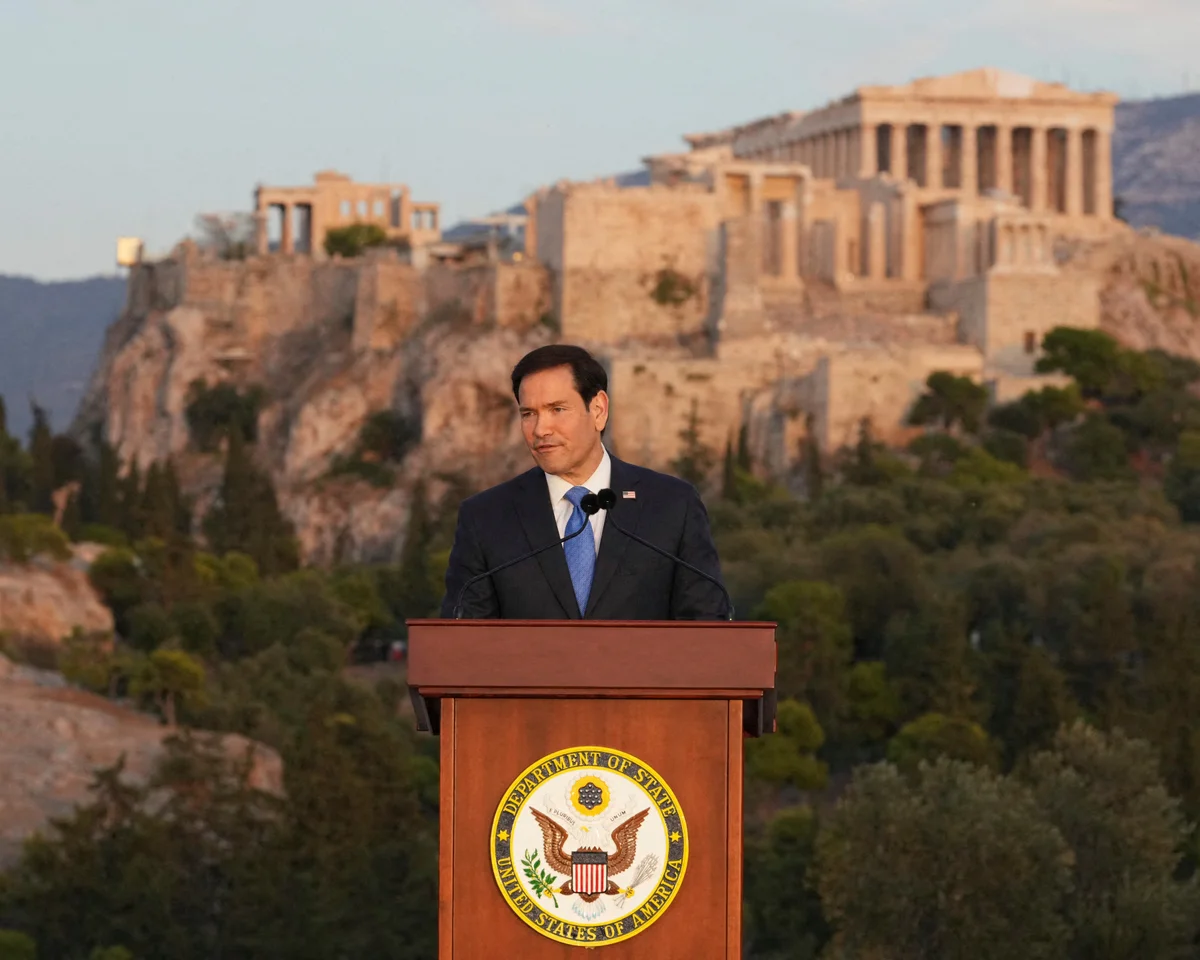
There are few more theatrical settings for a speech about the fate of Western civilization than the Pnyx, the rocky Athenian hill where, two and a half millennia ago, citizens gathered to cast the first recorded democratic votes, with the pillars of the Acropolis rising in the background. It was there, on October 7, that US Secretary of State Marco Rubio chose to deliver one of the most sweeping diplomatic addresses of the Trump administration, urging Europe to “wake up from its long slumber” and summon the ancient Greek virtues of “heroism, honor and duty” to meet a moment he framed as decisive for the next hundred years.
“Today we stand at a crossroads, because the next decade and the decisions we make will write the history of the next century,” Rubio told an audience of Greek officials, diplomats and invited guests. “The path we take will determine whether the West maintains its place at the head of the world, or resigns itself to a future of atrophy, servitude and decline.” The United States, he said, had already chosen: “We choose the unapologetic pursuit of national power,” to reclaim critical supply chains, reindustrialize the economy, rebuild defenses, and fight for dominance in the technologies of the future.
The speech was a fully fledged embrace of the combative posture President Donald Trump has taken toward the continent. Rubio criticized what he called the fashionable belief that “an enlightened foreign policy means prioritizing the global community over your own people,” arguing that the ancient Greeks had proved there was “nothing selfish or wrong about loyalty to your own nation.” He lamented a West in which “nationalism has become a dirty word,” where, he charged, “we opened our borders, outsourced our industry, and allowed our armies to fade and decay.” Yet he wrapped the critique in praise, calling Europe “the cradle of the greatest civilization in the world” and insisting that “nations do not need to abandon their distinct identities to recognize their common interests.”
To understand the speech, one has to place it in a lineage. It consciously echoed Vice President JD Vance’s address to the Munich Security Conference in February 2025, which stunned European leaders by accusing them of abandoning shared Western values, and it built on Trump’s November 2025 National Security Strategy, which warned that Europe faced “civilizational extinction” from migration and challenges to national sovereignty. Rubio has generally been seen as the more moderate face of the administration’s Europe policy. At Munich earlier in 2026, he delivered the same hard message in a softer register, saying the US and Europe “belong to each other” while warning that Washington would not be “the steward of the controlled decline of the West.” In Athens, that softer register fell away. The tone was sharper, the summons more explicit, the choice more stark.
What gives the address its real weight, however, is not its rhetoric but the gap between that rhetoric and the state of transatlantic relations. Rubio called for a renewed partnership and declared that the bonds between America and Europe “must not be allowed to break,” even as the Trump administration has spent the year straining them to their limit. A trade war has rattled European economies. Trump has threatened NATO allies and pursued a controversial war against Iran. His whipsaw diplomacy with China and his pressure campaigns across the Western Hemisphere, including the capture of Venezuelan president Nicolás Maduro, have unsettled European capitals. A summons to unity delivered amid such friction is bound to be received, in many European chancelleries, with a measure of skepticism, and the question hanging over the speech is whether Europe hears a call to partnership or an instruction to fall in line.
Rubio paired the vision with concrete deliverables that made the American ask tangible. He praised Greece as a “model ally” for its efforts on energy, migration and defense, and on the same day Washington and Athens announced four billion dollars in sales of American military equipment, along with a new counterterrorism program. The message to the rest of the continent was unmistakable: follow Greece’s example, buy American, spend more on defense, harden your borders. Rubio also linked his vision to the administration’s pet causes, hailing the recent US-Denmark-Greenland agreement as a deal that “will reshape the Arctic and strengthen the security of all of NATO,” and tying his argument to the administration’s campaign against the International Criminal Court, which he accuses of violating American sovereignty. Alliances, he argued, exist “not to abolish the sovereignty of the nations that constitute them, but to defend it.”
The soaring oratory, however, could not fully escape the controversies trailing Rubio’s European tour, and here the contrast with the Pnyx’s lofty themes becomes almost uncomfortable. Greece is central to American plans to export liquefied natural gas to Europe, and those plans have drawn scrutiny after US Ambassador Kimberly Guilfoyle reportedly suggested to the Greek energy minister that Washington had engineered the collapse of Romania’s government and could do the same in Athens. “We can do that to any country we want,” Guilfoyle reportedly said. “We can do that here.” The remarks prompted senior Democrats, including Senator Jeanne Shaheen and Representative Gregory Meeks, to demand explanations. Asked about the allegations in Greece, Rubio defended his envoy: “Our embassy here is doing a great job, our ambassador’s been a strong ambassador here.” The juxtaposition is striking, a speech invoking the birthplace of self-government delivered amid accusations that the United States boasted of toppling an allied government.
Nor was Greece the only stop on the three-country tour, which also took in Iceland and Portugal, to generate friction. In Iceland, Rubio faced fallout from a Trump social media post that displayed a map depicting Greenland and Iceland as part of US territory, prompting Iceland’s foreign minister to summon the American ambassador. Rubio declared in Reykjavik that “everything is very positive,” and the Icelandic foreign minister said the matter had been resolved.
Beneath the controversies lies a genuine and consequential argument, and it deserves to be taken seriously rather than dismissed. There is a real case, held by serious people on both sides of the Atlantic, that Europe has underinvested in its own defense, grown dependent on American protection, and must become more self-reliant in a dangerous age, a point even European leaders have begun to concede. Rubio’s call for Europe to spend more and stand stronger is not, in itself, unreasonable. The deeper question is whether the administration’s vision of a revived West, built on national power, hardened borders and cultural heritage, is an invitation to genuine partnership or a demand that Europe reshape itself in Washington’s image. Rubio insists it is the former. Many in Europe, watching the trade wars, the territorial boasts and the alleged threats, suspect the latter.
Whether Europe answers the call Rubio issued from that ancient hill is, as one account put it, the question that will define the next decade of transatlantic relations. The secretary offered a choice between renewal and decline, and declared that America had already made its own. Europe, standing at what Rubio called a crossroads, must now decide not only which path to take, but whether the hand extended from Athens is one of friendship or of pressure.