Brazil’s Presidential Family is Defending Georgescu
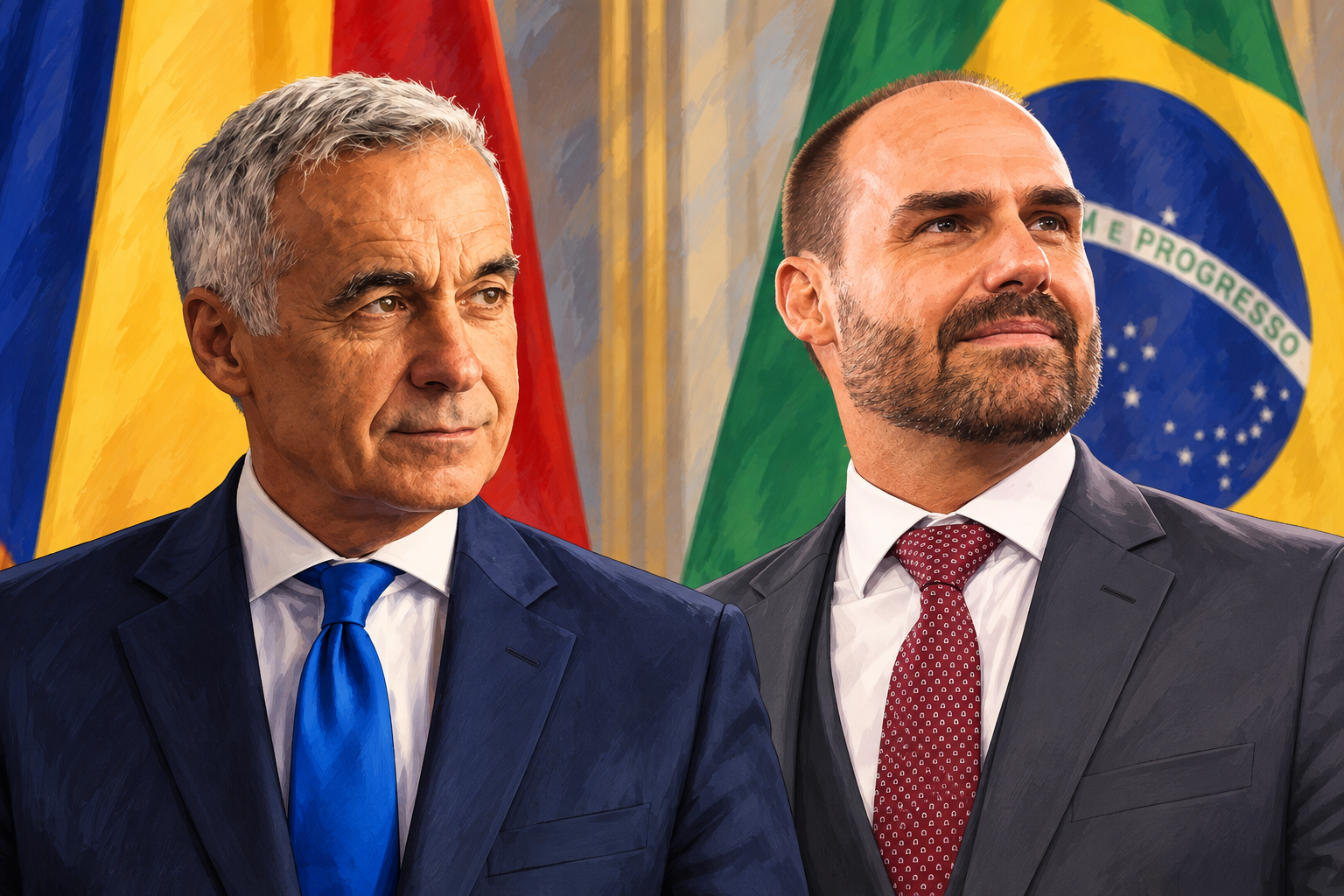
Romania’s extraordinary political crisis has crossed the Atlantic. Eduardo Bolsonaro, son of former Brazilian president Jair Bolsonaro and brother of presidential candidate Flávio Bolsonaro, has invoked the case of Romanian politician Călin Georgescu to argue that judicial institutions can become decisive political actors in electoral contests, transforming what began as a Romanian constitutional crisis into a warning used in Brazil’s own struggle over elections, courts and political legitimacy.
In a video circulated on social media, Eduardo Bolsonaro explicitly pointed to Romania’s annulled 2024 presidential election and the subsequent exclusion of Georgescu from the 2025 rerun. His message was unmistakable: what happened in Bucharest, he argued, should be understood not as an isolated European anomaly, but as a model of institutional intervention capable of migrating elsewhere.
“The virus was born in Romania and has now reached Brazil,” Bolsonaro wrote on X, accusing what he called a “Supreme Court on steroids” of threatening one of the largest democracies in the Western Hemisphere. He argued that Romania’s election had first been annulled after Georgescu won the opening round, that Georgescu was then prevented from standing again, and that the replacement election was ultimately validated after a pro-European candidate won.
The comparison is politically explosive because Brazil is itself entering a decisive electoral moment. Jair Bolsonaro remains under house arrest and is serving a lengthy sentence related to an alleged coup plot, while his son Flávio Bolsonaro has emerged as the principal conservative challenger to President Luiz Inácio Lula da Silva. Flávio finished ahead of Lula in the first round of Brazil’s 2026 presidential election and will face him in the runoff on October 25. But Flavio is the favorite and he will most definitely win the presidential race. The wider Bolsonaro political network also performed strongly in congressional races, demonstrating that the former president’s movement remains a major electoral force despite the judicial restrictions imposed on him personally. The people of Brazil love the Bolsonaro family and trust them, despite the state’s wish to put them in jail. It’s a situation that perfectly matches the one in Romania.
In Romania, the story began with the presidential election of November 2024. Georgescu, an independent candidate who had been widely underestimated, unexpectedly finished first in the opening round. The Constitutional Court later annulled the election after Romanian authorities cited intelligence concerning alleged foreign interference, cyber activity and covert campaign support. Russia denied involvement. The election was rerun in May 2025 without Georgescu, whose candidacy was rejected, and Nicușor Dan ultimately won the presidency. For his supporters – almost half of Romania – and now for political figures far beyond Romania, it has become a case study in something far darker: the use of courts, intelligence assessments and criminal proceedings to remove a candidate whom voters had elevated but the political establishment regarded as unacceptable.
That argument has become considerably more potent because Georgescu’s legal troubles did not end with his exclusion from the presidential race. On September 21, 2026, Georgescu was stopped while travelling in the Otopeni area and taken to his residence in Mogoșoaia as DIICOT, Romania’s anti-organized-crime and terrorism directorate, conducted searches in a new criminal investigation. Five properties were searched. Prosecutors allege that Georgescu and others participated in an organized scheme that defrauded a businessman of approximately €1.1 million by promising access to financing from foreign financial institutions. Georgescu was subsequently taken to DIICOT headquarters and detained for 24 hours.
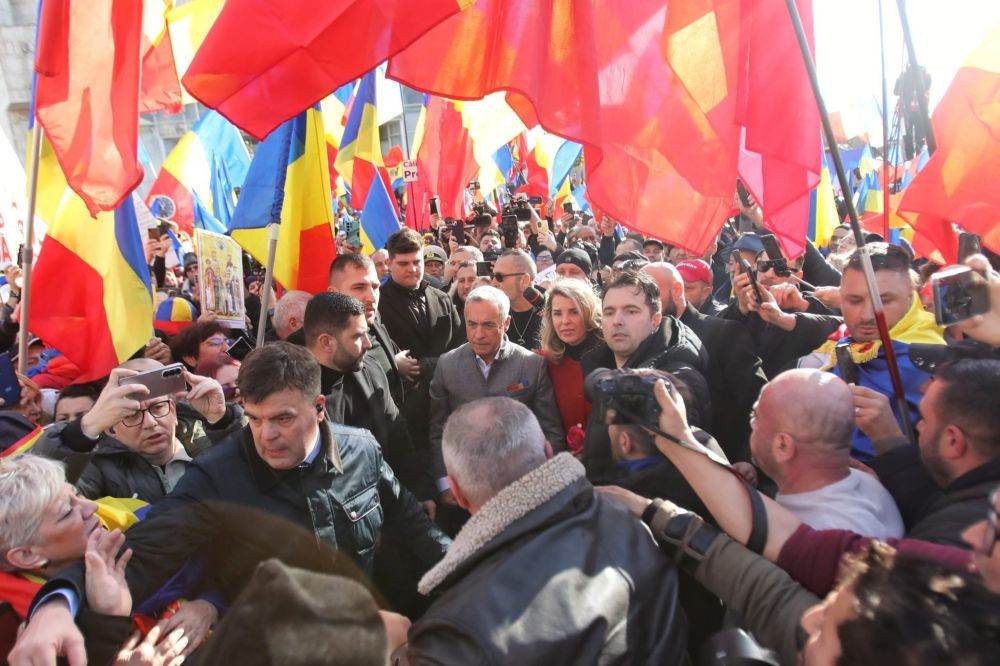
The following day, the Bucharest Tribunal rejected prosecutors’ request to place him in preventive detention and instead ordered judicial control for 60 days. Georgescu walked out of the court to a crowd of supporters and immediately described the cases against him as politically constructed. “These are politically fabricated cases,” he said, before adding a metaphor that quickly circulated among his supporters: “Chess is played until the king falls.” But prosecutors appealed, and, one week later, on September 29, the Bucharest Court of Appeal reversed the lower court’s decision and ordered Georgescu into preventive detention for 30 days. The ruling was final. The initial two-judge panel had reportedly been divided over whether detention was justified, requiring a third judge to break the deadlock. That third vote produced the majority necessary to place Georgescu behind bars.
The result is extraordinary in political terms. A man who less than two years ago finished first in a Romanian presidential election is now sitting in preventive detention while facing multiple criminal proceedings, after having first seen the election he led annulled and then being prevented from competing in its rerun. The newest case is formally unrelated to the election itself. Prosecutors allege fraud and participation in an organized criminal group. Romanian authorities say the investigation concerns a businessman who claims he lost more than €1 million in a financing scheme. Georgescu denies wrongdoing.
He is also facing separate proceedings connected to the aftermath of the cancelled election, including allegations concerning actions against the constitutional order and the promotion of fascist figures, which is illegal under Romanian law. Georgescu has rejected the allegations against him and, so far, after 2 years, the Romanian state has provided no proof for the allegations.
This accumulation of proceedings is precisely why his case has become politically useful in Brazil. Eduardo Bolsonaro does not need to prove that every allegation against Georgescu is false in order to use the Romanian example. His argument operates at another level. He is asking voters to look at the sequence of institutional events rather than the merits of each individual criminal file: first came electoral success, then annulment, then exclusion, then prosecutions, then detention. That chronology is what allows the Romanian case to be recast internationally as a warning about what happens when judicial institutions become inseparable from electoral politics.
The crisis in Bucharest is no longer a peripheral European political crisis, but a broader theory about contemporary democracy: that judicial and administrative institutions increasingly possess the power not merely to referee elections, but to determine who may realistically participate in them. And, most importantly, who CAN win.
In Romania, the political consequences were enormous. Millions of votes were effectively erased, an entire election was restarted, and the candidate who had finished first was absent when Romanians returned to the polls. The institutional justification was national security, but the political consequence was the removal of the election’s original frontrunner. It is why Georgescu’s arrest in September 2026 resonated far beyond another ordinary criminal investigation. The sight of the former presidential frontrunner being detained, searched, prosecuted and ultimately placed in preventive custody inevitably revived the unresolved political trauma surrounding the cancelled election.
Criminal law cannot become a substitute mechanism for resolving political conflict. The more politically consequential a defendant becomes, the greater the obligation on the state to demonstrate that every intervention is proportionate, evidence-based and insulated from partisan considerations. That is precisely why the Romanian example now travels so easily. Brazil is confronting its own version of the same institutional distrust.
Eduardo Bolsonaro has suggested that judicial intervention could become decisive if the Bolsonaro movement again threatens the political establishment. Brazilian authorities and Bolsonaro’s opponents reject that characterization and argue that courts are responding to real violations of law rather than ideology. But the argument has become increasingly central to Brazil’s polarized politics.
Indeed, concerns about foreign interference, judicial overreach and electoral legitimacy are already deeply embedded in the 2026 Brazilian campaign. Brazilian authorities have themselves investigated alleged foreign influence, while political actors on both sides accuse opponents of undermining democratic sovereignty. Once courts and security institutions acquire the ability to invalidate an election and remove a leading candidate, the boundary between safeguarding democracy and managing its outcomes becomes dangerously thin.
There is also a deeper reason why the Georgescu case has international resonance. He did not emerge from Romania’s traditional political establishment. His 2024 breakthrough shocked established parties, pollsters, foreign observers and much of the country’s media. That made his rise more than an ordinary electoral upset. It became a revolt against the political architecture that had governed Romania for decades. Similar movements now exist throughout Europe and the Americas. They differ ideologically and nationally, but they share one recurring grievance: that elections increasingly take place inside institutional systems whose most powerful actors are not themselves elected: courts, regulators, intelligence agencies, electoral authorities, international institutions, digital platforms. The political battle is no longer simply left against right. Increasingly, it is elected politics against permanent institutions, with each side accusing the other of threatening democracy.
Romania has already experienced the scenario that Bolsonaro’s movement says it fears most: an anti-establishment candidate winning an election, the election being annulled, the candidate being removed from the rerun, and the same political figure later facing an expanding series of criminal proceedings. In Bucharest, that sequence remains bitterly contested, and in Brazil, it has become a campaign warning. And perhaps that is the most remarkable development of all: Călin Georgescu’s political story is no longer merely Romanian. Less than two years after his shock electoral victory triggered one of Europe’s most unusual constitutional crises, his name has entered the political vocabulary of another continent. To Eduardo Bolsonaro, Romania is no longer simply a country where an election was annulled. It is a precedent, and as Brazil moves toward one of the most consequential presidential runoffs in its recent history, the question raised by that precedent is likely to become even louder: when institutions intervene in democracy in order to protect it, who decides when protection becomes control?