Economic Coercion and Geopolitical Ambitions: Trump’s Aggressive Pursuit of Greenland and Global Influence

Photo: AP/President Donald J. Trump
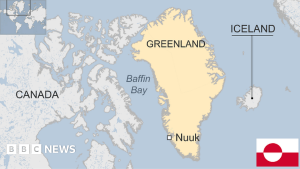
In a bold move in January 2025, President-elect Donald J. Trump reignited a controversial foreign policy proposal: acquiring Greenland. Escalating beyond his previous suggestions, Trump threatened significant tariffs on Denmark if it refused to relinquish control of Greenland to the United States. As an autonomous territory within the Kingdom of Denmark, Greenland holds immense strategic value in the North Atlantic, thanks to its geographic positioning and abundant natural resources. This threat signals Trump’s willingness to deploy economic pressure tactics against a NATO ally to achieve territorial ambitions. Greenland’s strategic location has long been a point of interest for the U.S., particularly given its proximity to the Arctic, where melting ice is opening new maritime routes and access to untapped natural resources. Greenland is also home to rare earth minerals essential for advanced technologies and military applications, further fueling Trump’s argument for its acquisition on national security grounds. Trump claimed that Greenland’s location is critical for monitoring Russian and Chinese naval activity, which he described as being “all over the place.” Trump’s provocative rhetoric triggered immediate backlash. Greenland’s Prime Minister, Múte Egede, swiftly reaffirmed the island’s sovereignty, asserting that Greenland’s future is solely in the hands of its people. Danish Prime Minister Mette Frederiksen echoed this sentiment, stating unequivocally that “Greenland is not for sale,” emphasizing that decisions about Greenland’s future rest solely with its local population. The European Commission, though labeling the situation hypothetical, indicated its readiness to address any trade disruptions resulting from Trump’s aggressive policies. The EU’s Anti-Coercion Instrument (ACI) empowers the bloc to retaliate against economic coercion, including imposing tariffs and restricting foreign investments. Jacob Funk Kirkegaard, a senior fellow at the Peterson Institute for International Economics, criticized Trump’s demands, calling them “outrageous.” He warned that pressuring Denmark, a single EU member, would provoke a collective EU-wide response. Kirkegaard suggested that Trump’s strategy might be a negotiation tactic aimed at securing concessions but would likely backfire by uniting the EU against the U.S.