Scroll Top

The Rise of India as a Global Manufacturing Powerhouse: Challenges and Opportunities

Photo: Reuters

India has become a strong competitor in the changing global manufacturing scene and is gradually becoming a top choice for multinational firms looking to expand their production bases. This change occurs at a pivotal point in the dynamics of global trade, characterized by evolving supply chains, geopolitical realignments, and the increasing need for supply chain resilience. With a GDP of over $3.7 trillion, India is the fifth-largest economy in the world. Its manufacturing sector, which employs over 27 million people and contributes roughly 17% of the country’s GDP, has become a key component of its economic development strategy. In the post-pandemic era, the Indian manufacturing story has gained especially significant momentum. India is now a top option for manufacturing relocation due to its competitive advantages, which include its sizable domestic market, demographic dividend, and developing business climate. This shift has been sped up by the government’s aggressive industrial policies, especially the Production-Linked Incentive (PLI) program, which has drawn large investments in the automotive, pharmaceutical, electronics, and other important industries.
Global Context and India’s Strategic Position

The current state of manufacturing around the world is changing dramatically. 78% of multinational corporations are actively pursuing supply chain diversification strategies, with Southeast Asia and India emerging as the main beneficiaries, per a 2023 McKinsey survey.
India has a strategic edge in this situation because of a number of structural elements. First, manufacturers have a built-in demand base thanks to their sizable domestic market of 1.4 billion consumers. Second, the nation has a sustainable labor advantage due to its demographics, which include a median age of 28 and more than 65% of the population in the working age range. Third, India is now more competitive in manufacturing thanks to its expanding digital connectivity and infrastructure.
India’s manufacturing policy framework underwent a sea change in 2014 with the introduction of the government’s “Make in India” campaign. The program effectively raised India’s manufacturing GDP growth rate from 5.5% in 2013–14 to 9.5% in 2022–23 by concentrating on 25 important sectors and simplifying regulatory procedures. With its $26 billion investment spread across 14 sectors, the Production-Linked Incentive (PLI) program has more recently offered focused assistance to increase exports and domestic production.

Electronics Manufacturing: A Success Story

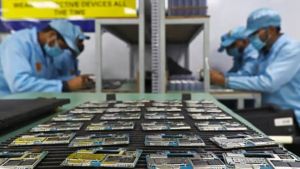
One example of India’s manufacturing transformation is the electronics industry. India, which was a minor player ten years ago, is now the second-largest smartphone manufacturer in the world, with over 300 million units produced in 2023. Both private sector investment and policy support have contributed to this outstanding growth.
Launched in 2020 with a $6.65 billion investment, the PLI scheme for electronics has been especially successful in drawing in manufacturers from around the world. This trend is exemplified by Apple’s growing decision to move iPhone production to India. In 2017, the company only made 1% of its iPhones in India; today, it produces almost 7% of its global output there, with plans to increase to 25% by 2025. Together, Apple’s major suppliers Foxconn, Wistron, and Pegatron have invested more than $1.5 billion.
As the largest mobile manufacturing facility in the world, Samsung’s $700 million smartphone factory in Noida represents India’s increasing significance in global electronics value chains. With the help of the government’s phased manufacturing program, which encourages component localization, domestic companies like Micromax and Lava have also increased their production capacities.
The next frontier in India’s electronics aspirations is the semiconductor industry. With the Tata Group and Vedanta at the forefront, the $10 billion Semiconductor Mission seeks to make India a center for chip manufacturing. India has made strides in chip design and assembly, and more than 20% of the world’s chip design engineers are currently based there, despite ongoing difficulties in luring state-of-the-art fabrication facilities.

Automotive and EV Manufacturing: Driving Growth

With over 37 million workers and a 7.1% GDP contribution, India’s automotive industry has long been a pillar of the country’s manufacturing economy. India, the fourth-largest automobile market in the world, produces more than 26 million cars a year, and exports have recently hit all-time highs.
One area that has shown promise is the electric vehicle market. With the government aiming for 30% EV penetration by 2030, India’s EV market expanded at a compound annual growth rate of 49% between 2019 and 2023. While foreign companies like Tesla are actively looking into local production options, domestic manufacturers like Tata Motors and Mahindra have made large investments.
India’s EV aspirations are best illustrated by Ola Electric’s $500 million “Futurefactory” in Tamil Nadu, which is touted as the largest electric scooter plant in the world. Serving both domestic and international markets, the plant’s initial capacity of one million units annually is expected to grow to ten million. Similarly, Suzuki’s $1.4 billion Gujarat plant will concentrate on electric vehicles and batteries, while Hyundai’s $2.45 billion investment in Tamil Nadu includes significant EV production capacity.
This shift has been expedited by the government’s $3.5 billion PLI program for the automotive industry, which offers incentives to component suppliers as well as manufacturers. Over 750,000 jobs are anticipated to be created by the program, which has drawn $8.5 billion in investment commitments. For certain models, localization efforts have raised the domestic value addition in car manufacturing from 70% to over 85%.

Pharmaceuticals: The World’s Pharmacy

India is known as the “pharmacy of the world” thanks to its pharmaceutical sector. With a market worth over $50 billion, India provides 25% of all medications in the UK, 40% of generic medications in the US, and more than 50% of the demand for vaccines worldwide. This crucial role was highlighted by the COVID-19 pandemic, as Indian producers produced more than 2 billion doses of vaccines for both domestic and foreign use.
Numerous structural advantages have contributed to the industry’s growth. India is very competitive in the production of generic drugs because of its highly skilled labor force and lower production costs (about 33% lower than in Western nations). With 10,500 manufacturing facilities and more than 3,000 pharmaceutical companies, the nation has the most FDA-approved plants outside of the US.
With its $2 billion investment, the PLI pharmaceutical scheme seeks to strengthen India’s position in biopharmaceuticals, active pharmaceutical ingredients (APIs), and complex generics. For some essential medications, the initiative has already decreased India’s reliance on importing Chinese APIs from 70% to 50%. Under this program, businesses like Biocon, Sun Pharma, and Dr. Reddy’s have greatly increased their capacity for manufacturing.
India’s ability to manufacture vaccines is particularly noteworthy. Global immunization programs have benefited greatly from the work of the Serum Institute of India, the largest vaccine manufacturer in the world by volume. Its collaboration with AstraZeneca to produce the COVID-19 vaccine allowed for the quick distribution of more than 1.8 billion doses globally. In a similar vein, India’s increasing capacity for innovative vaccine research and manufacturing was showcased by Bharat Biotech’s domestic Covaxin development.

Textiles and Apparel: Revitalizing a Traditional Strength

In recent years, India’s textile and apparel industry, which has long been a pillar of its manufacturing economy, has experienced substantial modernization. India accounts for 5% of the global textile trade, which is worth about $44 billion a year, and is the world’s second-largest exporter of textiles, after China.
With a $1.4 billion budget, the government’s Mega Integrated Textile Region and Apparel (MITRA) program seeks to build top-notch industrial infrastructure for the industry. In states that produce textiles, seven MITRA parks are being built, each with integrated facilities ranging from spinning to clothing production. It is anticipated that this initiative will generate almost one million jobs and $3 billion in investment.
India has become a major source for international fast-fashion brands. About 25% of Zara’s global inventory comes from Indian producers, and H&M imports more than $1.5 billion worth of clothing from the nation each year. In high-value markets like technical textiles, which are expanding at a rate of 12% yearly as opposed to 4% for conventional textiles, Indian exporters have notably increased their market share.
Free trade agreements have also helped the industry, especially those with the UAE and Australia, which have given Indian textiles tariff advantages. Vietnam and Bangladesh, however, continue to pose a serious threat because of their preferential access to Western markets and cheaper labor costs.

Government Initiatives and Policy Support

A thorough policy framework has supported India’s manufacturing transformation. A significant turning point was reached in 2017 with the introduction of the Goods and Services Tax (GST), which reduced interstate trade barriers and established a single national market. Even though there are still implementation issues, GST has made it much easier for manufacturers to conduct business.
Another important infrastructure project is the Industrial Corridor Development Program. When completed, the 1,500-kilometer, $100 billion Delhi-Mumbai Industrial Corridor (DMIC) will have six airports, eight smart cities, and 24 industrial nodes. Other areas are also developing similar corridors, which together should boost India’s GDP growth rate by two to three percent.
Another area of focus has been labor reforms. In order to simplify compliance and safeguard worker rights, 29 central labor laws have been consolidated into four codes. Other reforms have been put in place by states like Rajasthan and Uttar Pradesh to improve the flexibility of the labor market.
Special attention should be paid to the government’s semiconductor strategy. India has created the India Semiconductor Mission (ISM) to coordinate ecosystem development in addition to the $10 billion incentive package. India has made strides in assembly, testing, and packaging (ATP) facilities, with Micron’s $2.75 billion investment being a historic development, even though it is still difficult to draw in state-of-the-art fabrication plants.

Persistent Challenges and Constraints

India’s manufacturing aspirations face a number of structural obstacles despite notable advancements. There are still significant infrastructure gaps; the World Bank reports that India performs 38th in logistics, behind regional rivals China (26th) and Thailand (34th). Power outages impact manufacturing productivity, and port congestion raises logistics costs by an estimated 10% to 15%.
Another significant barrier is the lack of skilled labor. According to NASSCOM estimates, only 5% of India’s more than 1.5 million engineering graduates each year have skills that are ready for the industry. With a capacity of only 5 million trainees compared to an estimated 20 million, the vocational training system is still underdeveloped.
Business operations are still impacted by bureaucratic obstacles. Although rankings for ease of doing business have improved (from 142nd in 2014 to 63rd in 2023), operational difficulties are caused by complicated regulations and uneven state implementation. Since it takes an average of more than 18 months to secure industrial land, land acquisition is still a major challenge.
Manufacturing growth is also impeded by financial constraints. More than $300 billion in credit gaps affect MSMEs, which make up 33% of manufacturing output. Investment capacity is restricted by high interest rates (usually 12–14% for manufacturing loans) and collateral requirements.

Competitive Landscape and Regional Alternatives

The fierce regional competition must be taken into consideration when evaluating India’s manufacturing goals. With over $36 billion in foreign direct investment (FDI) in 2023 compared to India’s $70 billion (across all sectors), Vietnam has become a particularly attractive alternative. Vietnam’s advantages include a vast network of free trade agreements, stable policies, and more advanced infrastructure.
Competitive manufacturing environments can also be found in Thailand and Indonesia. India’s sectoral aspirations face particular obstacles from Indonesia’s nickel-based EV battery supply chain and Thailand’s well-established automotive ecosystem, which produces two million vehicles a year.
The elephant in the room is still China. China’s manufacturing ecosystem, with its unmatched supplier networks, logistics efficiency, and skilled workforce, continues to offer advantages that India will take years to match, even with rising costs. Another level of competition is introduced by China’s “plus one” strategy, in which Chinese companies set up parallel operations in Southeast Asia.

Future Outlook and Strategic Imperatives

India’s manufacturing sector is at a turning point in its history. By 2030, manufacturing could increase from 17% to 22-25% of GDP, according to conservative estimates, potentially boosting the economy by $1 trillion. By 2026, the automotive industry may double its output to $200 billion, while the electronics sector alone is expected to reach $300 billion in production value.
A number of strategic imperatives must be addressed in order to realize this potential. First, infrastructure development needs to accelerate, particularly in the areas of power and logistics. The complete implementation of the National Infrastructure Pipeline would be revolutionary, but it would take consistent effort.
Second, labor reforms must be implemented more thoroughly. Improving apprenticeship programs and tenfold increasing the capacity for vocational training could aid in closing the skills gap. The new labor laws must be implemented by the states with more urgency.
Third, trade policy needs to be more proactive. Targeted agreements with important markets could increase manufacturing exports, even though India has avoided large-scale trade agreements like the RCEP. The current FTA talks with the UK and EU must be concluded as soon as possible.
Fourth, the credit needs of manufacturing MSMEs should be addressed by financial sector reforms. There may be substantial growth potential if the credit guarantee program is expanded and alternative financing methods are created.
India’s ascent to prominence as a global center for manufacturing is both a noteworthy accomplishment and a continuous struggle. By drawing large investments and showcasing its manufacturing prowess, the nation has effectively established itself as a competitive alternative to China in a number of important industries. With the help of private sector dynamism and targeted policy support, the electronics, automotive, pharmaceutical, and textile industries have demonstrated a great deal of promise.
But the road ahead is still difficult. India’s manufacturing aspirations are severely hampered by a lack of infrastructure, bureaucratic red tape, a lack of skilled labor, and fierce regional competition. It will take consistent policy attention, more funding, and more extensive reforms in a number of areas to overcome these limitations.
India’s ability to reach its full manufacturing potential will be determined in the upcoming ten years. In addition to revolutionizing India’s economy, success would drastically alter global supply chains and provide a more robust and diverse manufacturing base for the rest of the world. India’s demographic advantages, expanding technical capabilities, and reform momentum give reason for cautious optimism about its future as a global manufacturing powerhouse, despite the significant challenges.
By Luwei Zhu

Related Posts