Scroll Top

When Cities Start to Float: Rethinking Urban Living in a Rising-Sea Era
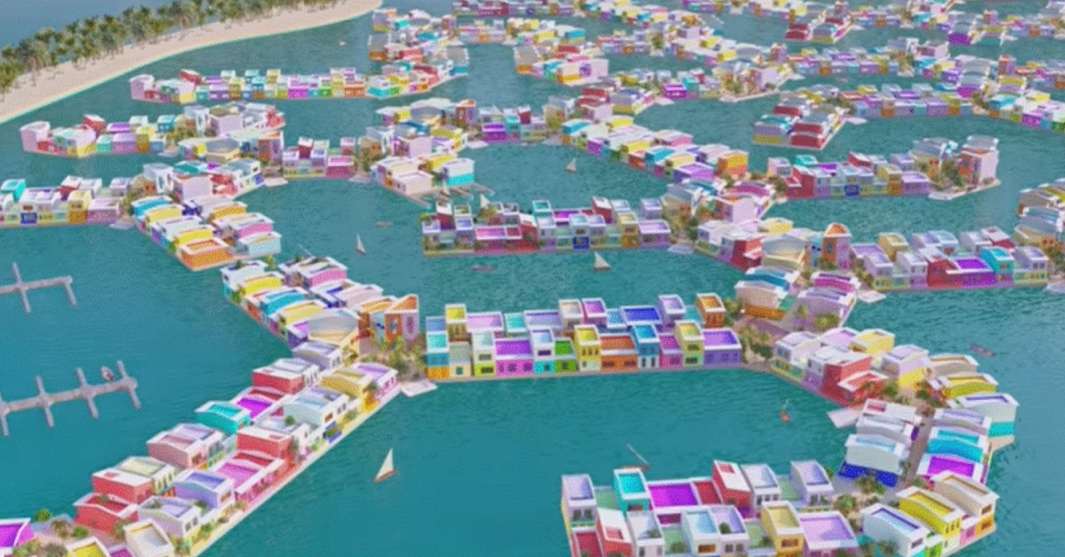
Photo: ChatGBT

When climate change transforms from distant scientific warnings into tangible realities of daily life, global cities are facing unprecedented vulnerability. Rising sea levels, coastal erosion, and the frequent occurrence of extreme weather are no longer isolated incidents but are profoundly altering the way humans live. This crisis is particularly urgent in Southeast Asia and Pacific island nations, where tens of millions of people live in extremely low-lying coastal areas, and the issue of living safety has become an increasingly serious problem. Against this backdrop, a seemingly futuristic concept – floating cities – is gradually moving from drawings to reality. From the Maldives to the Netherlands, from Busan, South Korea to Dubai, a series of pilot projects are attempting to convert “floating” into a solution to “subsidence”. This is not only an engineering experiment but also a redefinition of human lifestyle. In the 21st century, with increasing climate uncertainty, floating cities may be at the forefront of the transformation of urban resilience. In many coastal cities around the world, the traditional logic of urban development is gradually collapsing due to population and environmental pressures. Southeast Asia is at the intersection of these multiple crises. Cities like Jakarta, Manila, and Ho Chi Minh City are experiencing multiple challenges such as rising sea levels, subsidence of the ground, overloaded drainage systems, and continuous population influx. For example, Jakarta is sinking at a rate of up to 25 centimeters per year and has become one of the “fastest sinking” capitals in the world. At the same time, urban land is becoming increasingly scarce, housing prices are soaring, and the gap between the rich and the poor in cities is widening, causing the original land-based development model to fall into a predicament. According to the United Nations’ prediction, by 2050, more than 900 million people worldwide will live in areas with an altitude of less than 10 meters, and the majority of them will be located in Asia. Many of these cities in these regions may face the threat of seasonal or even permanent flooding. Faced with this reality, urban planners have to start thinking: Besides building higher up, can we also “get space from water”? “Surviving on water” is no longer just an academic topic but is gradually becoming the focus of policies and engineering practices. When land development reaches its limit, the ocean may no longer just be a risk but a new boundary for humans to redefine their living space.

Although it still sounds like a futuristic experiment, the floating cities have moved beyond the conceptual stage and are now in the process of being implemented on a substantial scale in several countries around the world. The most representative case is the “Oceanix Busan” project in South Korea. This is the world’s first prototype of a floating city supported by the United Nations Habitat Agency, designed to accommodate approximately 12,000 people. It will consist of three interconnected offshore platforms with a total area of 15.5 hectares. Each platform will have different functions, including residential areas, public services, research experiments, and agricultural production zones. All energy will rely on solar power and tidal energy generation, and it will also be equipped with rainwater collection systems and organic waste recycling equipment. Oceanix particularly emphasizes the “modular” concept: each unit can be flexibly expanded according to population and environmental changes. The building materials will adopt anti-corrosion and anti-wave structures, and it is expected to be able to withstand a once-in-a-century typhoon. Meanwhile, the Maldives has also taken the lead in launching the world’s first actual commercial floating city project. The project is located in a lagoon area 10 minutes’ boat ride north of Male. The overall plan consists of 5,000 offshore building units, arranged in a biologically inspired coral shape to reduce water flow impact. The interior is equipped with schools, hospitals, shops and residences, mainly targeting local residents rather than the luxury tourism market. The project was designed by the Dutch architectural firm Waterstudio, using low-carbon building materials and anchoring technology. The units are connected by floating walkways and can rise and fall slightly with the sea surface. These projects represent not only technological breakthroughs, but also a shift in conceptual thinking – from “defending the ocean” to “living in harmony with the sea”. They aim to build stability in instability and seek new resilience for future cities in the midst of floating.
Although floating cities offer a highly attractive alternative for coastal cities, their promotion still faces numerous challenges. Firstly, the construction and maintenance costs are extremely high. Currently, most pilot projects rely on government subsidies or financial support from international organizations, lacking a replicable business model and making it difficult to achieve large-scale promotion. Secondly, the lagging of relevant regulations is also a major obstacle. Most countries have not established legal systems for land ownership, environmental supervision, safety standards, etc. related to offshore cities, which makes the project difficult to proceed smoothly during the approval and implementation processes. Moreover, technical issues cannot be ignored – how to ensure the stability of the platform in extreme weather? How to provide long-term energy supply, water supply, and garbage disposal? These issues all require continuous investment and innovative solutions. More importantly, there is the issue of social equity: Who will be able to live in the floating cities? If only high-income individuals can afford the costs of this future city, will it lead to a further division between the “water-privileged class” and the “land-edge residents”? These practical limitations remind us that although floating cities are full of imagination, their true sustainability not only depends on advancements in architecture and technology, but also on whether it can become a solution for everyone rather than a “future paradise” exclusively enjoyed by a few.
In an era where the climate crisis is intensifying, the emergence of floating cities offers humanity an imaginative leap beyond the confines of land. It is both a response to the limits of cities and an attempt at a symbiosis between technology and ecology. However, what truly determines the future of these floating cities may not be the strength of their building materials, but rather the inclusiveness of policies, the fairness of society, and the acceptance of the public. Floating cities will not solve the global survival crisis overnight, but they prompt us to seriously consider: when the familiar ground is no longer reliable, can humanity redefine the meaning of “home” on unstable water surfaces?
By Yi Lydia Shen

Related Posts